
Chapter 16
Swami Vivekananda: the Scientist-Monk
They watched it together on the tablet, a grainy re-enactment of a September morning in 1893, a young man in ochre rising before four thousand strangers in Chicago. Meera had goosebumps before he finished five words. “He looks fearless,” she said. Thatha shook his head slowly. “He was terrified. He had postponed his speech twice that morning. Remember that, Meera. It matters more than the applause. Fearlessness is not the absence of fear. It is what he did with it. Tonight: how a doubting student became the voice of this whole tradition.”
The skeptic who demanded evidence
Narendranath Datta was born in Kolkata in 1863, a champion athlete, a trained singer, a voracious student of Western philosophy and science, and a relentless doubter. As a young man he put one question to every famous holy man in Bengal: “Sir, have you seen God?” He collected evasions, lectures, and poetry, until he asked the temple priest Ramakrishna, who answered without a pause: “Yes. I see Him as clearly as I see you, only far more intensely.” Even then Narendra did not simply believe. He spent years testing his teacher — probing, arguing, setting traps for fraud — before conviction came. The young man who became Swami Vivekananda entered the spiritual life the way this book asks you to: demanding first-hand evidence, and refusing to outsource the verdict.
The making of the monk
Life tested his convictions the hard way, which is why they rang true. His father died suddenly, and the family fell overnight from comfort into real poverty. The young man walked job to job, hungry, while relatives circled the property; he later said he sometimes told his mother he was dining at a friend’s house so that his portion would stretch for the others. When his teacher Ramakrishna passed, the young disciples had nothing but a broken-down house and each other. Then he did what the rishis of Chapter 4 would have recognized at once: he vanished into India on foot, years of wandering as an unknown monk, sleeping where night found him, hosted by maharajas one week and by the poorest of the poor the next, seeing his civilization’s glory and its misery without a filter. The journey ended at the southern tip of the land, where he swam to a rock off Kanyakumari and sat in meditation for three days. And came back with his life’s mission fused into one thought: the strength of Vedanta and the service of the poor were not two causes but one. The rock bears his memorial today. And when he finally reached Chicago, the story goes that he arrived with the wrong dates, little money, and one night sleeping rough in a boxcar, taken in by a stranger, Mrs. George Hale, whose family became his lifelong friends. The most consequential speech in the tradition’s modern history began with a lost young man being shown simple kindness. He never forgot it; neither should we.
His years in the West are studded with encounters history remembers. In 1896 he met Nikola Tesla, who — fascinated by the monk’s exposition of prana and akasha, energy and matter as one substance in two states — promised to demonstrate the equivalence mathematically; Tesla never completed the demonstration (that equation would arrive by another route, nine years later, in a paper signed Einstein), but the anecdote preserves something remarkable: the inventor-celebrity of the age taking a Hindu monk’s categories seriously enough to attempt the mathematics. Harvard’s philosophy faculty, after his 1896 lecture there, sounded him out about a chair in Eastern philosophy, a wandering Indian monk, offered Harvard; he declined, being a sannyasi. Meanwhile his letters home poured fire into a subjugated generation: religion, he wrote them, is man-making — strength for the weak, education for the masses, and— his phrase, shraddha, faith in oneself, as the first religious duty of a defeated people. He drove himself without mercy across two continents, and his health paid; he had told friends he would not see forty. On the fourth of July, 1902, at Belur Math, he taught in the morning, meditated in the evening, and left the body at thirty-nine, having remarked once that it would be good to leave while the machine was still in working order. Thirty-nine years; two worlds changed. The chapter of the seers, as Chapter 4 promised, has never closed.
The Debate Hall
“An inspiring man,” the challenger allows. “But one charismatic monk and one good speech, how much can that really prove about a tradition?”
The reply
Judge by what outlived the charisma. The Ramakrishna Mission he founded — hospitals, schools, famine and disaster relief — has now served for more than a century after his death at thirty-nine; institutions do not run one hundred years on applause. The four yogas framework he articulated became the standard map of Hindu practice worldwide. Harvard’s philosophers invited him to lecture; the Raja Yoga book seeded the West’s entire engagement with meditation. And here is the deeper answer: he would have rejected the premise of your question. ‘Do not believe a thing because I say so,’ he told his own students. The man’s whole message was that no man, himself included, is the proof; practice is the proof. A tradition is not validated by one voice. It was, however, translated by one — accurately — and the world has been checking his translation against the original ever since, and finding it faithful.
Chicago, 1893
Six years after Ramakrishna’s passing, the thirty-year-old monk stood — nearly penniless, almost unknown — before the World’s Parliament of Religions in Chicago, and opened with words that brought thousands to their feet: “Sisters and brothers of America.” In the talks that followed he presented Vedanta to the modern world: one reality, many paths; every tradition a stream finding the same sea; religion tested in experience, not enforced by creed. It was Rig Veda 1.164.46 — truth is one, the wise call it variously — spoken to the twentieth century just before it began. Much of how the world today understands Hinduism — and much of this book’s confidence — flows from that address.
Each soul is potentially divine
“Each soul is potentially divine. The goal is to manifest this divinity within, by controlling nature, external and internal.”This single sentence is his summary of all Vedanta, and of all four yogas as the means., Swami Vivekananda, Raja Yoga (Complete Works)
Hear what the sentence does: it takes the Mahavakyas of Chapter 14 — you are That — and turns them into a program. If the divine is already in every soul, then spiritual life is not begging for what you lack but uncovering what you are; education, likewise, he defined as “the manifestation of the perfection already in man.” And if it is in every soul, then every human you meet — including the poorest — carries it, which became his revolution of service.
Four yogas — every temperament has a door
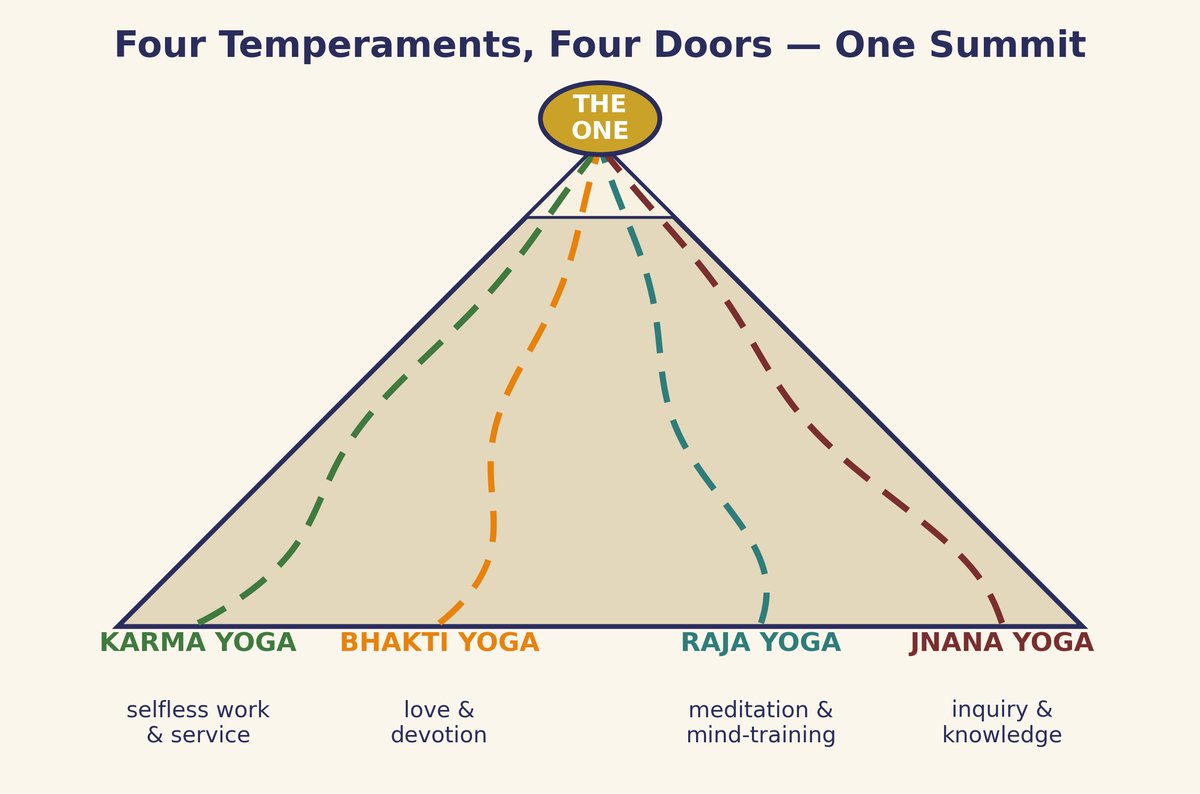
Vivekananda organized the Gita’s generosity (Chapter 15) into the framework the whole world now uses: four yogas for four human types. Karma yoga. The path of selfless work, for the active. Bhakti yoga. The path of love, for the emotional. Raja yoga — Patanjali’s path of meditation and mind-training (Chapter 8), for the introspective — his book of that name introduced systematic meditation to the West. Jnana yoga. The path of inquiry, for the philosophical. He insisted the paths are equal, may be combined, and meet at one summit, so no honest temperament is ever locked out of the climb.
Strength, fearlessness, service
If one word summarizes his message, he said, it is abhih, fearlessness, the Upanishads’ word. “Strength is life, weakness is death”; “All the power is within you, believe in that.” This was not swagger; it was psychology drawn straight from the doctrine of the Atman: a being whose real nature is the deathless Self (Gita 2.20) has no business grovelling. His favorite battle-cry he lifted directly from Nachiketa’s Upanishad, “Uttishthata! Jagrata!”, “Arise! Awake! And stop not till the goal is reached” (Katha 1.3.14). And he turned the philosophy outward: if the divine dwells in all, then “they alone live who live for others,” and the poor are daridra-narayana, God in the form of the needy, to be served as worship itself. The Ramakrishna Mission he founded, hospitals, schools, disaster relief, running to this day, is the Manushya Yagna of Chapter 13 built into a permanent institution.
Religion as a science of experience
Vivekananda’s most radical teaching is the one this whole book is built on: religion, he insisted, must hold itself to the standard of a science. “Religion is realisation; not talk, nor doctrine... it is being and becoming, not hearing or acknowledging.” The claims of Vedanta, he argued, are claims about experience. And like any experimental claims, they must be verified in the laboratory of one’s own disciplined mind, by anyone willing to run the experiment, or they are worth nothing. Faith, in his vocabulary, meant the working hypothesis that keeps you experimenting, never a substitute for the experiment. “Do not believe a thing because I say so,” he told his students; test it as you would in a laboratory. Shravana, manana, nididhyasana — hear, reason, verify (Chapter 18) — he simply refused to let the third step be skipped.
India remembers what he lit: his birthday, January 12, is celebrated as National Youth Day, and his charge to the young was exact, strength, study, service, and no fear. He predicted that India would rise not by imitating others but by standing on its own spiritual confidence; more than a century later, with yoga, dhyana, and Vedanta studied and practiced across the whole world, the prediction reads very well.
Two honest notes, in his own spirit. First, Vivekananda is a modern interpreter. His “practical Vedanta” is an enormously influential reading of Shankara’s tradition, not shruti; where he simplifies or innovates, scholars note it, and he would not have minded. Second, when he reached for scientific analogies — prana and akasha explained through the “ether” of 1890s physics — he used the best science of his day, some of which is now outdated. Keep his method — verify, fear nothing, serve everyone — and feel free to update his century-old physics examples. Updating the examples when evidence improves is not a betrayal of Vivekananda; it is obedience to him.
Run his experiment for one week: choose the classmate or sibling you find most difficult, and act — just act — on the hypothesis that “each soul is potentially divine” applies to them. Note honestly at week’s end what changed: in them, and in you. That noting-honestly is the part he cared about most.
Meera’s notebook
- ‘Have you seen God?’. And then he TESTED the one who said yes. Entry by evidence.
- Poverty, wandering, the rock at Kanyakumari: strength and service fused into one mission.
- Chicago, 1893. And he was terrified. Fearlessness is what you DO with fear.
- Each soul is potentially divine → uncover, don’t beg. Education = manifesting what’s already there.
- Four yogas, one summit: the worker, the lover, the mystic, the philosopher, every temperament has a door.
- Tesla tried the math; Harvard floated a chair; the Mission still serves. 39 years, two worlds changed.
Meera watched the Chicago clip twice more before bed, mouthing the opening words. Fearlessness is what he did with it. “Thatha, the boy at school, the one who laughed at the chandan mark. He’s been reading things online. He says he has ‘real questions’ now.” She said it like a warning. Thatha looked, if anything, pleased. “Good. Then tomorrow we hold the chapter I have been saving: how to stand.” ❖
Check your understanding
- What question did young Narendra ask every holy man, and what made Ramakrishna’s answer different?
- Name the four yogas and the temperament each serves.
- What did Vivekananda mean by “religion is realisation,” and which three-step Vedantic method does it insist on completing?
- Give one example of how his teaching turned philosophy into service.
- What happened when Vivekananda met Tesla?
- What was he sounded out for after his Harvard lecture?
- Reflect: “You alone are your own friend, and your own enemy” (Gita 6.5), “All the power is within you” (Vivekananda). How are these two sentences related?