
Chapter 15
The Bhagavad Gita: a Field Guide for Life’s Battles
It came back up at dinner. The science fair. Months of honest work on her water-quality experiment, beaten by a glittered poster, and Meera still felt the sting of it. “I did everything right,” she said, “and it did not win. So what was the point of doing it right?” Thatha put down his cup, went to the cupboard, and returned with the palm-sized Gita. “You have just asked,” he said, “in your own words, the exact question that stops the greatest warrior of his age dead on a battlefield, what is the point of doing my duty if I cannot control how it turns out? The most useful book in this house was spoken to a man standing where you are standing tonight. It will not hand you a trophy, and it will not hand you a verdict. It will hand you something far better: a way to act with your whole heart and be free of the result. Read.”
Where the Gita happens
The Gita is not spoken in a temple or a forest ashram. It is spoken in the middle of two armies, in the minutes before a battle, to a man on the point of walking out. Arjuna — the greatest warrior of his age — looks across the field, sees teachers and cousins on the other side, and drops: his limbs fail, his mouth dries, his body trembles, his skin burns, his famous bow slips from his hand, and he sits down in the chariot saying “I will not fight” (Bhagavad Gita 1.28–30, 1.47). The text records the symptoms with clinical precision. It is describing a total crisis of duty, fear, and grief. That is deliberate. The Gita announces by its very setting: this teaching is for the worst moment of your life, not the calmest.
The whole Gita in one sentence
There is a beloved story about how completely this teaching can be distilled. Ahilyabai Holkar — the eighteenth-century queen of Malwa, remembered as one of the wisest and most dharmic rulers in Indian history — is said to have taken the Gita’s very first line and found the whole book folded inside it. The Gita opens with the words dharma-kshetre kuru-kshetre, on the field of dharma, the field of Kuru. Turning the phrase gently over, she read out its instruction for a whole life in four words: kshetre kshetre dharmam kuru, in every field, do your dharma. In whatever field you find yourself, a battlefield, a classroom, a science fair, a kitchen, a kingdom, do the right thing, fully, there. That is seven hundred verses in one breath, and a young reader can carry it out the door tonight.
The war nobody wanted
To weigh the Gita fairly you must know how hard its people tried to avoid the war. The Pandava brothers, cheated of their kingdom by loaded dice and sent into thirteen years of exile, came back asking only for their own. Refused, they reduced the ask: five villages, one for each brother, five villages in exchange for peace. Duryodhana’s answer became infamous: not land enough to fit on the point of a needle. Krishna himself then went as envoy to the enemy court and pleaded for a settlement. And the court answered by trying to seize the ambassador. Only after every road to peace was closed by the other side does the Gita open, and even then its first chapter is a warrior arguing against fighting. Whatever else one says of this scripture, let no one say it is eager for war: it is a book about the duty that remains when peace has been refused by everyone empowered to grant it.
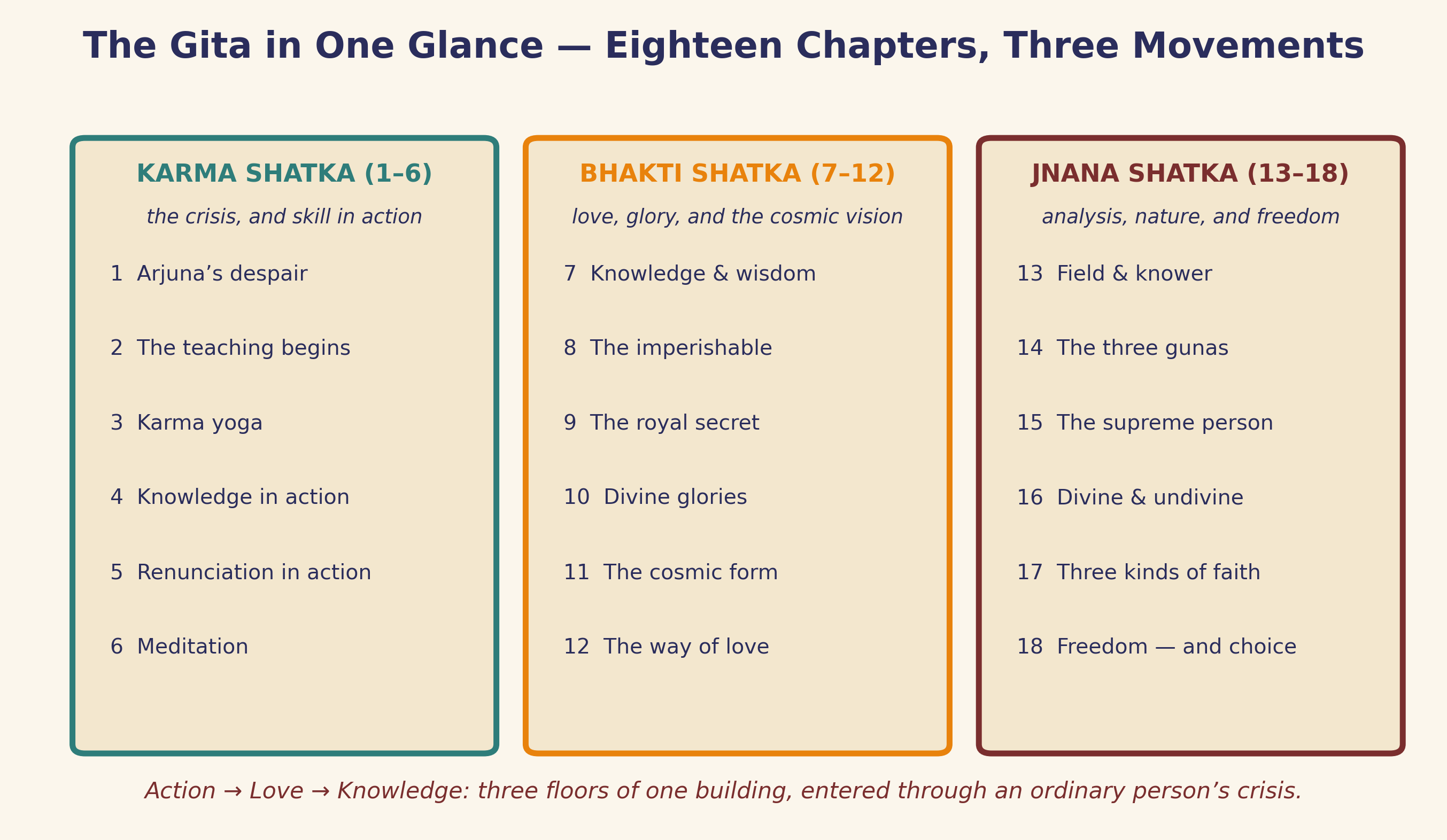
The text’s own architecture rewards knowing, too. Tradition reads its eighteen chapters as three movements of six: the first shatka centering on karma, action, duty, and the steady mind; the middle shatka on bhakti, culminating in the eleventh chapter’s overwhelming vision of the cosmic form, where Arjuna sees all worlds and all time in his charioteer and can barely stand; the final shatka on jnana. The analysis of nature, the gunas, and the summing-up. Action, love, knowledge: the three paths of this book, laid as the three floors of one building, with the ordinary person’s crisis as the front door.
Why Arjuna? The qualifications of the one who is taught
Here is a question worth pausing on, because it answers ‘so why should I bother preparing myself?’. Of all the people on that field, why does Krishna pour the highest knowledge into Arjuna? Not because Arjuna is faultless — he is collapsing — but because he carries the exact qualifications the tradition says a seeker must have before deep knowledge can take root. Watch them appear in the first chapters. He has viveka, discrimination: he is troubled because he is trying to tell right from wrong. He has mumukshutva, a burning wish to know the truth and be free of his confusion, my very being is stricken; I ask you, tell me clearly what is right (2.7). And he has the humility to become a student: in that same verse the proud warrior says the hardest words a proud person can say, shishyas te ’ham shadhi mam, I am your student; teach me (2.7). He already trusts the teacher; he can endure discomfort without fleeing it; and he has spent a lifetime in self-mastery. He is, in short, a prepared vessel. And knowledge, like water, only stays in a vessel that can hold it.
This links straight back to the yoga shastra of Chapter 8, which is emphatic that the deepest teaching is earned by preparation, the yamas and niyamas, the steadying of body and breath, the disciplining of the senses that come before the higher limbs. The tradition even names the seeker’s readiness as a set: the sadhana-chatushtaya, the fourfold qualification, viveka (discrimination between the lasting and the passing), vairagya (dispassion, not clutching the fruits), the six inner disciplines beginning with a calm and controlled mind, and mumukshutva (the genuine longing for freedom). Read that list, then look at Arjuna: the Gita is not only a teaching, it is a portrait of the student who is ready to receive one. And the encouraging news for a young reader is that every one of these qualifications is trainable. This whole book has been training them. You are not born a fit vessel; you become one, exactly as Arjuna did, one honest effort at a time.
Krishna the teacher: watch the method
Read the Gita once for the teaching and a second time for the teaching method, because Krishna’s pedagogy is a masterclass any educator would envy. He begins where the student is: not with metaphysics but with Arjuna’s actual collapse. And his very first move is emotional, almost bracing, a friend’s challenge to remember who he is (2.2–3), before a single doctrine is offered. Then reasoning, layer by patient layer, each argument tailored to a warrior’s vocabulary, duty, honor, skill, victory over the self. When Arjuna objects, the objections are welcomed and answered, never crushed; when he confesses the mind is as hard to hold as the wind, the teacher agrees before prescribing (6.35). When words reach their limit, Krishna teaches by showing. The eleventh chapter’s cosmic vision, granted because the student asked to see. And at the very end, the summation is followed not by a command but by the release of the student into his own judgment: reflect fully, then do as you choose (18.63), whereupon the teacher asks whether the student has actually understood (18.72), the final act of a teacher who wants comprehension, not compliance. Meet the student in crisis; reason with respect; welcome objections; show, don’t only tell; verify understanding; hand back the choice. Every good teacher you will ever have is somewhere on that list, and the list was compiled on a battlefield.
Read the eleventh chapter of the Gita with a parent or grandparent. The cosmic vision, the one place where the book stops arguing and simply SHOWS. Read Arjuna’s stunned response aloud (11.15–31) and talk about one question: why do you think Krishna saved showing for after reasoning?
The medicine, in three layers
Krishna’s counsel to Arjuna moves through the layers this book has followed. First, know what you are: the Self is never born and never dies (2.20), the deepest fear rests on a misidentification. Second, know your duty and do it with skill: act because action is right, not because you are gripping the fruit, “you have a right to your action alone, never to its fruits” (2.47), for “yoga is skill in action” (2.50). Third, steady the instrument: an even mind, “samatvam yoga uchyate” (2.48), is both the method and the goal. Notice that not one layer of the medicine is “stop feeling”; every layer is “see clearly, then act.”
The portrait of the steady one (sthitaprajna)
Arjuna then asks the most practical question in the book: what does such a person actually look like, how do they sit, walk, speak? (2.54). Krishna’s answer (2.55–72) is the tradition’s portrait of mastered emotion:
“Duhkheshv anudvigna-manah sukheshu vigata-sprihah...”“One whose mind is unshaken in sorrow, without craving in pleasure, free of obsession, fear, and rage, that one is called a sage of steady wisdom.”, Bhagavad Gita 2.56
And the working image: as a tortoise draws in its limbs, the steady one can withdraw the senses from their objects at will (2.58), not numbness, but voluntary control of attention, the exact skill the eight limbs of Chapter 8 train. This portrait, unshaken, uncraving, attention under command, is what every practice in this handbook is building toward.
Four doors for four temperaments
The Gita’s generosity is structural: it refuses to prescribe one path for every person. The doer is given karma yoga, selfless action as worship. The lover is given bhakti yoga. And its beautiful minimum offering: “a leaf, a flower, a fruit, water, offered with love, I accept it” (9.26); devotion is measured in sincerity, not expense. The thinker is given jnana yoga, “nothing in this world purifies like knowledge” (4.38). The mystic is given dhyana yoga, chapter six’s meditation manual, complete with posture, and with health advice any doctor would sign: moderation in food, recreation, effort, and sleep (6.16–17). When Arjuna protests that controlling the mind is like controlling the wind (6.34), Krishna does not scold him. He agrees, and gives the two-word prescription every skill-learner knows:
“Asamshayam maha-baho mano durnigraham chalam; abhyasena tu kaunteya vairagyena cha grihyate.”“Without doubt the mind is restless and hard to hold, but by practice (abhyasa) and dispassion (vairagya) it is grasped.”, Bhagavad Gita 6.35
And for the one who falls short? The gentlest verse in scripture: no sincere effort is ever lost; even a little of this practice protects from great fear (2.40, 6.40). Meanwhile one thread runs under all four paths, “on Me all this is strung, like pearls on a thread” (7.7): many doors, one house.
Lift yourself — and the astonishing last instruction
“Uddhared atmanatmanam natmanam avasadayet; atmaiva hy atmano bandhur atmaiva ripur atmanah.”“Lift yourself by your own self; do not let yourself sink, for you alone are your own friend, and you alone are your own enemy.”, Bhagavad Gita 6.5
Responsibility could not be stated more plainly: the decisive relationship in your life is the one you have with your own mind. And then, after seven hundred verses, comes the ending that makes the Gita unlike any other scripture. Krishna — speaking, within the story, as God himself — does not command. He says:
“Iti te jnanam akhyatam guhyad guhyataram maya; vimrishyaitad asheshena yathecchasi tatha kuru.”“Thus I have declared to you this knowledge, secret of secrets. Reflect on it fully, and then do as you choose.”, Bhagavad Gita 18.63
Reflect fully; then choose freely. The final word of the song of God is an appeal to reasoned, free judgment. The very method of this book, placed in the mouth of the divine teacher himself. Arjuna’s reply completes it: “My delusion is destroyed; I have regained memory of what I am; my doubts are gone — I will act by your word” (18.73) — obedience, but only after the doubts died honestly.
The Debate Hall
“Still,” the challenger says , “at the end of it, a god tells a man to fight a war. How do you defend a violent scripture?”
The reply
Read what the book actually says, not just where it is set. The Gita never teaches fight; it teaches do your dharma, without hatred, without greed, and without flinching. Arjuna is a soldier lawfully defending against an aggression that every road to peace had already failed to stop (remember the war nobody wanted), so for him, in that field, dharma happens to be battle. But look carefully at what the Gita forbids even there: fighting from anger, fighting for spoils, and despair dressed up as ethics. It is also worth seeing that the same book has been the source generations draw on for the courage to resist injustice without hatred. Its teaching of steady, selfless, fearless action has fed both soldiers and peacemakers, because it is not about violence at all. It is about doing the right thing in your own field, kshetre kshetre dharmam kuru, with a clean and unshaken heart. And its final word is not a command to fight but an appeal to your own free judgment: reflect fully, then choose (18.63). A book that hands the choice back to you is not a book of violence. It is a book of duty, large enough to have guided honest people for two thousand years.
The most translated wisdom on earth — read the translations with care
The world has voted on this book with its attention. The Bhagavad Gita is among the most translated and most commented-upon texts in all of human history, rendered into every major language on earth, with hundreds of English versions alone, and new ones still appearing. Emerson and Thoreau carried it in America’s first encounter with Indian thought; Huxley and Eliot pondered it; Oppenheimer learned Sanskrit partly to read it and reached for its words at the pivot of the twentieth century. Seven hundred verses, still coaching humanity at its hardest moments, and you hold it by birthright.
But that very abundance carries a quiet warning a careful reader should hear: a translation is always an interpretation, and the Gita’s key words are nearly untranslatable. Dharma becomes, in different English Gitas, duty, righteousness, law, religion, virtue, or order, each choice bending the sentence a little. Yoga is rendered as discipline, union, method, devotion, or skill. Even the famous 2.47 shifts its color from translator to translator. So when someone quotes what the Gita says in English, the wise response is gentle curiosity: whose translation, and what did the Sanskrit actually hold? This is not a weakness of the text. It is the ordinary humility of carrying deep meaning across languages, and it is a good reason, if the door ever opens to you, to meet a few of its verses in the original, where a single word can contain a paragraph.
One book, many readings — the great interpreters
Part of the Gita’s depth is that its greatest students have honestly read it differently. And the tradition holds their disagreement as richness, not embarrassment. Shankara read the Gita as a text of jnana, knowledge: its final aim is realization of the one non-dual Self, and action prepares the mind for that seeing. Ramanuja read it as a song of bhakti: loving surrender to a personal God is its heart, with 18.66 as its summit. Madhva read it through his dualism, the eternal distinction of soul and God. In the modern age Bal Gangadhar Tilak read it as a mighty call to karma yoga, selfless action in the world rather than withdrawal from it, while Sri Aurobindo read it as a map of the soul’s integral evolution toward the divine. Same seven hundred verses; a library of readings. This is exactly what a living, inexhaustible scripture looks like: deep enough to give each sincere seeker a true answer, and honest enough never to pretend there is only one.
A scientist’s daily verse: Dr. A. P. J. Abdul Kalam
If you want a single modern figure who shows a young Indian that science and this scripture belong in the same life, it is Dr. A. P. J. Abdul Kalam, rocket scientist, architect of India’s space and missile programs, and the beloved People’s President who spent his last hours teaching students. Kalam was a devout Muslim who prayed daily. And who also read the Bhagavad Gita, the Quran, and the Bible alike, writing in his memoir My Journey that he had read and assimilated the knowledge contained in different religious texts, from the Koran to the Gita to the Holy Bible, and that together they had made him a product of India’s syncretic soul. He drew particular strength from the Gita’s second chapter — the very chapter you have been reading, on the deathless Self and on action without attachment to the fruit — and he described his life as the perfect coming together of science and spirituality, the twin driving forces of his life. Let that settle the false choice for good: the man who launched India’s rockets found no contradiction in drawing daily strength from the song sung on Kurukshetra. Neither need you.
The Gita is set on a real battlefield, and its acceptance of war has long prompted reflection. Many readers interpret the conflict allegorically, Kurukshetra as the inner field, the war as the daily struggle against one’s own ignorance and lower tendencies (the reading Ahilyabai’s in every field, do your dharma invites). Others read it as a serious treatment of the hard moral responsibilities that can arise in a just war lawfully fought. Both interpretations have long, honorable histories within the tradition, and the question remains a living subject of reflection, which is itself in the tradition’s spirit.
Traditional accounts describe the Gita as spoken by Sri Krishna on the battlefield and later set down and preserved by Vyasa Maharshi within the Mahabharata, which is why the tradition honors Vyasa as the great compiler through whom this teaching, and so much else, reached us.
On practice and realization
The Gita’s psychological teachings, steady wisdom, disciplined practice (abhyasa), dispassion (vairagya), moderation, can be tested and applied in everyday life by anyone. Its metaphysical teachings belong to the realm of shraddha (faith), inquiry, and direct realization. This book maintains that distinction throughout, and Gita 18.63 serves as its guiding principle: reflect deeply, then choose freely.
Read the sthitaprajna passage (Gita 2.54–72, eighteen verses, ten minutes) with a parent or elder, and each of you name one trait from the portrait you would most like to have. Then pick the smallest possible practice of it for one week. Abhyasa and vairagya, you now know the method.
Meera’s notebook
- Spoken in crisis, FOR crisis, to a man about to walk out. My kind of scripture.
- The medicine in layers: know what I am → act with skill → steady the instrument. Never ‘stop feeling.’
- Sthitaprajna: unshaken in sorrow, uncraving in pleasure, attention under command, the portrait I’m building toward.
- Peace was refused first, five villages, even. The Gita never says fight; it says do your dharma without hatred, greed, or flinching. Duty, not violence.
- Ahilyabai’s one-sentence Gita: kshetre kshetre dharmam kuru, in EVERY field, do your dharma. My science fair counts as a field.
- Why Arjuna got the teaching: viveka, mumukshutva, and shishyas te ’ham, I am your student. The qualifications are trainable. I am in training.
- Most translated book on earth. But every translation is an interpretation. Dharma and yoga barely cross into English. Ask: whose translation?
- One book, many readings: Shankara (knowledge), Ramanuja (love), Madhva (duality), Tilak (action), Aurobindo (evolution). Depth, not confusion.
- Abdul Kalam — rocket scientist, devout Muslim — drew daily strength from Gita ch.2. Science and scripture, one life. The false choice, settled.
- Abhyasa + vairagya: the two-word answer to a mind like the wind.
- 18.63, reflect fully, then do as you choose. God’s last instruction is free judgment. The charter.
Meera resolved her Kurukshetra the Gita’s way. She reflected fully, chose freely, and spoke to her friend directly, without anger and without an audience; it cost something, and it was right, and both facts were somehow bearable together. “Thatha, who taught the world all this? Outside, I mean. How did it get from that cupboard to… everywhere?” Thatha smiled at something far away. “A young man with a question even you have never dared,” he said. “Tomorrow: the monk.” ❖
Check your understanding
- Describe the setting of the Gita and Arjuna’s symptoms. Why does the setting matter?
- Name the four paths and the temperament each fits.
- What two words answer “the mind is like the wind” (6.35)?
- What does Krishna say in the Gita’s final instruction (18.63), and why is it called this book’s charter?
- Name the three shatkas of the Gita.
- Give Ahilyabai’s one-sentence distillation of the Gita, and name three of Arjuna’s qualifications that made him ready to receive it.
- Why must the Gita’s English translations be read with care? Give one key word that resists translation, and name two scholars who read the Gita differently.
- List three features of Krishna’s teaching method.
- Reflect: Which verse of this chapter would you want to remember at your own hardest moment, and why?