
Chapter 14
Voices of the Upanishads: Great Dialogues and the Four Great Sayings
The book smelled of decades. Meera opened the Katha Upanishad where the ribbon lay and read aloud, slowly, the story of a boy her own age walking into the house of Death. And Death not being there, and the boy waiting three nights, unfed and unafraid. She looked up. “He waited for Death. To ask him a question.” Thatha nodded. “Now you understand why I never worry when you argue with me,” he said. “It is the family style. Read on.”
“Upanishad” means sitting near. And the texts themselves are mostly conversations: students grilling teachers, children questioning kings, a boy interrogating Death itself. Before we hear the four most famous sentences of the tradition, meet the questioners. As you read each story, ask what behavior the tradition chooses to honor.
Nachiketa — the boy who questioned Death
The Katha Upanishad opens with a boy, Nachiketa, sent to the house of Yama, Death himself. Offered any boon, the boy asks the one question adults avoid: what really happens when a person dies? Death squirms. He offers the boy elephants, gold, kingdoms, long life, anything but the answer. Nachiketa refuses every bribe: keep your chariots; they wear out; answer the question (Katha 1.1.20–29). Only then does Death, delighted, begin to teach, and his first lesson is the choice every questioner faces:
“Shreyash cha preyash cha manushyam etah... shreyo hi dhiro ’bhi preyaso vrinite.”“The good and the pleasant both approach a person. The wise examine the two, and choose the good over the pleasant.”, Katha Upanishad 1.2.2
Shreyas (the good, the true) versus preyas (the pleasant, the easy): a scientist who refuses a comfortable wrong answer, and a student who refuses to stop asking, are both walking Nachiketa’s road. The tradition’s hero is a child who could not be bribed out of a question.
The backstory sharpens the boy further. His father Vajashravasa was performing a give-away-everything sacrifice. And giving away old, dry, worthless cows. Young Nachiketa watched, and the dishonesty sat in him like a splinter: a sacrifice of leftovers is a lie told to heaven. ‘Father,’ he asked — once, twice, three times — ‘to whom will you give me?’ until the embarrassed man snapped: ‘To Death I give you!’ And the boy, taking truth more seriously than his father took ritual, went. Mark the opening scene the Upanishad chose for itself: a child holding an adult to honesty about religion, placed at the front door of one of the tradition’s holiest books. Remember it whenever anyone calls this a tradition of blind obedience.
Shvetaketu and the salt — an experiment inside scripture
In the Chandogya Upanishad, the sage Uddalaka teaches his proud son Shvetaketu with demonstrations, not sermons. Break open the tiny seed of the great banyan tree, what do you find? “Nothing, father.” From that subtle “nothing,” says Uddalaka, the vast tree stands (Chandogya 6.12). Then: put this lump of salt in water and come back tomorrow. The salt has vanished, yet taste the water from the top, the middle, the bottom: salty everywhere. Invisible, yet pervading everything (Chandogya 6.13). Just so, the subtle essence pervades the world. And then comes the thunderclap, repeated nine times through the teaching:
“Sa ya esho ’nima aitad atmyam idam sarvam, tat satyam, sa atma, tat tvam asi, Shvetaketo.”“That subtle essence is the self of all this. That is the truth. That is the Self. You are That, Shvetaketu.”, Chandogya Upanishad 6.8.7
Replicate the oldest experiment in scripture. Dissolve salt in a glass of water tonight; tomorrow, taste from the top, middle, and bottom. You are repeating a demonstration performed by a father for his son nearly three thousand years ago. And pondering exactly what he wanted pondered: reality can be invisible and everywhere at once.
Bhrigu — the method itself
The Taittiriya Upanishad tells of Bhrigu, who asks his father Varuna: teach me Brahman. The father’s reply is astonishing, Brahman can’t be taught but explored; he reveals an exploration method:
“Tapasa brahma vijijnasasva. Tapo brahma.”“Seek to know Brahman through tapas (disciplined inquiry). Tapas itself is the way.”, Taittiriya Upanishad 3.2
Bhrigu goes away and investigates. He proposes: Brahman is food (matter). He tests the idea, finds it incomplete, returns. And the father says only: inquire further. Bhrigu proposes prana (life-energy). Incomplete. Mind. Incomplete. Intellect. Incomplete. Finally: ananda, boundless being-awareness-bliss (Taittiriya 3.2–6). Look at the shape of that story: hypothesis, test, revision, five iterations, no answer handed over. The Upanishad is teaching the loop every laboratory runs. And insisting that even the deepest truth must be reached by it, not merely believed.
Satyakama and Gargi — who is allowed to ask
Two more questioners show what the tradition honors. Satyakama Jabala, wanting to study, admits openly that he does not know his father’s name. His mother served in many houses. The teacher’s response: only a truthful person speaks so plainly; bring the firewood, you are accepted (Chandogya 4.4). Truthfulness, not pedigree, is the entry ticket to knowledge. And in the great public debate of King Janaka’s court, the philosopher who pushes the sage Yajnavalkya hardest, “By what is that woven? And that? And that?”, is a woman, Gargi Vachaknavi, pressing the regress of causes exactly the way a physicist presses “and what explains that law?” (Brihadaranyaka 3.6, 3.8). A child, a boy of unknown parentage, a woman in open debate: the Upanishads’ heroes are simply the best questioners in the room.
One more voice belongs in this gallery. When the sage Yajnavalkya prepared to renounce the world, he offered his wife Maitreyi his wealth. Her reply is one of the great sentences of the tradition: “What shall I do with that by which I do not become immortal? Tell me, rather, what you know.” (Brihadaranyaka 2.4.2–3). Offered property or philosophy, she chose philosophy. And the Upanishad preserves the teaching he gave her as one of its summits. Count the heroes again: a fearless boy, a truthful orphan, and two women philosophers, honored at the very core of shruti.
The two birds
One Upanishadic image gathers the whole psychology of this book into a single tree:
“Dva suparna sayuja sakhaya samanam vriksham parishasvajate...”“Two birds, close companions, clasp the same tree. One eats the sweet and bitter fruits; the other looks on, serene, without eating.”, Mundaka Upanishad 3.1.1
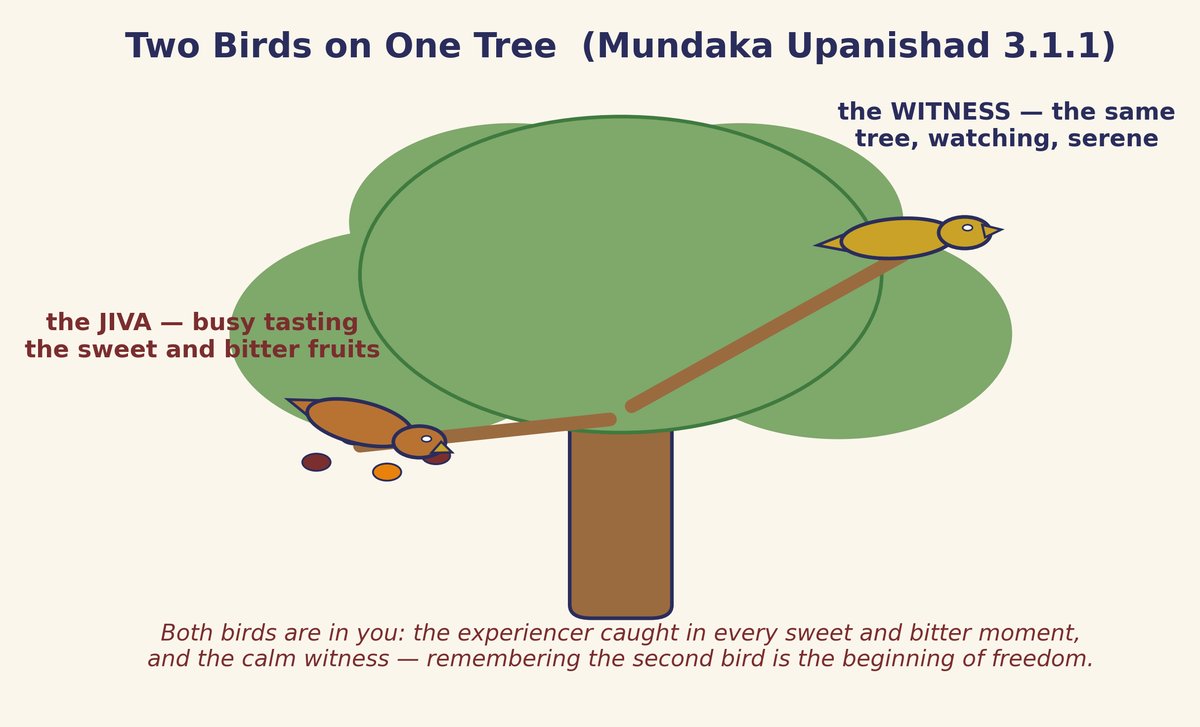
The lower bird is the jiva, you as experiencer, hopping from sweet fruit to bitter, elated and dejected by turns. The upper bird is the witness. The Atman of Chapter 5’s chariot, watching with perfect calm. The teaching: when the lower bird looks up and recognizes the upper, its agitation ends. Every “am I the anger, or the one noticing it?” exercise in this book is the lower bird learning to look up.
The Four Great Sayings (Mahavakyas)
Tradition distills the entire philosophy into four sentences — one drawn from each Veda — called the Mahavakyas. You have now met the dialogues they come from:
Prajnanam Brahma , “Consciousness is Brahman” (Aitareya Upanishad 3.3, Rig Veda). Reality’s deepest nature is the very awareness reading this sentence.
Aham Brahmasmi , “I am Brahman” (Brihadaranyaka Upanishad 1.4.10, Yajur Veda). The seeker’s discovery, spoken in the first person.
Tat Tvam Asi , “You are That” (Chandogya Upanishad 6.8.7, Sama Veda). The teacher’s declaration to the student, Uddalaka’s salt-water thunderclap.
Ayam Atma Brahma , “This Self is Brahman” (Mandukya Upanishad 2, Atharva Veda). The calm, impersonal statement of the fact.
The map inside AUM
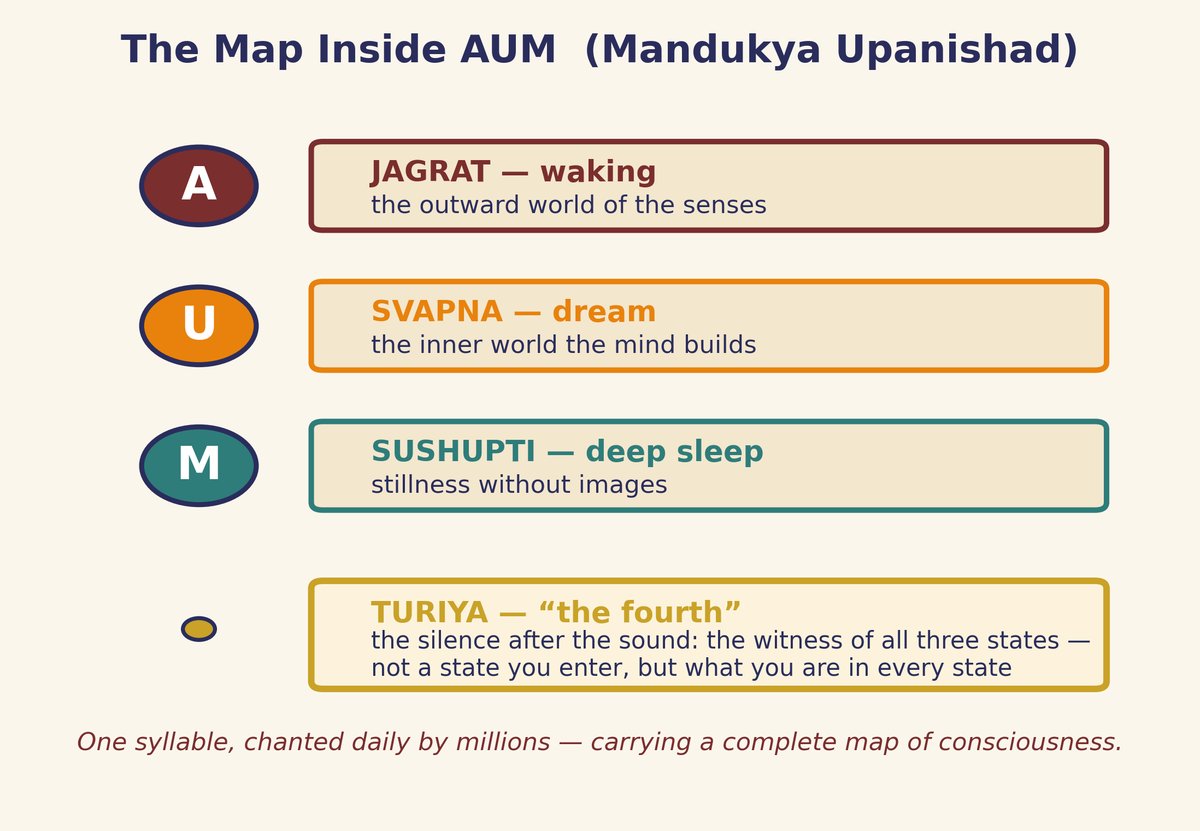
The Mandukya — shortest of the great Upanishads, twelve verses — hides an entire map of consciousness inside the syllable your family chants daily. A stands for the waking state, the outward world of the senses. U stands for dream, the inner world the mind builds nightly from its own material, yes, the rishis mapped your dreams. M stands for deep sleep, stillness without images, where the tired mind rests in causeless peace. And the silence after the sound — the pause before the next AUM — stands for turiya, ‘the fourth’: the witness present in all three states, watching waking, watching dream, watching even the blankness of sleep. Not a fourth place to go; the one who was there in all three. Every morning’s chant is a complete tour of what you are.
The god, the demon, and the reflection: Indra and Virochana
One more Chandogya dialogue (8.7–8.12) belongs here, because it contains the tradition’s own critique of materialism, told as a story with a sense of humor. Hearing that whoever knows the Self attains all worlds, both the gods and the asuras sent their best students to Prajapati’s school: Indra for the gods, Virochana for the asuras. Both served the full thirty-two-year apprenticeship. Prajapati then gave them a first-draft answer, deliberately incomplete: look at yourselves in a pan of water, that which you see is the Self. Both looked, saw their fine reflections, and went home satisfied. Virochana never came back: he taught the asuras that the body is the Self, adorn it, feed it, serve it, for it is all there is. And the Upanishad remarks, dryly, that this is still the doctrine of the asuras. But Indra, walking home, was stopped by a thought: this reflected self is well-dressed when the body is well-dressed. And blind when the body is blind, and perishes when the body perishes. What good is that Self? He turned around. It took him three more rounds of study, a hundred and one years in all, through the dream-self, the deep-sleep self, and at last the witness beyond all three, before Prajapati gave him the whole truth. Read the story’s design: the tradition placed ‘the body is all there is’ inside its own scripture, as the answer a good student refuses to stop at, not because the body is despised, but because the student who keeps asking outgrows it. Materialism, the Upanishad is saying with a smile, is not wrong so much as it is homework abandoned at the first attractive answer.
Here is the progression Shankara’s school loves to point out: a definition, a discovery, a teaching, and a settled truth. The same insight passing from statement to realization. And one more Upanishadic jewel guards the whole inquiry from a subtle error: the Self is not another object to be found, because it is the finder,
“Yan manasa na manute, yenahur mano matam, tad eva brahma tvam viddhi.”“That which the mind cannot think, but by which the mind thinks, know That alone as Brahman.”, Kena Upanishad 1.6
The Debate Hall
“Charming stories,” says the challenger. “But these dialogues are thousands of years old. What can a boy arguing with Death say to a teenager with a smartphone?”
The reply
Everything, and more urgently than ever, because look at what the smartphone actually is: the most sophisticated preyas-machine ever constructed, a device engineered by the best minds of an age to offer you the pleasant, on a schedule tuned to your nervous system, forever. Nachiketa’s choice, shreyas over preyas, the good over the pleasant, is not an ancient curiosity; it is the precise choice your generation makes forty times an hour. The Upanishads never went out of date for the simplest reason: they were never about the technology of their time. They were about the technology that hasn’t changed — the human mind — and every dialogue in this chapter is a user manual for it.
Are these stories history? The dialogues carry legendary elements, a boy at Death’s door is not a lab report. Read them the way the tradition itself uses them: as teaching instruments, whose every detail is chosen to honor a value. What is certainly historical is what the texts choose to celebrate, fearless questioning, refusal of bribes and easy answers, demonstration over decree, truthfulness as the entry ticket, and debate open to a child of unknown parentage and to a woman facing the greatest sage of the age. A tradition reveals itself by its choice of heroes.
Meera’s notebook
- Nachiketa refused elephants and gold to keep a question. Shreyas over preyas, the choice my phone offers me hourly.
- The salt experiment: I ran it. Invisible and everywhere, tat tvam asi.
- Bhrigu got a METHOD, not an answer: propose, test, revise, five times. The loop every lab runs.
- Truth was Satyakama’s entry ticket. Gargi pressed the regress like a physicist. Maitreyi chose knowledge over property.
- Two birds, one tree: the taster and the witness. Looking up is the whole game.
- AUM = waking, dream, deep sleep. And turiya, the witness of all three. Virochana stopped at the mirror; Indra kept walking.
Meera did the salt experiment that very night — of course she did — and taped the data page into her notebook beside a single underlined line: You are That. “Thatha, these were all conversations in peaceful places. Forests. Courts. But you said the most famous conversation of all happened in the middle of a war.” Thatha’s face grew still and bright at once. “Tomorrow,” he said, “the battlefield.” ❖
Check your understanding
- What did Nachiketa refuse, and what is the difference between shreyas and preyas?
- Describe Uddalaka’s salt demonstration and the sentence it leads to.
- What makes the Bhrigu–Varuna dialogue “the scientific method inside scripture”?
- Name the four Mahavakyas, their Upanishads, and their one-line meanings.
- What did Virochana conclude, and what made Indra turn back?
- Reflect: Which questioner, Nachiketa, Shvetaketu, Bhrigu, Satyakama, or Gargi, is most like you, and why?