
Chapter 13
Our Duties: the Five Great Yagnas
“Because we owe.” Grandma’s two words turned out to be an entire theology. “Think of everything you did not earn,” Thatha began that evening. “The language you think in, given. The knowledge in your books, given. Your body, through a hundred generations, given. The rain, the crows, the strangers who grew your rice, given, given, given. A human being is born the most indebted creature on earth. Tonight: the five daily repayments your grandmother has been making, , since before your mother was born.”
A human being, the shastra teaches, is born into debts of gratitude, to the seers who gave us knowledge, to the powers that sustain nature, to the ancestors who gave us life, to the creatures who share the earth, and to fellow humans. The tradition organizes the repayment into five daily offerings, the Pancha Maha Yagnas (Taittiriya Aranyaka 2.10; Manusmriti 3.70; Shatapatha Brahmana 11.5.6). “Yagna” here does not mean an elaborate fire ceremony; it means a daily act of grateful giving-back.
Where the idea of ‘debt’ comes from
Before the five, there were three. The oldest layer of the tradition speaks of the rina-traya, the three debts a person is simply born owing, named in the Taittiriya Samhita (6.3.10) and repeated across the dharma texts. The Sanskrit word is rina, and it means exactly what it means at a bank: an obligation you did not choose but are bound to honor. To be born human, the seers observed, is to arrive already in debt, because you received an unimaginable inheritance before you could earn a thing.
The three original debts name the three great gifts. There is the debt to the rishis (rishi-rina), for the knowledge, language, and wisdom handed down to you, repaid by study and by passing the learning on. There is the debt to the devas (deva-rina), for the sun, rain, air, and the ordered powers of nature that sustain your life, repaid by worship and grateful offering. And there is the debt to the ancestors (pitru-rina), for your very body and existence, the unbroken chain of parents reaching back to the first, repaid by remembrance and by raising a good next generation. The later tradition added two more — the debt to fellow humans and the debt to all creatures — widening the circle into the five daily yagnas you are about to meet. Three debts became five duties, but the logic never changed: you give back because you first received.
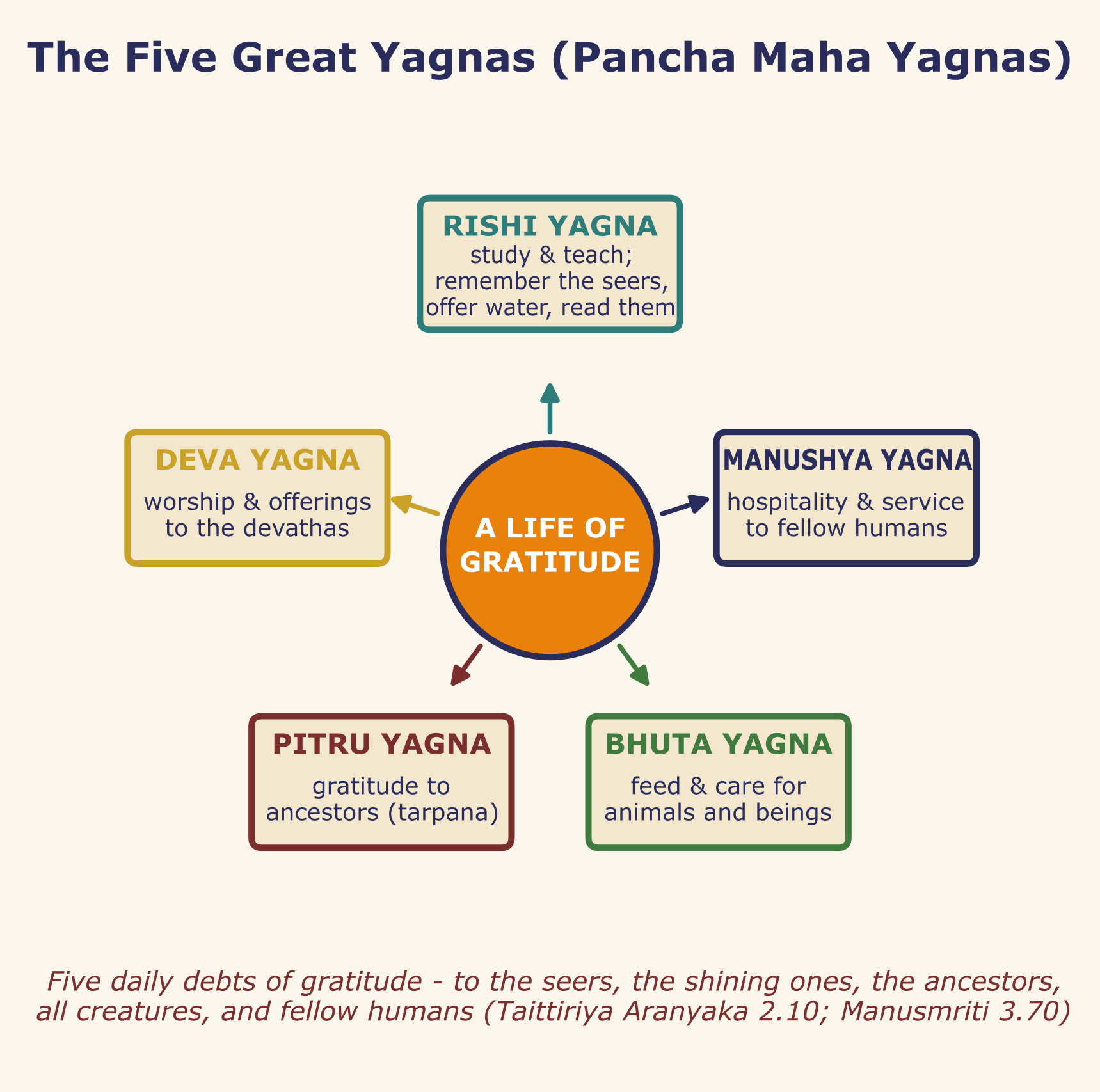
1. Rishi (Brahma) Yagna — our duty to the seers
The rishis are our first grandfathers (Chapter 4), and the debt to them is repaid in three simple, daily ways. Remember them in the morning, even a moment’s salutation to the seers of one’s gotra and to the Saptarishis keeps the family memory alive. Offer water (tarpana). The traditional gesture of respect and refreshment to the line of teachers and seers. And above all, read their books, study is itself declared the highest offering to the rishis: teaching and learning the knowledge they transmitted is how their gift stays alive. The Taittiriya Upanishad’s graduation address commands exactly this: “svadhyayan ma pramadah”, “do not neglect study” (Taittiriya 1.11).
2. Deva Yagna — our duty to the shining powers
Daily worship, offerings, and gratitude to the devathas — a lamp, a prayer, a small oblation — acknowledging the cosmic powers (Chapter 6) that run the sun, the rain, the breath. When the devathas are honored, the tradition says, dharma flourishes and nature stays in balance.
3. Pitru Yagna — our duty to the ancestors
Gratitude to the departed generations of one’s own family, water offerings (tarpana), remembrance ceremonies (shraddha), and the simple daily act of honoring parents and elders while they live. The Upanishad’s command is direct: “matru devo bhava, pitru devo bhava”, “let your mother be a god to you; let your father be a god to you” (Taittiriya 1.11).
4. Bhuta Yagna — our duty to all creatures
A share of food for the animals and beings around us, feeding birds and stray creatures, the rice-flour rangoli at the doorstep that feeds ants, water for passing animals. This is the daily, practical form of the tradition’s prayer for the well-being of all beings (Chapter 1).
5. Manushya (Nru) Yagna — our duty to every human
Hospitality, kindness, and service to fellow human beings, feeding a guest, helping the needy, courtesy to strangers. The Upanishad gives it the strongest possible form: “atithi devo bhava”, “let the guest be a god to you” (Taittiriya 1.11). Every human who crosses your threshold is to be treated as the divine arriving in human form, which is, of course, exactly what the philosophy of Chapters 5 and 6 says they are.
Debts left unpaid: how neglect tangles your karma
Now a harder and more interesting question, the one a thoughtful young reader will ask: what actually happens if a person simply ignores all this, skips the yagnas, forgets the debts, takes the whole inheritance and gives nothing back? The tradition’s answer is not that angry gods hurl thunderbolts. It is quieter, and far more serious: an unpaid debt does not vanish; it stays on the account. Recall the law of karma from Chapter 5, every action leaves a trace, every obligation is real. A debt of gratitude neglected is simply karma left unresolved, an account still open in the great ledger of cause and effect.
See why this tangles a life rather than merely earning a black mark. To live only as a taker — consuming knowledge, nature, ancestry, and others’ kindness while returning nothing — is to keep adding to a debt you are not paying down, and the tradition teaches that such accumulated, unsettled karma is exactly what binds a soul to the wheel of samsara (Chapter 5). Every open account is a thread tying you to another turn of the wheel, another birth in which the books must eventually be balanced. Neglecting the yagnas, in this light, is not a sin to be punished so much as a debt that deepens your entanglement, keeping you bound where you long to be free. The daily giving-back is how you keep the account current, so that gratitude never curdles into an ever-growing arrears against your own liberation.
Step back and see the design whole: every day, a household is asked to give something to knowledge, to the powers of nature, to the past generations, to the animals, and to fellow humans. That is an environmental and social ethic installed as daily habit — gratitude to non-human life thousands of years before ‘sustainability’ was a word — and modern psychology now counts practiced gratitude among the most reliable contributors to human well-being. The five yagnas are not a burden; they are a daily happiness technology with a conscience.
Clearing the debts: the doorway to moksha
And here the five yagnas join the deepest theme of this whole book. The purpose of life, Chapter 19 told us, is moksha — liberation, the soul’s return to its source — and the tradition is remarkably practical about the road there: you do not leap to freedom over your unpaid obligations; you walk to it by settling them. The classical teaching, built right into the ashrama system, is that a person clears the three debts through the householder years — repaying the rishis by study, the devas by worship, the ancestors by raising a family and honoring the departed — and only then, accounts settled, is fully free to turn toward renunciation and the final search. Debts first, liberation next: the tradition even warns that one should not flee to the forest while the ledger is still open.
The logic is beautiful once you see it. If unpaid debt is what keeps the soul bound (as we just saw), then clearing debt is what loosens the ties, each obligation honored is one thread of entanglement dissolved, one account closed, one less reason to be pulled back to the wheel. The five daily yagnas are not, then, a distraction from the spiritual goal; they are its groundwork. A life of faithful giving-back steadily empties the account that binds you, until — the debts of gratitude paid in full — the soul stands free to complete its journey home. This is why the tradition treats the humble householder feeding crows and guests as walking the very same road as the meditating sage: both are clearing the debt that stands between the self and its freedom. Live owing nothing, and you are ready to be free.
From the pages of history — and one story of a king
The institution is as old as the tradition’s memory. The Vedic householder tended the agnihotra, the twice-daily fire offering, morning and evening without fail. And as centuries passed, the same five-fold gratitude flowed into the forms your own house knows: the lamp lit at dusk, the first rice set aside, the water offered, the guest fed before the family eats. The container changed; the debt-keeping never lapsed. And when the tradition wanted to show the yagnas’ summit, it told the story of King Rantideva, who gave away his wealth until he had nothing, and then fasted; and when after forty-eight days a meal was finally set before him, there came to his door — one after another — a brahmin, a laborer, and an outcaste man with his dogs, each hungry; and Rantideva gave the food away portion by portion, and the last of the water too, saying he desired no glory, only to enter into all beings and suffer their pain for them. The Bhagavata Purana tells it (9.21) not as a rule — nobody is asked to starve — but as a north star: this is the direction in which the five yagnas point.
Why the tradition ranks the gift of food first
Among all giving, the tradition placed annadanam — the gift of food — at the summit, and told a pointed story to say why. Karna, the Mahabharata’s tragic hero, was famed as the most generous man alive: no one who asked him for gold, jewels, or armor ever left empty-handed. He gave away his own divine armor knowing it would cost him his life. Yet the tradition’s tale adds a sting: reaching the other world, Karna was offered gold and jewels in abundance. But no food; for, the story explains, he had given every treasure except that, and a soul receives in the measure and kind of its giving. The point is not cruelty to Karna — the epic honors him — but a teaching aimed at every comfortable donor since: treasure delights, but food sustains life itself; the hungry cannot eat gold. This is why the temple kitchens of Chapter 11 never stop, why the wedding feast feeds the uninvited, why Grandma’s first rice goes out before the family eats. And why, when you one day have wealth of your own, the tradition’s counsel will be waiting: give many things, but never let food be the gift you forgot.
The Debate Hall
“I understand feeding the living,” says the challenger. “But water for the dead? Why owe anything to people who no longer exist?”
The reply
Start with what is beyond dispute: everything you have — your genes, your language, your property, your safety, the very customs you question with — was built and handed to you by the dead. The debt is real whether or not the creditors can collect. Tarpana and shraddha are the tradition’s technology for paying it in the only currencies the living possess: remembrance, gratitude, and continuity. Psychologists who study grief now recommend exactly what these rites institutionalize, regular, structured remembrance that keeps the dead woven into life instead of amputated from it. And on the tradition’s own account the jivatma continues its journey, and the goodwill of descendants reaches it, a teaching you may hold with shraddha. Either way the practice stands: a civilization that formally thanks its dead every year raises children who understand where everything came from.
“Matru devo bhava. Pitru devo bhava. Acharya devo bhava. Atithi devo bhava.”“Let your mother, your father, your teacher, and your guest each be as a god to you.”, Taittiriya Upanishad 1.11
This week, perform the five yagnas in miniature, one per day: Monday — read one verse of the rishis and offer a spoon of water in their memory; Tuesday — light a lamp with a moment’s gratitude; Wednesday — do one kind act for your parents or remember a departed elder; Thursday — feed birds or put out water for animals; Friday, show real hospitality to one person. Five days, five debts, one grateful life.
Meera’s notebook
- Born owing: to seers, devas, ancestors, creatures, humans. Five debts, five daily repayments.
- Before the five there were THREE (rina-traya, Taittiriya): rishi-rina, deva-rina, pitru-rina. Rina = a real debt I didn’t choose but must honor.
- Skip the debts and the karma doesn’t vanish. The account stays OPEN. Unpaid debt = a thread tying me to another turn of the wheel. Not punishment; entanglement.
- Clearing debts = the road to MOKSHA. Householder settles the three, THEN renounces. Each debt paid = one thread cut. Live owing nothing = ready to be free.
- Grandma’s crows were bhuta-yagna all along. Now the duty is mine, and mornings feel different.
- Rantideva gave the last meal and the last water: the north star, not the rule.
- Karna gave everything except food. And learned that treasure delights, but food sustains life. Never forget food.
- Tarpana and shraddha: structured remembrance, exactly what grief psychology now recommends.
- Gratitude practiced daily = the happiness technology with a conscience.
Meera began leaving the rice for the crows herself — Grandma ceded the duty with suspicious readiness — and found, to her surprise, that the day felt different when it began with giving. “Is that the point?” she asked. “That it changes me?” Thatha spread his hands. “Tomorrow’s chapter exactly: what all of this practice builds in the practitioner. And why the toppers and the champions have been using your ancestors’ toolkit all along.” ❖
Check your understanding
- Name the five great yagnas and the “debt” each repays.
- What are the three daily duties toward the rishis?
- Name the rina-traya — the three debts a person is born owing — and how each is repaid.
- In the tradition’s teaching, how does neglecting the debts affect one’s karma and bondage to samsara?
- Why does the tradition say the debts must be cleared on the way to moksha?
- Which Upanishad passage commands honoring mother, father, teacher, and guest as gods?
- What did Karna’s story teach about the gift of food?
- Reflect: Which of the five yagnas is weakest in your current life, and what is one small way to strengthen it this week?