
Chapter 12
The Logic in Our Everyday Practices
The microscope turned out to be needed sooner than planned: a boy at school had pointed at the small chandan mark Meera wore after the temple visit and laughed. She had not wiped it off — she was proud of that — but she had wanted, badly, something better than ‘it’s tradition.’ “Tonight,” said Thatha, “I give you the tool I promised: three honest tiers, and the habit of running every custom through them. After tonight, ‘it’s tradition’ will be the beginning of your answer, never the end of it.”
Many customs of daily Hindu life carry a design logic worth examining. To examine them like a scientist, we will sort every explanation into three honest tiers:
[WELL-SUPPORTED] the benefit is established by modern evidence.
[SENSIBLE DESIGN] the custom encodes practical wisdom — hygiene, posture, psychology, social good — that stands on its own.
[TRADITIONAL EXPLANATION] the reason the shastra or custom gives, honored as the tradition’s account, awaiting — not equal to — scientific verification.
One practice can carry all three tiers at once. Watch how it works:
Sitting on an asana (mat) for practice
The traditional explanation: a practitioner’s rising sattvic/kundalini energy should not discharge into the bare earth; the insulating seat (kusha grass, wool, deerskin in the old texts) preserves it. And sitting upright keeps the subtle current free to rise, rather than being dragged down along the body’s contact with the ground. The sensible design: a dedicated seat insulates from cold and damp (which disturb long sitting), gives a stable base for an erect spine, and — psychologically — marks off a “practice zone” that cues the mind into meditation mode the moment you sit, the way a desk cues studying. Well-supported: an upright, stable, comfortable posture measurably aids alert relaxation and sustained attention, exactly Patanjali’s sthira-sukham asanam (Yoga Sutras 2.46).
Sleeping with the head to the south
The traditional explanation: vastu and custom treat the body as having a polarity, the head as its “north”; sleeping head-north sets like poles together, so head-south (or east) is prescribed for restful alignment with the earth’s field. The sensible design: a fixed sleeping orientation is part of a consistent bedtime ritual, and consistent sleep routines are one of the strongest levers for sleep quality. Honest physics: the earth’s magnetic field (~50 microtesla) is thousands of times too weak to push on the body, so the magnetic account remains a traditional explanation, not established science. Follow the custom happily — for the ritual consistency and the family continuity — while reporting the physics honestly.
Removing the shirt in (South Indian) temples
The traditional explanation: the devotee’s bare chest receives the sannidhya — the radiant presence of the deity — without obstruction. The sensible design: the custom is a great equalizer, rich and poor stand identical before the deity, with no display of status through clothing; it enforces humility at the threshold; and in the hot, humid south it is climate-wise. A dress code that erases wealth differences inside a sacred space is thoughtful social engineering.
Arghya-pradanam — offering water to the rising sun
The traditional explanation: the morning offering honors Surya, the visible devata, with water and the Gayatri mantra. Well-supported: the practice puts you outdoors facing early-morning sunlight every day. And morning light exposure is one of the best-established regulators of the circadian rhythm (better sleep, mood, alertness), with sensible sun-hours for vitamin D. Add the steady breathing of mantra recitation and the still posture, and the ritual quietly packages three healthy behaviors modern medicine independently recommends. Whether or not one holds the devotional account, the design earns respect.
Another traditional explanation holds that the morning offering strengthens Surya against the Mandeha rakshasas, demons said to assail the sun at every dawn. Rather than a claim about the physical star, hear this as the tradition’s own symbolism: the daily battle is against the inner forces that assail clarity — dullness, distraction, despair — and the practitioner joins that battle each morning on the side of light. Read this way, the ritual is a daily act of cosmic solidarity that trains alertness, discipline, and sharpness. And learning to read symbols at this depth is exactly how the tradition teaches its inner layers.
More examples, same method
Namaste as greeting , [SENSIBLE DESIGN] a warm, respectful, contact-free greeting (a fact the whole world appreciated in 2020); [TRADITIONAL] a salute to the divine in the other.
Sitting cross-legged to eat , [SENSIBLE DESIGN] a stable, grounded posture that naturally slows the pace of eating and encourages mindful consumption; in Ayurvedic principle the position gently supports digestion and the downward vital current (apana vayu); and the sit-and-rise itself is light daily mobility work and body awareness.
Fasting on ekadashi and festivals — [TRADITIONAL] purification and discipline; [RESONANCE] periodic fasting is an active area of modern research — interesting parallels, still being studied; the discipline (tapas) benefit is real either way.
Copper vessels for water , [WELL-SUPPORTED, narrowly] copper surfaces are antimicrobial (hospitals use them); traditional storage overnight in copper has measurable effects on some microbes, one of the rare customs where the lab partly agrees with the kitchen.
Tulsi, turmeric, and the kitchen pharmacy , [WELL-SUPPORTED/ACTIVE RESEARCH] many Ayurvedic kitchen staples have studied pharmacology; specific claims still require specific evidence.
The temple bell and pradakshina , [SENSIBLE DESIGN] a sharp bell-strike interrupts mental chatter and marks the threshold of attention; walking rounds combine gentle movement with single-pointed focus.
The kolam / rangoli at the doorstep , [WELL-SUPPORTED, and delightful] beyond the bhuta-yagna of rice-flour for ants, the kolam is living mathematics: its dot-grids and unbroken loops encode symmetry, topology, and rule-based pattern generation so faithfully that computer scientists have formally studied kolam designs as picture languages and array grammars. Grandmothers drawing at dawn have been doing recreational mathematics for centuries, and calling it beauty.
Lighting the deepam (lamp) , [SENSIBLE DESIGN] a single steady flame is a natural anchor for attention and marks the threshold of sacred time; [TRADITIONAL] fire as witness and as knowledge itself, the physical enactment of ‘tamaso ma jyotir gamaya,’ from darkness toward light.
Touching the feet of elders — [SENSIBLE DESIGN] a daily, embodied practice of humility that visibly honors experience and keeps the generations bonded — rare and precious in the modern world; [TRADITIONAL] the elder’s blessing (ashirvada) transmits merit and goodwill. And anyone who has been blessed by someone who truly loves them knows the effect is real where it matters.
Sankalpa, stating the intention before any rite — [WELL-SUPPORTED] articulating a specific intention before a task improves follow-through — modern goal-setting research rediscovered what the tradition made the mandatory first step of every single ceremony.
The sixteen samskaras: engineering the milestones
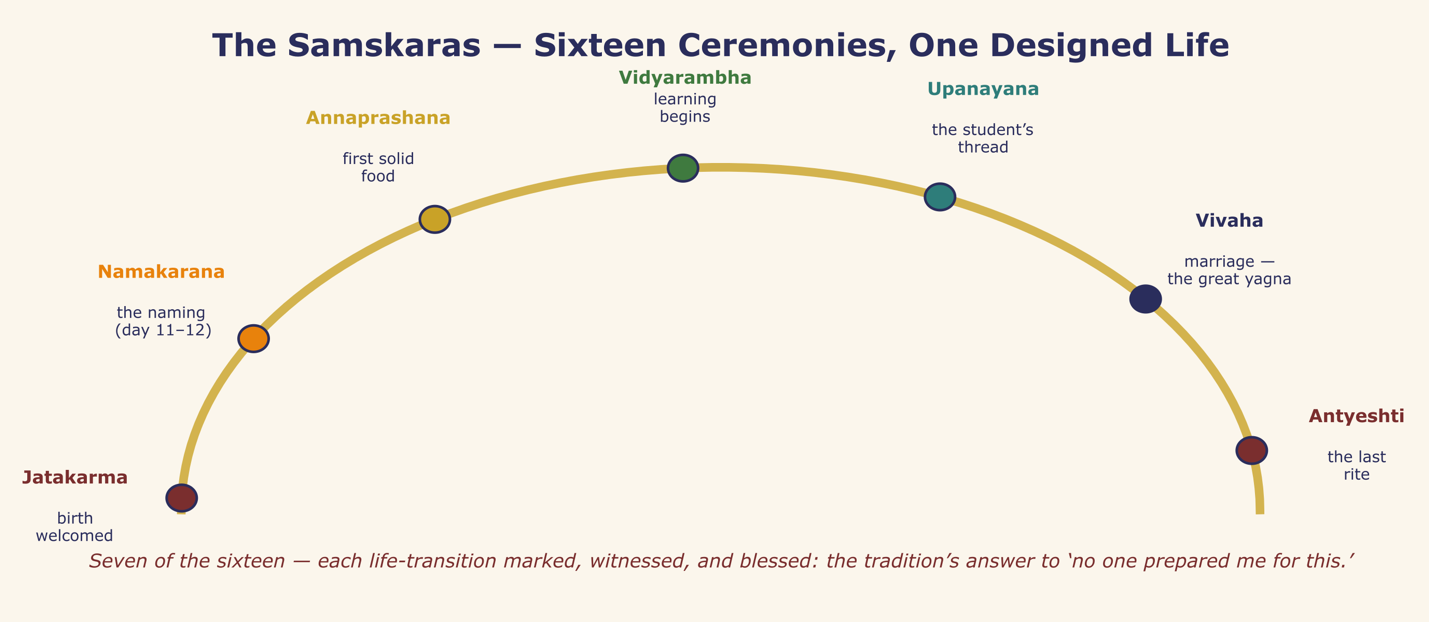
Zoom out from daily customs to life-sized ones and you find the same design intelligence at scale. The tradition marks a life with sixteen samskaras, sacraments punctuating every major transition: Pre-natal (Garbhadhana; Pumsavana; Simantonnayana); jatakarma welcoming the newborn; namakarana, the naming, with family gathered around a name chosen to be an aspiration; niskhkramana, The first time the baby is taken out of the home to see the sun; Chudakarma, The first tonsure ceremony; annaprashana, the ceremonial first solid food; Karnavedha, The traditional ear-piercing ceremony; vidyarambha, the first letters traced — often in a plate of rice — turning literacy itself into a rite; upanayana, the student’s thread, formally opening the season of study; Snataka, The graduation ceremony celebrating the successful completion of formal studies; vivaha, marriage, conducted not as a contract but as a yagna with fire as witness; Vanaprastha, The stage of gradual detachment, where a person transitions from worldly life to spiritual contemplation; Sannyasa: The final stage of total renunciation and asceticism to dedicate one's life to God; and antyeshti, the last rite, returning the elements to the elements with dignity. Modern psychology speaks of how unmarked transitions leave people disoriented, of the human need for ritual to metabolize change. The samskara system is that need answered in full, millennia early: every threshold of a life witnessed, named, and blessed, so that no one crosses the big doors of existence alone or unannounced. [SENSIBLE DESIGN] at civilizational scale, with each individual rite carrying its own tiers for you to examine with the three questions.
Two related customs complete the toolkit. The vrata — a vowed observance, often a fast or a discipline taken for a fixed period — is the tradition’s commitment device: modern behavioral science rediscovered that public, time-bound, slightly costly commitments are what actually change habits, and the vrata is that, with a sacred witness attached. And muhurta, the choosing of auspicious times, sort it honestly: [TRADITIONAL] the jyotisha account of favorable moments; [SENSIBLE DESIGN] a shared calendar that coordinates families and communities to act together and treat beginnings as consequential, a wedding whose hour was chosen with care is a wedding no one treats casually. As always: three questions, three tiers, no embarrassment.
At the next samskara or family ceremony you attend — a naming, a thread ceremony, a wedding — go as this book’s reader: identify which life-threshold is being crossed, spot the sankalpa, the fire as witness, the guest-honoring, and the community standing witness. Ceremonies you understand stop being long. They become legible.
The method matters more than any single example. When you meet a custom, ask three questions in order: What does the tradition say it is for? What practical design can I see in it with my own eyes? What, if anything, has been scientifically verified? A practice can be precious at tier three, wise at tier two, and proven at tier one. And you never have to exaggerate one tier to honor another. This three-question habit is itself the most scientific ritual in this book.
Pick one family custom not listed here. Run the three questions on it and write one sentence per tier. You are now doing what this whole chapter does, honoring your tradition with open eyes.
The Debate Hall
“A neat trick,” says the challenger. “But isn’t the honest position that every custom is superstition until proven otherwise?”
The reply
That standard would abolish most of human life — birthday candles, graduation gowns, handshakes, national anthems — none of which have, or need, clinical trials. Customs are not failed science; they are a different genus: compressed social memory, identity, and meaning, within which some carry practical design and a few turn out to be empirically supported. The three-tier method is the honest position: it neither swallows every claim nor sneers at every practice; it sorts. And note who is being more scientific here. The person with a method that distinguishes evidence, design, and tradition, or the person with a single dismissal for a thousand different things. A good scientist classifies before she judges. So does a good Hindu.
Meera’s notebook
- Three tiers, three questions, in order: what does tradition say / what design do I see / what is verified.
- Arghya = circadian gold. Head-south = honest physics note + ritual consistency. Asana = all three tiers at once.
- The kolam is grandma’s recreational mathematics, computer scientists study its grammars.
- Sixteen samskaras: no threshold of life crossed alone or unannounced.
- Vrata = a time-bound, costly, witnessed commitment, exactly what habit science says works.
- ‘It’s tradition’ is now the BEGINNING of my answer, never the end of it.
The next morning Meera watched her grandmother finish the kolam and, before eating, set aside a small portion of rice on the compound wall, for the crows, as she had done every single day of Meera’s life. Meera had seen it ten thousand times. For the first time, she asked why. Grandma smiled: “Because we owe.” Owe? Owe whom? Thatha, passing with his newspaper, said only: “Tonight’s chapter.” ❖
You must ask everything.
Check your understanding
- Name the three honesty tiers and what each means.
- For the asana custom, give one explanation from each tier.
- Which practice in this chapter packages morning light, breathing, and stillness into one ritual?
- What is the honest physics note about sleeping direction?
- Name four of the sixteen samskaras.
- What does a vrata share with modern behavioral science?
- Reflect: Why is it more respectful — not less — to examine customs with the three-tier method?