
Chapter 11
Temples and Murti Worship
Sunday. The temple’s stone floor was cool under Meera’s bare feet, and the air was three smells at once, camphor, jasmine, oil. Thatha did not head straight for the sanctum; he stopped her under the gopuram and made her look up until her neck ached. “Before we go in,” he said over the bell-sound, “understand that you are not entering a building. You are entering an argument, a thousand-year-old argument in granite about how a mind reaches the formless. Tonight’s chapter is taught by the architects.”
A doorway, not the limit
The tradition distinguishes Nirguna Brahman (reality without form) from Saguna Brahman (the same reality approached with form). A murti — better translated “form” than “idol” — is a pratika, a chosen symbol and support for the mind. No serious teacher claims the stone is the totality of the infinite; the form is a place to focus, the way a scientist uses a model of the atom, a useful handle, not the thing itself.
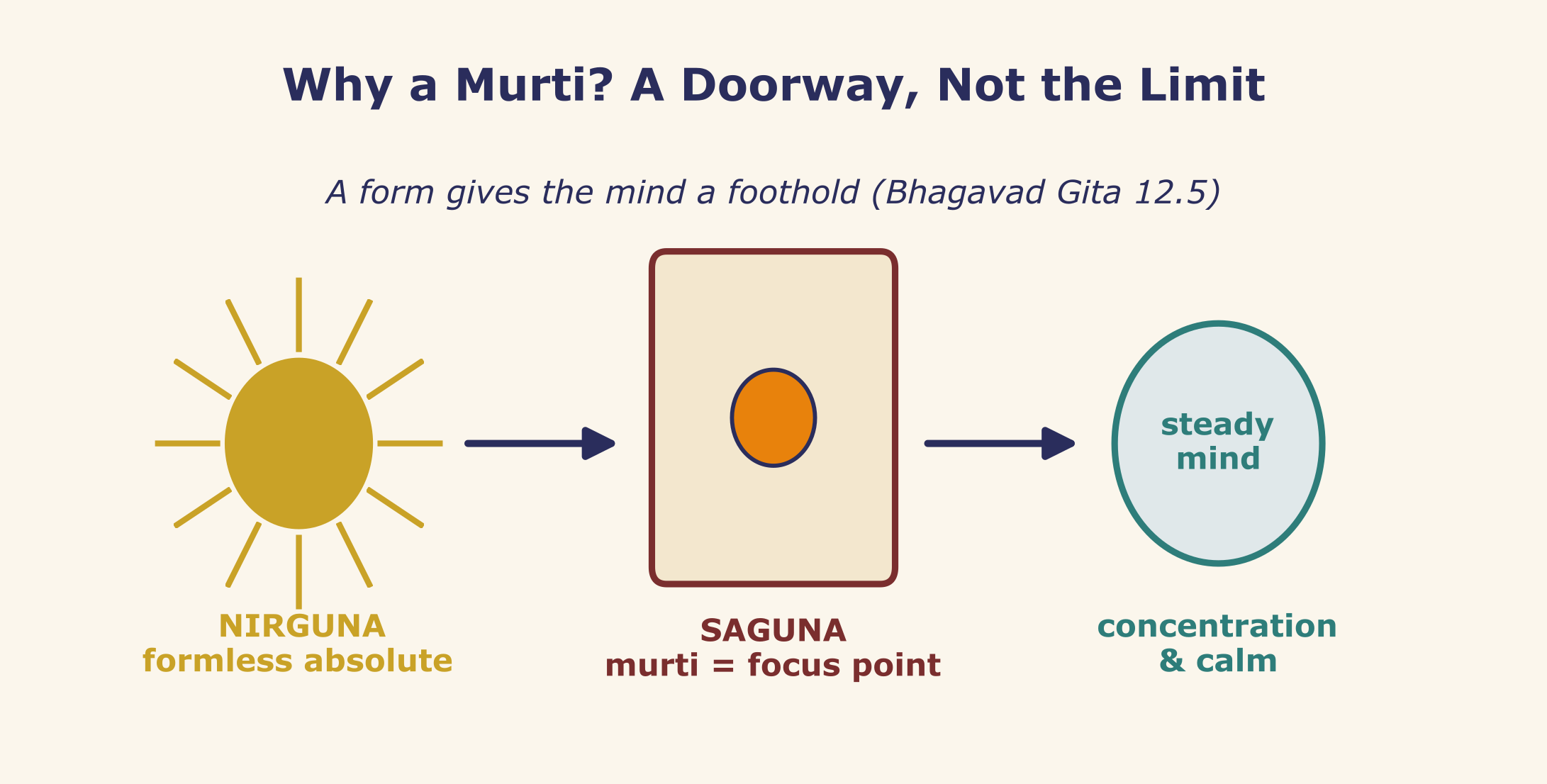
“Klesho 'dhikataras tesham avyaktasakta-chetasam.”“Greater is the struggle for those whose minds are set on the unmanifest (formless)...”, Bhagavad Gita 12.5
The formless is hard for a human mind to hold; a form gives the mind a foothold, psychology, stated plainly in the shastra. Shankara, the great teacher of the formless, nonetheless composed beloved hymns to deities with form and organized the harmonious Panchayatana puja, powerful permission, from the highest non-dualist, to use form wisely.
The defensible reasons temples work
Focus and attention: a fixed point (the murti), a repeated sound (bell, mantra), a scent (incense), and a rhythm (ritual) pull the scattered mind to one place. Sacred space: a distinct, quiet, beautiful space shifts the brain’s mode. The reason a library feels different from a playground. Multi-sense memory: sight, sound, smell, touch, and taste together create a rich, steadying experience. Community and continuity: temples bind generations and give children a felt connection to something larger and older than themselves.
Sound belongs on that list of defensible reasons, and here the tradition’s instinct meets a genuine scientific curiosity. Chanting, bells, and the long resonance of a stone chamber are not random: rhythmic sound slows the breath and settles the mind, an effect you can feel in any temple. More striking, archaeoacoustics — the study of how ancient sacred spaces handle sound — has found that many stone sanctuaries across the world resonate strongly in a narrow band around 110, 111 Hz. A peer-reviewed EEG study led by Dr. Ian Cook at UCLA (2008) reported that, at about 110 Hz, activity over the brain’s prefrontal cortex shifted in a way associated with a quieter, more meditative, less verbal state. Ancient builders almost certainly could not measure hertz. But tuning a sacred chamber by ear until it ‘felt right’ may well have selected for exactly this resonance, the same way our tradition arrived at the calming power of sustained chant long before anyone could graph a brainwave.
Confidence you can visit
And the confidence here can rest on stone. The Brihadeeswara temple at Thanjavur raised a granite vimana over sixty meters high, crowned with a capstone estimated at around eighty tonnes, a thousand years ago, and it stands today. The Kailasa temple at Ellora was carved, top-down, out of a single living mountain rock, architects still study how it was even planned. The iron pillar of Delhi has resisted rust for some sixteen centuries and is examined by modern metallurgists. Konark’s great wheels double as working sundials. Whatever one concludes about subtle energies, the engineering, astronomy, logistics, and artistry of the temple tradition are proven in the most literal sense possible: they are still standing, and the world travels to see them.
The temple is a map of you
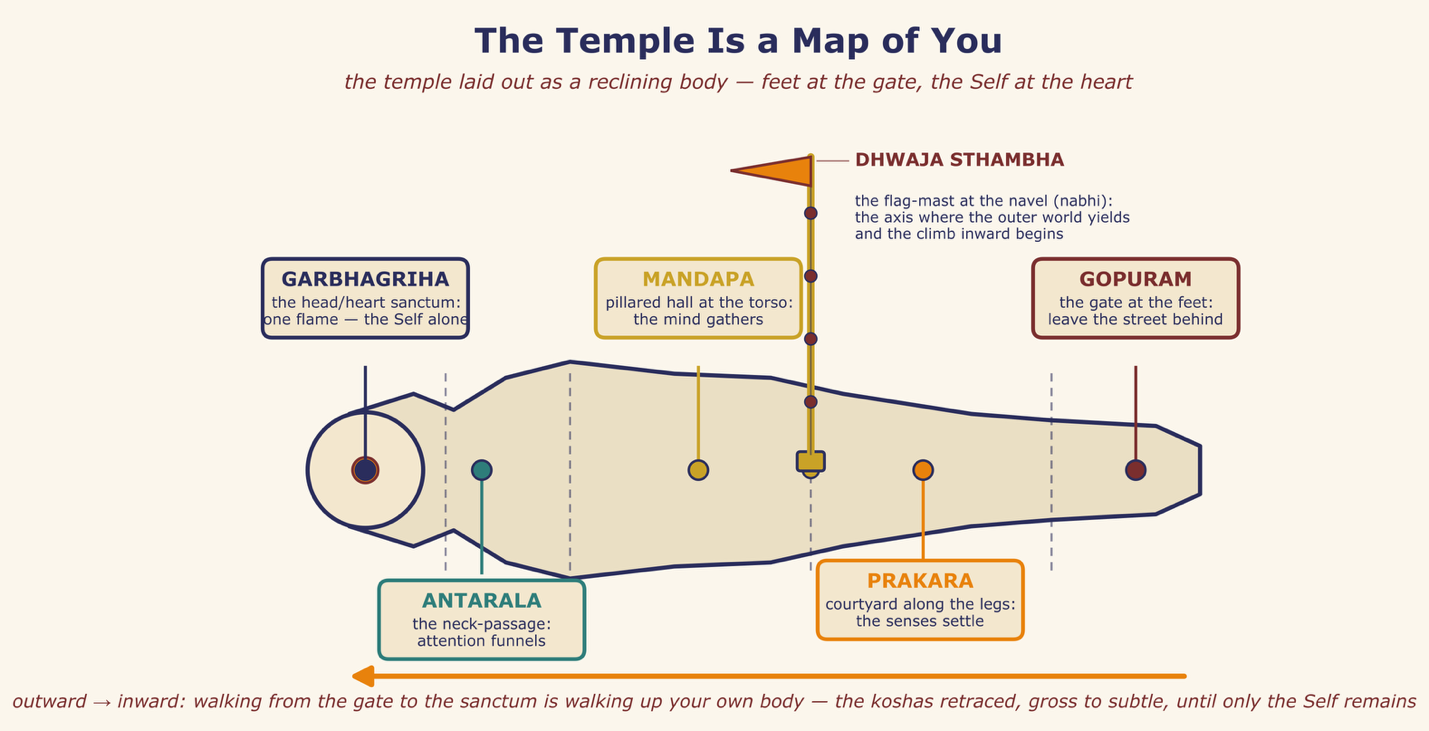
And the deepest design is invisible until someone shows you. Walk the temple’s axis: the towering gopuram announces the threshold and makes you small; the open courtyard lets the senses settle; the pillared mandapa gathers the mind; the narrow antarala funnels attention to a point. And at the end waits the garbhagriha, the ‘womb-chamber,’ deliberately small, deliberately dark, holding one form and one flame. Grand on the outside, almost bare at the center: the exact opposite of a palace, and precisely the architecture of meditation. The agamas prescribe this sequence knowingly. The walk from gate to sanctum retraces the journey through your own koshas from Chapter 5, from the outermost layer to the still point. The temple is the seeker’s inner journey, built in stone at civic scale, so that a whole community could rehearse it weekly with their feet.
Not all temples are alike: many purposes, many designs
A young pilgrim soon notices something the postcards never mention: temples are not interchangeable. They are built and consecrated for different purposes, and the tradition matches the temple to the need with real deliberateness. Knowing the main kinds turns a confusing map into a clear one.
Some temples are built around the five great elements themselves. The Pancha Bhoota Sthalams — five ancient Shiva temples in south India — each honor one of the pancha-bhutas of Chapter 5: earth at Kanchipuram (Ekambareswarar), water at Thiruvanaikaval (Jambukeswarar), fire at Thiruvannamalai (Arunachaleswarar), air at Srikalahasti, and space —akasha— at Chidambaram, whose sanctum famously enshrines empty space. A whole pilgrimage, one element at a time: the periodic table of the spirit, laid out across a subcontinent.
Other temples are matched to particular seasons of life and need. Some are above all places of ancestral rite, Gaya the most famous, where families perform the shraddha and tarpana that repay the Pitru-debt of Chapter 13. Some are woven into jyotisha, the tradition’s astronomy-astrology: the Navagraha temples, one for each of the nine ‘grahas,’ are visited for the discipline of remedy and reflection when a particular planet’s season weighs on a life. The great majority are simply houses of darshan and peace, the neighbourhood temple where a community gathers to steady itself. And a few are known as powerful seats of sadhana, intense centres of spiritual practice: the Shakti Peethas, and above all Kamakhya in Assam, are sought by serious practitioners as places where inner practice is said to deepen and quicken.
You do not need to believe any one temple is objectively ‘stronger’ than another to see the wisdom in this. A civilization that assigns different places to grief, to remedy, to daily peace, and to intensive practice is doing something psychologically sound: it gives each of life’s great needs its own address, its own threshold, its own ritual, so that a person always knows where to carry a particular burden.
The dhyana-shlokas: the forms the rishis saw
Here is a detail that quietly answers the question of where the murti’s exact form comes from. Long before a sculptor lifts a chisel, the form already exists in words, in the dhyana-shlokas, the ‘meditation verses’ that describe each deity feature by feature: the color of the skin, the number of arms, what each hand holds, the posture, the ornaments, the expression. These verses are what a devotee recites to build the image in the mind’s eye before worship, and they are also the sculptor’s blueprint: the Shilpa Shastras require that a murti be carved to match its dhyana-shloka, which is why the same deity is recognizable in a thousand temples across two thousand years.
The tradition’s own account of where these verses came from is striking: the rishis, in deep meditation, are said to have inwardly seen the forms and then set down what they saw, so that others could follow the same inner vision. Whether one takes that literally or as the tradition’s way of honoring its visionary poets, the working result is real and remarkable, a civilization’s sacred images standardized not by a committee but by shared contemplative verse, the seen form preserved in sound so it could be carved in stone. The dhyana-shloka is the bridge from the formless, through the meditating mind, to the murti in the sanctum. The whole doorway logic of this chapter, compressed into a single verse.
There is one more piece of temple lore worth knowing, because it answers the ‘statue’ taunt at its root: the rite of prana-pratishtha. A murti is not worshipped as it leaves the sculptor’s workshop; the agamas prescribe an elaborate consecration in which the divine presence is formally invoked into the form, breathed in, the name literally means ‘establishing the life-breath.’ The tradition’s own theology, in other words, agrees with the critic that stone by itself is stone; it simply adds what the critic missed, that after consecration the form serves as a living focus of the invoked presence, the way a flag is cloth until it is raised, and then men salute it.
The living temple: kitchen, bank, stage, and school
A last correction to the postcard image: the great temple was never only a shrine. It was the operating system of its town. Temple kitchens fed pilgrims at industrial scale, and still do: the Jagannatha temple at Puri runs what is often called the largest kitchen of its kind on earth, its rows of earthen pots steaming daily for tens of thousands, while Tirupati’s kitchens and famous laddu operation feed pilgrim crowds that rank among the largest sustained gatherings anywhere, annadanam, the manushya-yagna of Chapter 13, running continuously for centuries as functioning infrastructure. Temple halls were the concert stage and the dance academy, entire classical arts, Bharatanatyam among them, grew up in temple service; temple tanks were civic waterworks; temple inscriptions served as land records and public archives; temple granaries buffered famines. Note what this does to the challenger’s picture of temples as monuments to superstition: these were — and in living temples remain — integrated institutions of worship, welfare, art, water, and record-keeping. The gopuram was the skyline of a working city of dharma, not the tombstone of a belief.
The Debate Hall
“Call it what you like,” the challenger presses. “You are bowing to a statue.”
The reply
Take out your phone and open the photograph of your mother. Is it paper and pixels? Entirely. Would you let me tear it up? Never, because through that paper you touch a person the paper is not. No one in the history of this tradition has believed the murti exhausts the infinite; the shastra itself distinguishes nirguna from saguna, and Gita 12.5 explains, as plain psychology, why embodied minds need a form to hold. The murti is the photograph of the Infinite, consecrated with full knowledge that it is a doorway. And the proof is in the practice: the same devotee who garlands the form at dawn will tell you, in the evening, ‘Ishvara is everywhere.’ A tradition that holds both sentences comfortably is not confused. It is complete.
You will hear specific physical claims, dome metals channeling energy, measurable fields in the inner sanctum, healing bell frequencies. Treat these as traditional explanations, not (yet) proven physics, while acknowledging a real datum: countless devotees across generations report feeling presence and peace in the sanctum, and your own felt experience there is evidence you are entitled to weigh for yourself. Even setting the physical claims entirely aside, you do not need them: focus, sacred space, multi-sense experience, and community are real, defensible, and sufficient. A word on the 110, 111 Hz finding, since it is genuine and therefore easy to over-sell: the measured effect is on the listener’s own brain activity in resonant stone chambers (studied mostly at megalithic sites such as Malta’s Hypogeum, not, so far, at named Indian temples), and it says nothing about ‘healing energy,’ ‘DNA repair,’ or cosmic vibration, claims that circulate online with no evidence behind them. Keep the real, modest, fascinating fact; leave the embroidery.
Meera’s notebook
- Nirguna and saguna: the same reality, without and with form. Gita 12.5 = the psychology of why forms help.
- The murti is the photograph of the Infinite, paper and pixels, and also my mother. Both true.
- Prana-pratishtha: stone is stone UNTIL consecration invokes the presence, the flag raised, then saluted.
- Temples aren’t interchangeable: PANCHABHOOTA (five elements), ancestral (Gaya), jyotisha (Navagraha), peace (most), intense sadhana (Kamakhya/Shakti Peethas). Each need gets its own address.
- Dhyana-shlokas: the rishis SAW the forms in meditation and put them in verse; sculptors carve to match, why one deity looks the same across 2000 years.
- Temples resonate near 110, 111 Hz; a 2008 UCLA EEG study saw the prefrontal cortex quiet toward a meditative state. Real + modest. NO DNA-repair / energy-healing nonsense.
- The walk gopuram → garbhagriha is my own koshas in stone: grand outside, one flame at the center.
- Temples ran kitchens, tanks, stages, archives, Puri still feeds tens of thousands daily. Working infrastructure, centuries old.
- Brihadeeswara, Kailasa, the iron pillar: confidence you can visit. Still standing.
On the drive home, Meera watched the gopuram shrink in the rear window and thought about arguments made of granite. “Thatha, the temple has reasons. Does everything have reasons? The mark Grandma wears? The lamp? Sleeping direction? All of it?” Thatha adjusted the mirror. “Tomorrow,” he said, “we put the whole household under the microscope.” ❖
Check your understanding
- What is the difference between Nirguna and Saguna Brahman?
- What psychological reason does Gita 12.5 give for form-based worship?
- List the four defensible reasons temple worship works.
- What is prana-pratishtha?
- Name the five Pancha Bhoota Sthalams and the element each enshrines.
- What is a dhyana-shloka, and how does it reach the sculptor’s chisel?
- What did the 2008 UCLA study find at ~110 Hz, and what should you NOT claim from it?
- Give two examples of the temple as a working civic institution.
- Reflect: Someone teases you about “idol worship.” Explain the doorway idea calmly.