
Chapter 10
Quantum Physics and Vedanta: Resonances, Handled Honestly
“The video said the electron behaves differently when observed,” Meera said, all in one breath, “and that’s just like the Upanishads saying consciousness is fundamental, and my cousin shared a reel saying quantum physics PROVES Vedanta, and, ” Thatha held up a hand, smiling. “Slowly. Tonight I give you something more valuable than that reel: the true story of what the great physicists actually said, what rhymes. And exactly where an honest person stops. Because on this topic, Meera, overclaiming is how our side loses.”
Why people connect the two
Three Vedanta ideas sound startlingly like quantum physics. First, the observer matters: Vedanta holds that consciousness is fundamental, and in quantum mechanics the act of measurement itself shapes what outcome an experiment yields. Second, the world is not the solid thing it appears to be: Vedanta has a precise word for this, maya, the way a single underlying reality appears as a solid, separate, many-thinged world, much as one rope in dim light appears as a snake. Maya does not mean the world is fake; it means the world is not quite what our senses report. And physics, arriving by its own road, unsettles that same reported solidity, what looks like firm matter turns out to be overwhelmingly empty space, and its particles are better described not as tiny hard specks but as spread-out clouds of probability. Third, a deep unity underlies apparent separateness: Vedanta says all is finally one, and in quantum entanglement two particles can remain linked across great distances in a way that defies our everyday sense of things as cleanly separate. Great physicists did not merely notice the resemblance. They studied the source. Erwin Schrödinger, a father of quantum mechanics, read Vedanta throughout his life and wrote that the Upanishadic insight, each individual consciousness ultimately one with the whole, was the deepest available view of reality; Niels Bohr and Werner Heisenberg engaged Indian thought seriously; and Robert Oppenheimer learned Sanskrit to read the Gita in the original and named it among the most influential books of his life. You inherit a philosophy the architects of modern physics kept on their desks. That is a plain historical fact, enjoy it fully; it needs no exaggeration.
From the pages of history: the physicist and the Upanishads
The Schrodinger story deserves telling properly. In the 1920s, while building the wave mechanics that would win him the Nobel Prize, Erwin Schrodinger was reading deeply in Vedanta. And he did not keep it private. In his essays and in the book that became ‘My View of the World,’ he argued that the multiplicity of minds is only apparent, that in truth consciousness is one. And he named his source plainly: this, he said, is the doctrine of the Upanishads, the identity of Atman and Brahman, which he regarded as the grandest of insights and lamented that the West found alien. Decades later Oppenheimer — who had learned Sanskrit at Berkeley for the pleasure of reading the Gita unfiltered — reached for its verses at the most consequential moment of the century. None of this proves metaphysics, and this chapter’s honest limits stand untouched. But when someone sneers that your philosophy is pre-scientific, you may answer with the historical record: the men who built the twentieth century’s deepest physics read this tradition not as an artifact, but as a peer.
And the conversation has not ended. It has, if anything, turned toward Vedanta’s home ground. The unsolved question at the center of modern mind-science is what philosophers call the hard problem of consciousness: mechanism explains what the brain does — processing, reacting, reporting — but no one has explained why any of it is accompanied by experience, by the felt taste of sugar or the redness of red. Some contemporary philosophers and scientists, pressed by that gap, now seriously entertain what the Upanishads asserted at the start: that consciousness may be fundamental, not produced by matter but present in the ground floor of reality. That view remains contested, and this book will not sell you a contested view as settled. But mark the direction of travel: the question the modern world cannot close, what is consciousness?, is the precise question your tradition placed at the center of its entire library, and answered with its boldest sentence: prajnanam brahma. Whatever the final verdict, you inherit three thousand years of head start on the deepest open problem there is.
There is one great physicist whose link to Vedanta must be told carefully, precisely because it is so often told carelessly. Albert Einstein did not, as far as the record shows, study the Upanishads the way Schrödinger did, and many of the lush ‘Einstein on the Gita’ quotes that circulate online are simply invented, a caution this book is glad to model, because the truth is impressive enough without decoration. What Einstein did leave us, in his own careful words, is a vision of reality that rhymes with Vedanta in a way worth pausing over. He spoke of a ‘cosmic religious feeling’, not belief in a personal, wish-granting God, but a profound awe before the rational, unified order underlying all of nature. He wrote that the most beautiful thing we can experience is the mysterious, and that a true scientist is moved by a rapturous amazement at the harmony of natural law, which reveals an intelligence so superior that, beside it, all human thinking is utterly insignificant.
Set that beside the Upanishads and the resemblance is quiet but real. Vedanta, too, points past the many separate things to a single underlying reality, Brahman; it, too, holds that this reality is not capricious but lawful, discoverable, one; and it, too, treats awe — not fear, not bargaining — as the right response to it. Einstein reached his vision through equations and Vedanta reached its through meditation and inquiry, and neither is proof of the other. But when one of history’s greatest scientists describes reality as a single rational harmony that dwarfs the separate ego and fills the honest mind with wonder, a young Hindu may notice, without exaggerating a word of it, that the seers by their lamps had been saying something remarkably close for three thousand years.
“Prajnanam brahma.”“Consciousness is Brahman.”, Aitareya Upanishad 3.3
“Sarvam khalv idam brahma.”“All this is indeed Brahman.”, Chandogya Upanishad 3.14.1
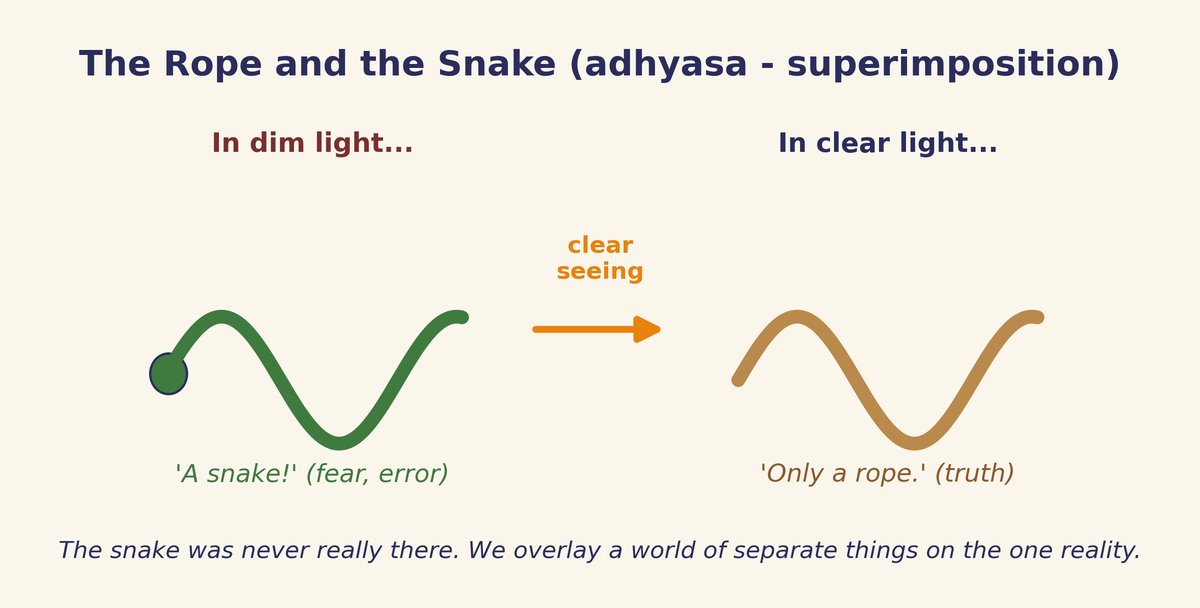
Shankara’s adhyasa (superimposition) is the classical parallel to “the world is not what it seems”: in dim light you mistake a coiled rope for a snake. The snake was never there; you superimposed it. Likewise we superimpose a world of separate solid things on the one underlying reality.
The oldest meditation on infinity
If the physicists’ unity echoes Vedanta, there is one idea where the tradition may have reached the ground first of all: infinity itself. Vedanta’s name for the ultimate reality is not only Brahman but ananta, ‘the endless.’ And the tradition did not merely assert that the infinite exists; it thought about how infinity behaves, in a verse recited to this day before the study of the Upanishads:
“Pūrnam adah pūrnam idam, pūrnāt pūrnam udacyate; pūrnasya pūrnam ādāya pūrnam evāvasiṣyate.”“That is whole; this is whole. From the whole, the whole arises. Take the whole from the whole, and the whole still remains.”, Shanti mantra, Brihadaranyaka & Isha Upanishad
Read that last line slowly, because it is doing real mathematics. It says: subtract the infinite from the infinite, and the infinite still remains. For most of history that sounded like mystical wordplay, until the nineteenth-century mathematician Georg Cantor proved that infinite sets behave this way. Remove all the even numbers from the endless list of whole numbers, and you have taken away an infinity, yet an infinity of odd numbers is still left, no smaller than before. The seers had intuited, in the language of prayer, a property of the infinite that mathematics would not formalize for thousands of years.
A careful mind should hold the edges honestly. This is not a claim that the Upanishads ‘did calculus,’ nor that science has proven the universe to be infinite, whether the cosmos is finite or endless is still an open question in physics, and the tradition sits perfectly at ease beside that uncertainty. What the Purnam verse shows is subtler, and in its way more moving: that a civilization contemplating the Absolute reached for the idea of a completeness that loses nothing when part is taken from it — the exact signature of the mathematical infinite — and wove it into a child’s first prayer. You inherit not a proof, but a three-thousand-year-old friendship with the idea of the endless.
The honest limits — read this twice
1. “The observer” in physics is not (necessarily) a conscious mind. Most physicists take “measurement” to mean any interaction with a measuring device. “Consciousness collapses the wave function” is a real but minority, contested interpretation, not settled science.
2. Quantum effects are mostly about the very small. They do not scale up to “you create your own reality.” Be wary of anyone selling that.
3. Resonance is not derivation. Two ideas can rhyme without one proving the other. The coincidence is fascinating, and that is all it is, until proven otherwise.
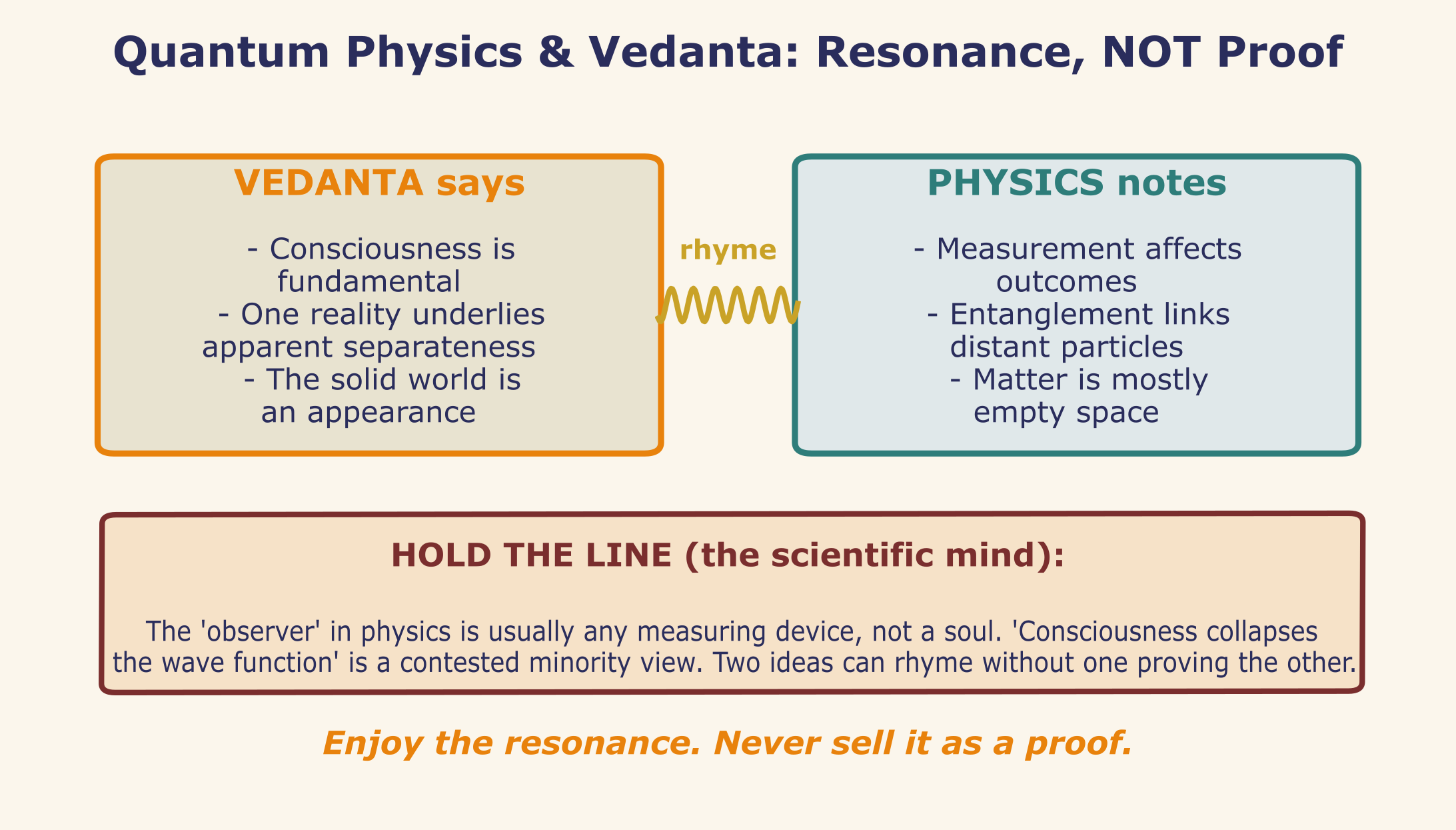
The right way to hold this: “Some of the deepest ideas in my tradition rhyme beautifully with some of the deepest ideas in modern physics. I find that thrilling and worth contemplating. I will not pretend it is proof, and I do not need it to be.” You can say that at ten and still be proud of it at fifty.
Meera’s notebook
- Three rhymes: the observer matters, the world isn’t solid, deep unity underneath.
- BUT: ‘observer’ usually means a device, not a soul. Rhyme ≠ proof, and saying so makes US stronger.
- Schrodinger read the Upanishads and said so in print. Oppenheimer learned Sanskrit for the Gita. Peers, not artifacts.
- Brahman = ananta, the endless. Pūrnam verse: infinity minus infinity = infinity. Cantor proved it ~3000 years later. We put it in a PRAYER.
- Einstein: no real Upanishad study, and those Gita quotes are FAKE, but his ‘cosmic religious feeling’ (one rational harmony, awe not bargaining) rhymes with Brahman. Resonance, told honestly.
- The hard problem, why is there EXPERIENCE at all?, is still open. It was our central question first: prajnanam brahma.
- The honest sentence: ‘It rhymes beautifully; I won’t pretend it’s proof, and I don’t need it to be.’ Works at 12; works at 50.
Meera replied to her cousin’s reel that night with three careful sentences — rhyme, not proof; Schrodinger, not sensation — and felt the particular satisfaction of being fair to both of her loves at once. “Thatha, we keep talking about ideas,” she said afterward. “But Sunday we’re going to the temple. Is there a chapter for that?” “There is,” he said. “And we will teach it on location.” ❖
Check your understanding
- Name the three resonances between Vedanta and quantum physics.
- What does “the observer” usually mean to physicists, and why does that matter?
- Explain the rope-and-snake in your own words.
- What does the Pūrnam verse say about subtracting the infinite from the infinite, and which mathematician later proved it?
- Why must the Einstein–Vedanta link be told carefully? Give the honest version.
- What is the ‘hard problem of consciousness,’ and why is it Vedanta’s home ground?
- Reflect: A friend says “quantum physics proves Hinduism.” Reply kindly and accurately.