
Chapter 9
What Gives This Tradition the Spirit of Science
It finally happened at school: a classmate declared, with the full confidence of sixteen, that “religion and science are enemies — everyone knows that.” Meera had opened her mouth — and found she wanted better ammunition than anger. “Thatha, is it true? Are they enemies?” He set down his tea. “Some religions and science have certainly quarreled. Tonight, let us examine the evidence for this one: five features, each with a text you can check, plus a hall full of logicians and two universities your classmate has never heard of.”
We will not call any religion “the most scientific”, that is an opinion. But we can list, honestly, five features that give Sanatana Dharma a scientific spirit, each tied to a text.
1. It begins with inquiry, not command. “Athato brahma-jijnasa”, “Now, the inquiry into Brahman” (Brahma Sutra 1.1.1). The foundational sentence is an invitation to investigate.
2. It prizes direct experience (anubhava) over hearsay. Shankara insists the final test of self-knowledge is direct realization, not belief in words, just as science’s final court is the experiment, not the authority.
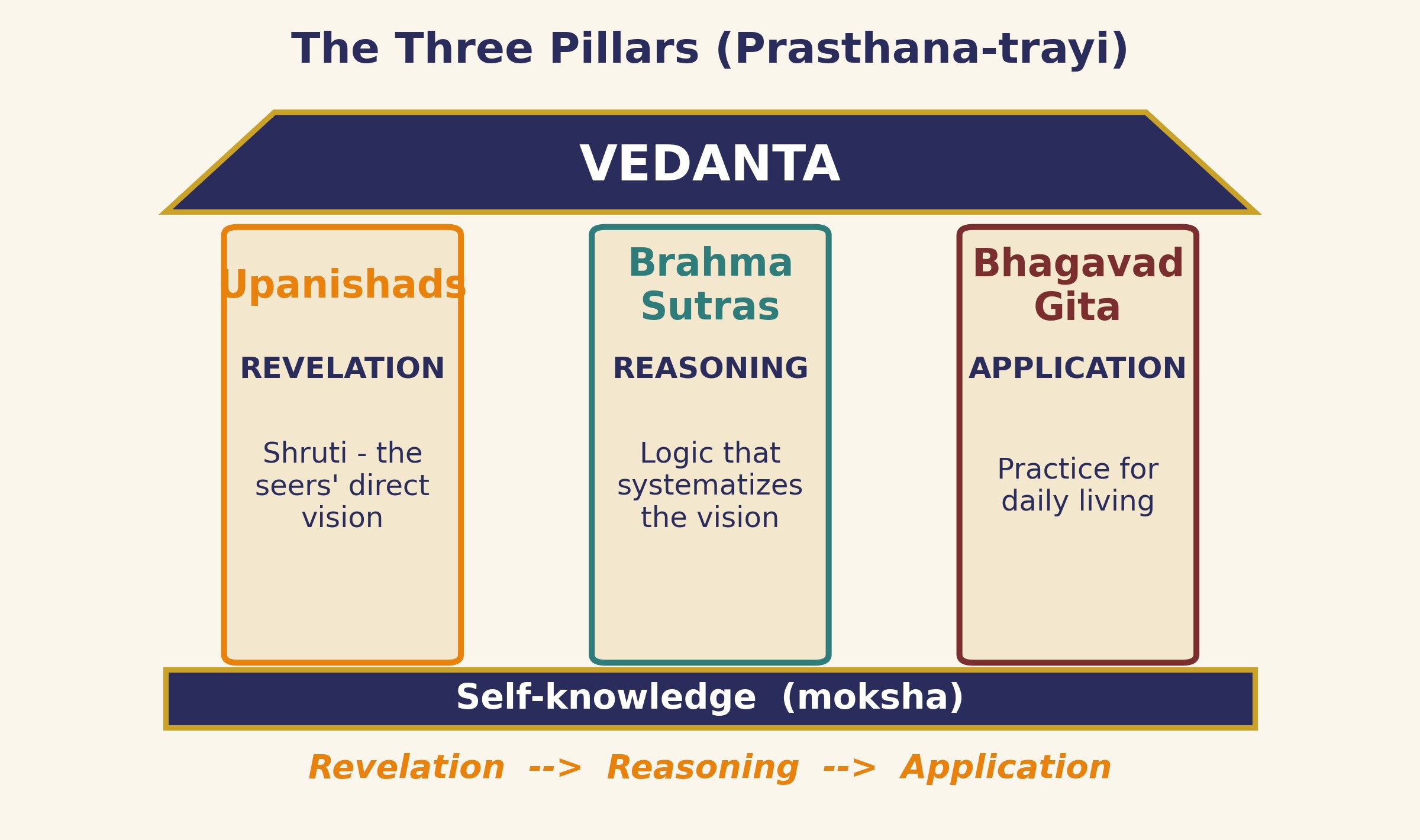
3. It reasons, and permits debate. The middle pillar of the Prasthana-trayi is reasoning itself. Shankara’s life was a series of public debates governed by the rule that the loser honestly accepts the better view.
4. It thinks in vast, impersonal scales of time. As Chapter 7 showed, kalpas of 4.32 billion years, cycling endlessly, a scale of imagination the modern mind can respect.
5. It is not threatened by “I don’t know.” The Nasadiya Sukta, the Rig Veda’s Hymn of Creation (10.129), ends not with dogma but humility: who really knows how it all began?, perhaps even the highest watcher does not. A scripture with that courage has the intellectual honesty at the heart of science.
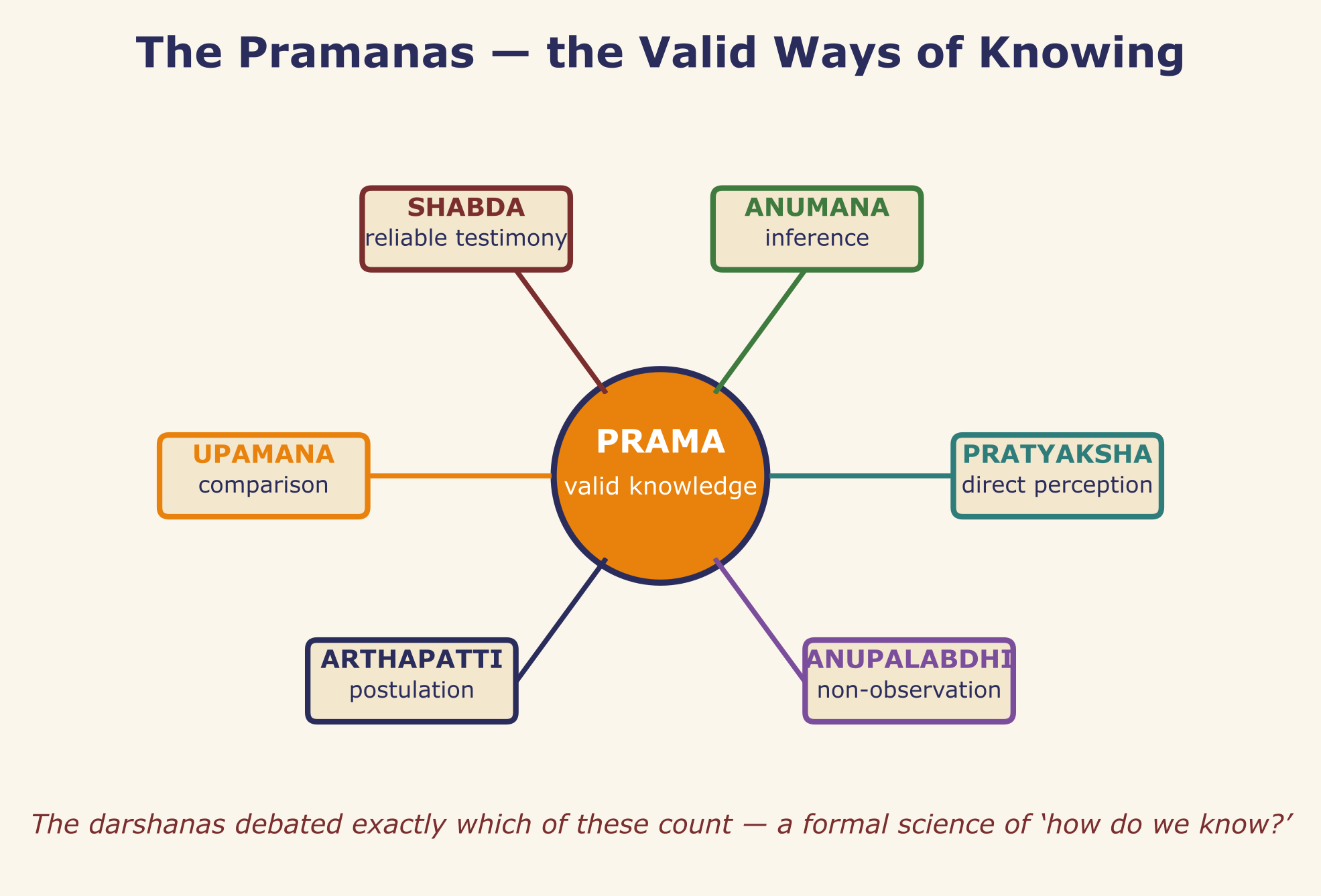
Two more exhibits belong in this gallery. First, the tradition built a formal theory of knowledge itself: the darshanas debated the pramanas — the valid means of knowing (direct perception, inference, reliable testimony, and more) — centuries before epistemology became an academic subject elsewhere, and the Nyaya school is a full-blown science of logic and debate. Second, it built the institutions to match: Takshashila and Nalanda drew students from across Asia when organized universities were unheard of almost everywhere else, and Nalanda’s library was famed across the ancient world. A civilization of logicians, grammarians, and universities is the opposite of a civilization of blind faith, remember that sentence; you will use it.
And the sciences of the body kept pace with the sciences of logic. The Sushruta Samhita describes surgical instruments by the dozen and procedures — including reconstructive nasal surgery — that historians of medicine cite as landmarks; the Charaka Samhita organized diagnosis, prognosis, and medical ethics into a physician’s complete education. Centuries later, the Kerala school of mathematics developed infinite-series methods for pi and the trigonometric functions that anticipated pieces of calculus well before Newton and Leibniz, a finding now standard in histories of mathematics. When a challenger claims this tradition feared inquiry, this is the shelf you point to.
The Debate Hall
“Then answer the obvious question,” says the challenger, and it is a fair one. “If this civilization was doing logic, surgery, and proto-calculus, why did modern science rise elsewhere? What happened?”
The reply
History happened. And history has addresses. Nalanda’s library burned in invasion around the twelfth century; the university networks that had run for a thousand years lost their patronage and their peace; and the colonial era that followed formally redirected education itself. The 1835 policy debates in British India openly proposed replacing indigenous learning with English instruction, and funding followed the proposal. Sever any civilization’s institutions for centuries and its output will show the wound; that is not a verdict on the civilization’s capacity but on its circumstances. And watch what the capacity did the moment circumstances eased: within decades of reawakening came Ramanujan’s notebooks, Raman’s Nobel-winning physics, Bose’s statistics that put his name beside Einstein’s. And today one of the largest scientific and engineering workforces on earth, including the space program that reached Mars orbit on its first attempt. A tree that regrows that fast after such a cutting was never dead at the root. The interrupted centuries were an interruption, not an ending, and not an essence.
Some popular books claim the ancient texts contain exact modern physics. The precise speed of light, the structure of the atom. Be cautious: these usually stretch a metaphor or misread a number. You do not need the exaggerations. The genuine scientific spirit — inquiry, direct testing, reasoning, vast scales, humility — is real, is enough, and will never embarrass you when you study real science.
Meera’s notebook
- It opens with ‘Now, the inquiry’ (Brahma Sutra 1.1.1) and prizes anubhava, experience over authority.
- Pramanas = a formal science of ‘how do we know.’ Nyaya = a whole school of logic.
- Takshashila and Nalanda: universities drawing all Asia, logicians and libraries, not blind faith.
- Sushruta’s surgery, Charaka’s ethics, Kerala’s proto-calculus: the shelf I point to.
- The stall has addresses: invasion, burned libraries, 1835. The rebound has names: Ramanujan, Raman, Bose, and Mars orbit, first attempt.
- The Nasadiya Sukta dares to end in ‘who really knows?’ Bravest sentence in any scripture.
The classmate, presented calmly with Nalanda, the pramanas, and the Nasadiya Sukta’s magnificent shrug, retreated to “well, okay, but that’s not normal religion.” Meera counted it as her first victory in vada. But walking home she passed the physics room, where a poster of the double-slit experiment caught her eye and would not let go. “Thatha,” she said that evening, “about quantum mechanics…” His face lit up. “Ah. The chapter I have been waiting for.” ❖
Check your understanding
- Which of the five features do you find strongest, and why?
- True or false: the Rig Veda calculated the exact age of the universe. State the honest version.
- What rule governed Shankara’s debates, and how is it like updating on evidence?
- What happened to Nalanda, and which three names answer ‘why did science stall’?
- Reflect: Why is “I don’t know” a strength in both science and spirituality?