
Chapter 8
Yoga Shastra: The Inner Technology
Friday’s exam sat on Meera’s chest like a small elephant. “I know everything,” she said, “and at night my brain plays it all back at double speed and I can’t sleep.” Thatha didn’t offer sympathy; he offered a mat. “Sit. The problem you have just described — a mind that will not obey its owner — is the exact problem an entire shastra was built to solve. Not stretching, Meera. Engineering. And its first tool is the one instrument you carry everywhere and have never once read the manual for: your breath.”
First, the real definition
Yoga does not primarily mean physical postures. The Gita defines it twice, and neither definition mentions the body:
“Yogah karmasu kaushalam.”“Yoga is skill in action.”, Bhagavad Gita 2.50
“Samatvam yoga uchyate.”“Yoga is called equanimity (evenness of mind).”, Bhagavad Gita 2.48
The working parts: manas, prana, chakras, kundalini
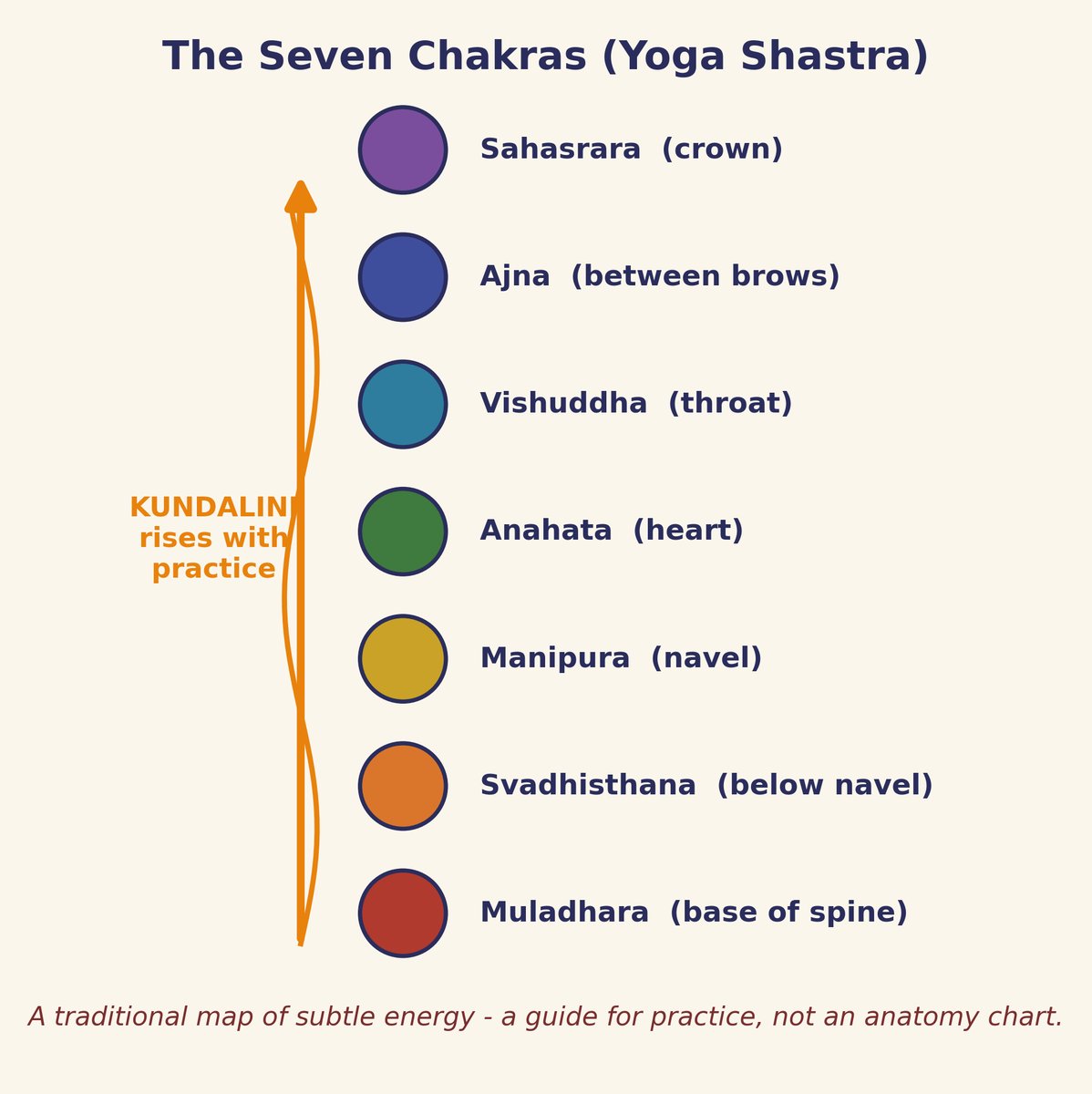
To understand the yoga shastra’s method, know its four working concepts. Manas, the mind, drives the senses and desires. The reins of the chariot from Chapter 5. Prana shakti is the life-force that moves through the body. The tradition describes it flowing like air, warming like fire, circulating like water; the breath is its handle, which is why breath-work (pranayama) is central. The chakras are seven centers of subtle energy mapped along the spine from its base to the crown. And kundalini is the vital spiritual energy pictured as coiled near the base of the spine; through purification and practice it is said to rise through the chakras, and its full ascent is described as illumination, bliss and freedom from rebirth.
The nadis — the channels through which prana flows
If prana is the life-force, the nadis are the channels it flows through. The word comes from the Sanskrit root nad, to flow, to vibrate, to stream. Just as water needs riverbeds and electricity needs wiring, the yoga shastra teaches that prana does not drift randomly through the body: it moves along a vast network of subtle channels. How vast? The Hatha Yoga Pradipika counts seventy-two thousand (4.18). The Upanishads — far older — already describe the network: the Prashna Upanishad speaks of a hundred and one principal nadis radiating from the heart, each branching again and again into thousands (Prashna 3.6). And the Katha Upanishad singles out one as special:
“Shatam chaika cha hridayasya nadyah, tasam murdhanam abhinihsritaika...”“A hundred and one are the nadis of the heart; one of them rises to the crown of the head. Going upward by that one, a person reaches the immortal.”, Katha Upanishad 2.3.16
The three that matter most
Of the seventy-two thousand, the yoga shastra says three are principal. And every practice of pranayama is built around them. Ida runs on the left and ends at the left nostril: lunar (chandra), cooling, calming, connected with rest and inward-turning. Pingala runs on the right and ends at the right nostril: solar (surya), heating, energizing, connected with activity and outward effort. Sushumna is the central channel, running along the spine from base to crown, the royal road of the tradition, the very nadi the Katha Upanishad pointed to, the path along which kundalini is said to rise, with the chakras mapped precisely at its junctions.
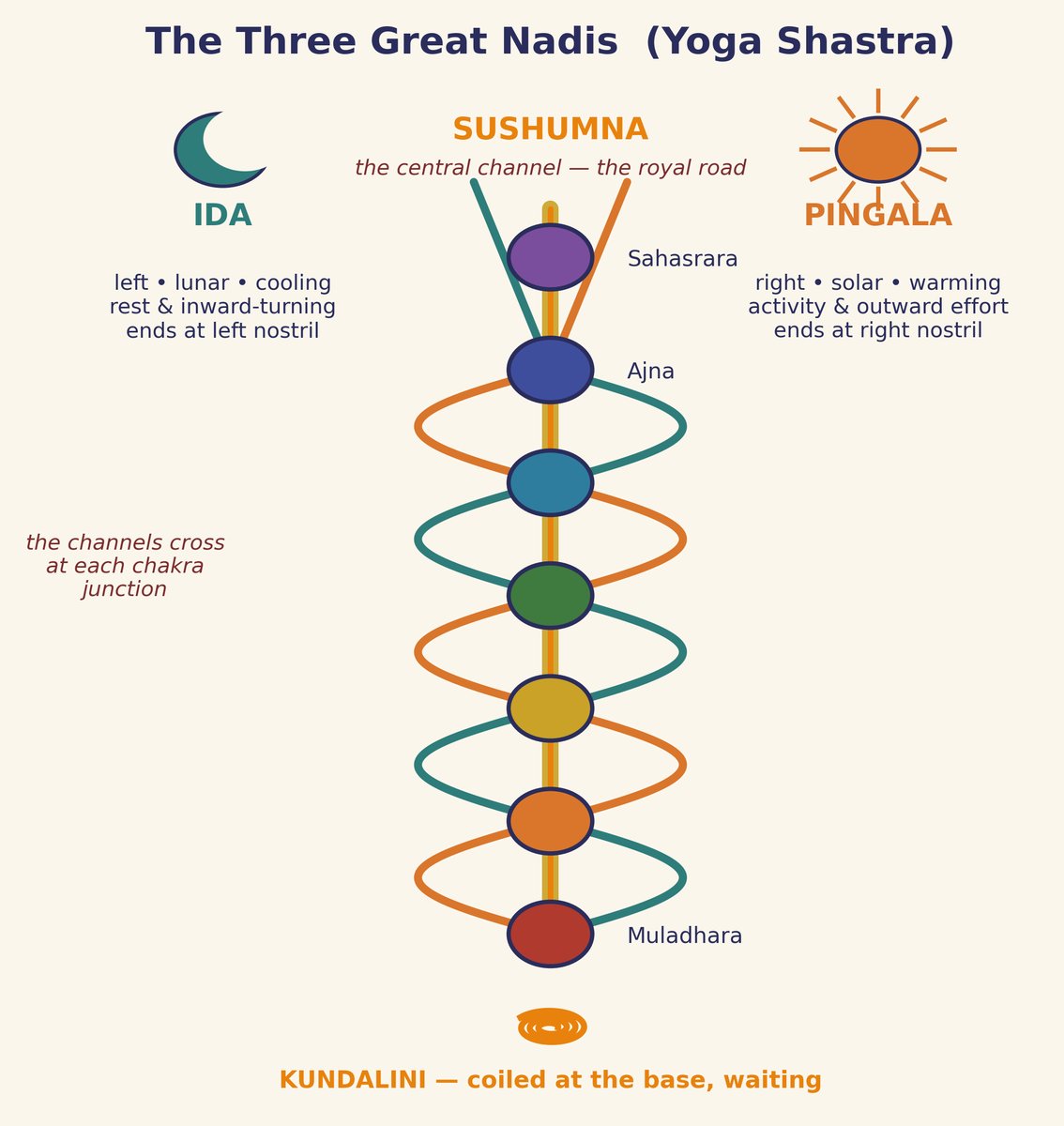
Here is the design insight, and it explains why breath-work sits at the center of the inner technology. In ordinary life, the shastra teaches, prana flows mostly through ida or pingala — swinging between restfulness and activity — while sushumna stays closed. The purpose of pranayama is to purify and balance the channels (nadi shuddhi) so prana can enter the central one. When it does, the tradition says, the mind becomes utterly still, because mind and prana are yoked together:
“Chale vate chalam chittam, nishchale nishchalam bhavet.”“When the breath moves, the mind moves; when the breath is still, the mind is still.”, Hatha Yoga Pradipika 2.2
So the map fits together as one machine: the nadis are the wiring, prana is the current, the chakras are the junction-stations along the central line, and kundalini is the power waiting at the base. Without the nadis, the rest of the map has no roads. And the map connects to things you can verify: your nostrils really do alternate their dominance in a natural rhythm through the day — physiologists call it the nasal cycle — and slow, balanced breathing measurably calms the nervous system. The tradition noticed the breath–mind connection thousands of years before laboratories confirmed parts of it.
This is nadi shodhana, the classic channel-purifying breath. Sit steadily and comfortably. Gently close the right nostril with the thumb and breathe in slowly through the left. Close the left with the ring finger, release the right, breathe out slowly through the right. In through the right; switch; out through the left. That is one round. Do five unhurried rounds and notice, honestly, how the mind feels afterward. You are testing the shastra’s claim that balancing the channels settles the mind. Do not force yourself to agree with that claim. If you notice no difference, simply record that honestly and move on; there are many experiments in this tradition, and one of them may speak to you more directly.
One current, five departments: the pancha pranas
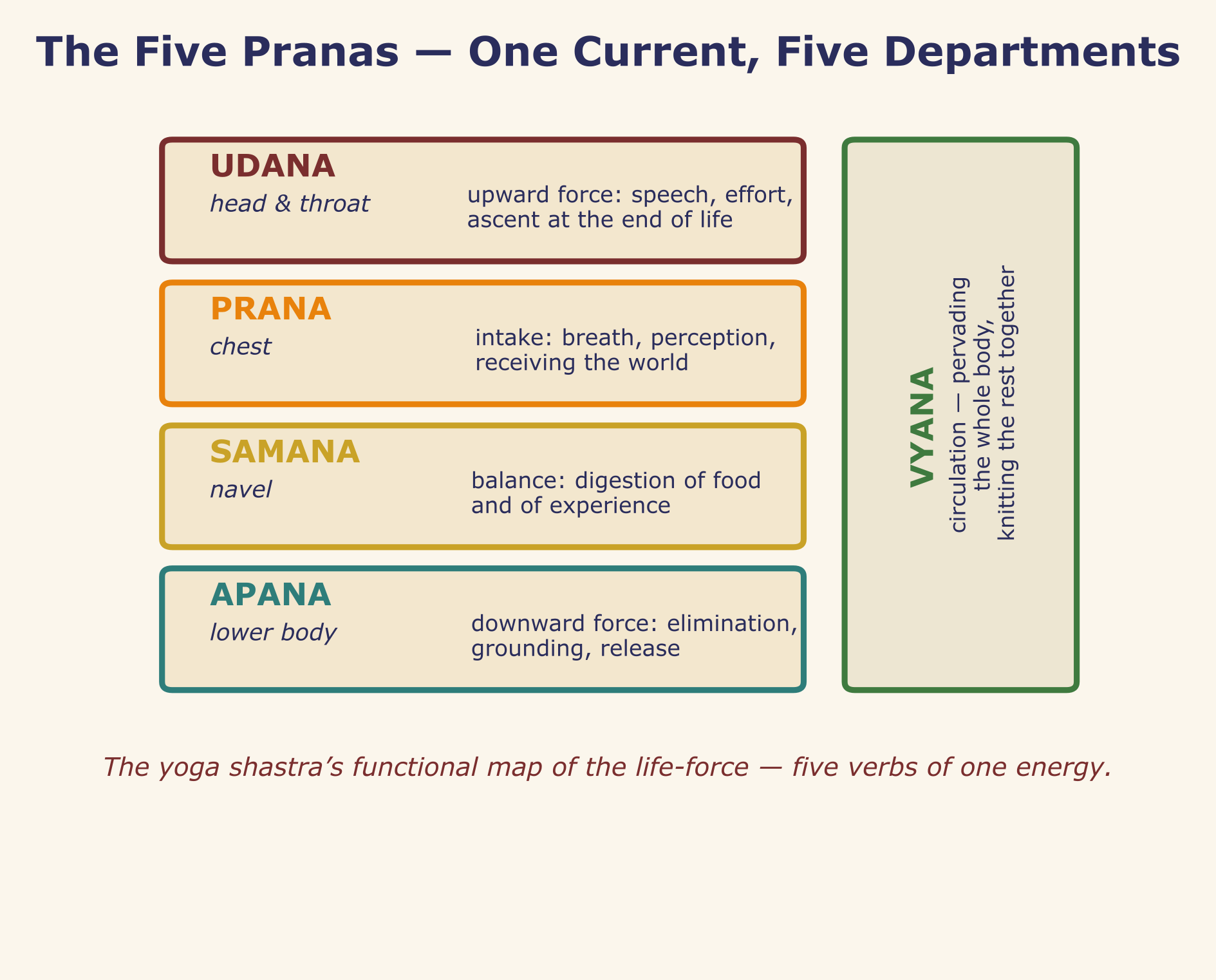
The shastra’s map of the life-force has one more level of detail, and it completes the engineering picture. Prana, the tradition teaches, operates through five functional divisions, the pancha pranas, five verbs of one energy. Prana proper governs intake: breath, perception, everything received. Apana governs the downward and outward: elimination, release, grounding. Samana, seated at the navel, governs balance and digestion, of food, and, the teachers liked to add, of experience. Udana governs the upward: speech, effort, growth, and, at life’s end, the ascent of the jiva. And vyana pervades the whole body, circulating and knitting the other four together. What stands out here is the style of mind at work: not content with ‘life-force,’ the tradition asked what the force does, factored it into functions, and mapped each to its region. The same decomposition instinct that drives physiology, applied from the inside, from the meditation seat. The map’s categories, intake, elimination, metabolism, expression, circulation, would not embarrass a biology syllabus; they were drawn up by observers with no instrument but attention.
Ashtanga — the eight limbs
At first, I misunderstood the eight limbs. I used to think they were the least interesting part of yoga: asana seemed to be the real practice, while the rest felt like abstract ideas added later to make a fitness discipline look like a shastra. But the more deeply I studied Patanjali’s Yoga Sutras, the more clearly I saw that I was wrong.
Patanjali’s complete curriculum. Patanjali organizes yoga into eight profound limbs, ashta-anga (Yoga Sutras 2.29): yama, ethical restraints toward others; niyama, personal disciplines; asana, steady posture; pranayama, regulation of breath and prana; pratyahara, withdrawal and mastery of the senses; dharana, concentration; dhyana, meditation; and samadhi, absorption.Why the order matters. Each limb prepares the next. Discipline and values build the practice, inner technology without character is like skyscraper without a strong foundation. Then the body is steadied, the breath is refined, the senses are gathered inward, and attention is trained step by step until meditation deepens into samadhi. In the state, the practitioner reaches an extraordinary level of clarity, focus, and integration — the kind of peak state sought, in different language, by athletes, leaders, artists, monks, and anyone striving to become the best version of themselves.The deeper design. Seen this way, the eight limbs are not decorative additions to posture practice. They are a complete, ordered curriculum for mastering the mind, refining prana, and — in the tradition’s account — preparing for the awakening of kundalini.
“Sthira-sukham asanam.”“Posture is that which is steady and comfortable.”, Patanjali Yoga Sutras 2.46
How should a scientific mind hold chakras, prana, and kundalini? As the yoga shastra’s working model of inner experience, a map refined over centuries by practitioners, describing what disciplined attention finds from the inside. It is not an anatomy chart; no scan shows a chakra. But the practices built on the map — posture, slow breathing, concentration, meditation — have effects you can verify yourself, and many (breath regulation calming the nervous system, meditation training attention) are now well studied. Use the map for practice; report honestly what you find; claim nothing you have not verified. One resonance is worth naming, precisely because it is a resonance and not a proof: the seven chakra locations sit strikingly close to the body’s major nerve plexuses, dense junctions where nerves gather and branch. Muladhara at the base near the pelvic plexus; manipura at the navel near the solar plexus (a name English already borrowed from the same intuition); anahata at the chest near the cardiac plexus; vishuddha at the throat near the pharyngeal plexus; and ajna between the brows near the pituitary and hypothalamus. The one point that reaches toward the brain itself. It is tempting to go further and announce that the chakras simply ARE these structures, or that they map onto the brain’s cortex, but that is exactly the overclaim to resist. Shastra describes chakras run along the spine, not across the cortex; the plexus parallel is a suggestive rhyme in location or a way to channel the energy to cortexes, not a scientifically tested cause and effect. Enjoy the rhyme, use the map for practice.
Sit steadily (sthira) and comfortably (sukham) for five minutes and simply lengthen the exhale, breathe out slowly. Focus on the natural flow of the breath, noticing it as it enters and leaves the nostrils. If you observe carefully, the mind may settle as the breath settles. You have just verified, in the smallest way, why the yoga shastra treats breath as the handle of the mind.
Mantra — sound turned inward
The word mantra comes from man (mind) and tra (instrument, protection): a tool that carries the mind. A mantra is not a magic password; it is a vibration deliberately installed and refined. The tradition prescribes an exact ladder of internalization: vaikhari japa — the mantra spoken aloud; upamshu japa — whispered, the lips barely moving; and manasika japa, purely mental, no sound at all. Each rung is declared finer and more powerful than the one below it, and the design makes sense of the claim: as the sound moves inward, the attention that rides it must grow steadier, until the mantra stops being something you make and becomes something you rest on.
The tradition’s teaching, stated plainly, is that repeated sacred sound re-patterns the one who repeats it, that the vibration works on thought, breath, and body at the deepest level. And some of that is already visible to instruments: chanting naturally lengthens the exhale and steadies the heart’s rhythm; the humming of bhramari measurably changes airflow in ways researchers find intriguing; brain-imaging studies of Om chanting have watched the quieting of the very regions that fire in anxiety. The calm a mantra brings is not imaginary, machines can watch it arrive.
And the reach may go deeper than mood. When researchers at Harvard put long-term meditators and mantra-reciters through gene analysis, they found something striking: sustained practice shifts gene expression — which genes are switched on and off — quieting the genes tied to inflammation and the stress response, and waking those tied to energy metabolism and cellular repair. Note the precise claim, because it matters: the practice is not rewriting your DNA; it is changing which parts of your DNA speak. The sound does not edit the script. It changes which lines get read aloud. That is the honest, evidence-backed version of an old intuition: that what you chant, repeatedly and inwardly, reaches all the way down.
You will also find bolder claims online, that mantra or sound physically rewrites the genetic code, ‘repairs DNA,’ or reprograms it like software. That stronger version has no established scientific support and rests on fringe work that has not replicated. Keep the two apart: sound changing which genes express is real and measured; sound rewriting the genes themselves is not. The verified version is remarkable enough.
You will also meet a stronger claim — popular on wellness media — that mantra transforms the body down to its cellular structure. Hold that the way this book has taught you to hold the chakra map: it is the tradition’s working model and the practitioner’s inside description, not established laboratory science, and pretending otherwise would cheapen what is there. What you can verify is the ladder itself. Take one mantra, it can be simply “Om” or “Aum”. Ten minutes a day for a week: two days aloud, two days whispered, three days purely mental. Watch what your own attention does on the way up. The benefit does not wait for the biology to be settled.
Mudras — the hands as a keyboard
Watch anyone meditate in this tradition and look at the hands: thumb and index finger touching, palms resting open on the knees. That is a mudra — the word means ‘seal’ — and in the yoga shastra’s working model the hands are not idle terminals but part of the circuit. A mudra closes a loop the way touching two wires completes one: the classic chin mudra joins the index finger (the tradition reads it as the individual self) to the thumb (the universal), an entire philosophy folded into two fingertips, held for the length of a sit.
That thumb-and-finger seal is only one of dozens. The tradition catalogs a whole vocabulary of mudras — the word means ‘seal’ or ‘gesture’ — and sorts them into families: the hasta mudras of the hands, the kaya mudras of whole-body posture, and the internal seals of hatha yoga that lock and channel energy. The hand mudras alone run into the dozens in classical practice, and into the hundreds once temple dance and iconography are counted, where every deity’s fingers are speaking a sentence.
The working model behind the hand mudras is elegant. Each finger is assigned one of the five elements — thumb as fire, index as air, middle as space, ring as earth, little as water — and joining or folding a finger is said to adjust that element in the system. Touch index to thumb and you have gyan mudra, the seal of knowledge, the one you have seen a thousand times. Fold the ring and little fingers under the thumb for prana mudra, said to kindle vitality; join thumb, ring, and little for varuna, the water seal; there are others — vayu, apana, surya, agni — a small keyboard of gestures, each with its traditional purpose, playable anywhere, costing nothing.
A large popular literature has grown around these, whole published manuals matching individual mudras to specific ailments and healing outcomes, and many practitioners swear by them. Here the book keeps its honest footing. The practice is real, ancient, and freely testable; the five-element model is a working map worth using. But the specific cure-this-disease tables of the popular manuals are traditional and experiential claims, not clinically established medicine. Use the map to practice and observe, report honestly what you find, and claim only what you can verify, which is exactly the freedom a fingertip experiment gives you.
What does it actually do? Practitioners across centuries — and practitioners alive today — report the same thing: the sit deepens. Hands stilled in a deliberate seal stop the restless fidget-loop; a fixed, gentle point of contact gives wandering attention an anchor below the neck; the posture of the fingers quietly announces to the whole system that nothing else is happening now. The shastra says the seal keeps prana from leaking outward. A neurologist might say proprioceptive anchoring and reduced motor noise. As this book has said before: those may be the same event described in two languages.
Run the two-sitting experiment. Tonight, sit for ten minutes with your palms simply open and loose. Tomorrow, the same ten minutes, but in chin mudra, thumb and index touching lightly, the contact soft as a bubble you must not burst. Compare honestly: how quickly did you settle, how often did the mind wander, how did the sit end? I personally found this profound; all my mantra japas and meditators significantly enhance my practice —the difference unmistakable. Then try a third sit in a different mudra entirely — prana or vayu and notice whether each has its own texture, where do you feel your breath is going, which area of your body is felt active. Do not take anyone’s word for it: this shastra’s laboratory has always been you.
From the pages of history: the shastra that conquered the world politely
Trace this technology’s journey and you trace a quiet world conquest. Patanjali systematized it around two thousand years ago; the hatha texts of the Nath tradition refined the body’s side of it; the Mysore hall and the Himalayan lineages carried it into the twentieth century; Vivekananda’s Raja Yoga introduced its psychology to the West. And today it is practiced in hospitals, schools, army camps, and living rooms on every continent, while the United Nations, at India’s proposal and with the co-sponsorship of a record number of nations, marks June 21 as the International Day of Yoga. No army carried it; no empire imposed it; no one was ever converted to it. It spread the only way a technology spreads: because it works when tried. That is a conquest to be proud of without a single asterisk.
And the conquest continues, in disguise. What corporate seminars now sell as ‘mindfulness’ is dhyana with the Sanskrit filed off. The ‘box breathing’ taught to Navy SEALs to steady them under fire is sama-vritti pranayama, equal-ratio breathing, sitting in the manuals for centuries. The ‘NSDR’ protocols of productivity podcasts are yoga nidra, renamed. The tools were adopted wholesale; the credits were quietly dropped.
So let the record keep its order. The headwaters of meditation are here: dhyana is taught in the Upanishads centuries before the Buddha, and the Buddha himself first trained under masters of India’s meditative stream before charting his own path, Buddhism then became one of the great carriers of this Indic art across Asia. And it was Patanjali, the name this tradition remembers as the godfather of meditation, who codified the whole discipline into the eight limbs the world still climbs. Whatever the app is called, whoever collects the subscription, when the world sits down and closes its eyes, it sits in this lineage.
Meera’s notebook
- Yoga = skill in action + evenness of mind. Posture is 1 limb of 8, and ethics come first.
- The machine: nadis = wiring, prana = current, chakras = junctions, kundalini = power at the base.
- Ida cools, pingala heats, sushumna is the royal road. Breath moves → mind moves. Verified: me, n=1.
- Five pranas = five departments: intake, release, digestion, expression, circulation.
- The shastra conquered the world politely, no army, no conversion; June 21 belongs to it now.
- My exam elephant is now a cat. ‘Just physiology’, mapped from the inside, millennia early.
- Hands are part of the circuit: chin mudra = the individual joining the universal. Tried it, the sit went deeper. n=1 again.
- Mantra ladder: aloud → whisper → mind-only. The calm is measurable; the cell-claim is the tradition’s model. Test the ladder, not the hype.
- Mudras = a keyboard, not one seal. Hasta / kaya / hatha families; fingers = 5 elements. Gyan, prana, varuna, vayu... healing tables are the tradition’s model, not proven medicine.
- Mantra reaches the GENES, but changes which ones SPEAK (expression), not the DNA code itself. Real & measured. The ‘rewrites DNA’ version is hype.
- Achamana (sip water) BEFORE pranayama, fixed order. And ATP is literally made in water: honor the thing your energy is built in.
Meera practiced the long exhale for four nights, skeptically, with a notebook. And on Friday walked into the exam with the elephant reduced to something closer to a cat. “It’s just physiology,” she told Thatha, guarding her wonder. “Just physiology that your ancestors mapped from the inside, millennia early,” he agreed pleasantly. “Which raises tomorrow’s question: what else in this tradition thinks like a science?” ❖
Check your understanding
- Give the Gita’s two definitions of yoga.
- List the eight limbs of Patanjali in order. Which two come before any posture, and why does that matter?
- What is kundalini in the tradition’s account, and how should a scientific mind hold that account?
- Name the five pranas and the function of each.
- What is a mudra in the shastra’s model, and what two-sitting experiment does this book propose?
- Name the three rungs of mantra internalization, from spoken to silent.
- Mudras are sorted into which three families, and what does the five-element finger model claim?
- What exactly does mantra practice change at the level of the genes, and what does it NOT change?
- Reflect: Why do you think ethics (yama, niyama) come before techniques in the eight limbs?