
Chapter 7
Creation and Cosmic Time
They spread a mat on the terrace that night, because Thatha insisted this chapter could not be taught under a roof. “Before I tell you how the texts say it all began,” he said, lying back among the stars, “I will tell you something braver: the Rig Veda’s own creation hymn — the oldest voice in the whole library — ends by wondering aloud whether anyone truly knows. A scripture that can say ‘perhaps even the highest does not know’ has nothing to fear from your telescope, Meera. Now look up, and let us talk about deep time.”
The order of creation
In the beginning, the Upanishad says, there was only Brahman, one, without a second (Chandogya 6.2.1). The Taittiriya Upanishad then gives a precise, stepwise order of manifestation, from the subtlest to the most solid:
“Tasmad va etasmad atmana akashah sambhutah, akashad vayuh, vayor agnih, agner apah, adbhyah prithivi...”“From that Self arose space; from space, air; from air, fire; from fire, water; from water, earth; from earth, plants; from plants, food; from food, the person.”, Taittiriya Upanishad 2.1
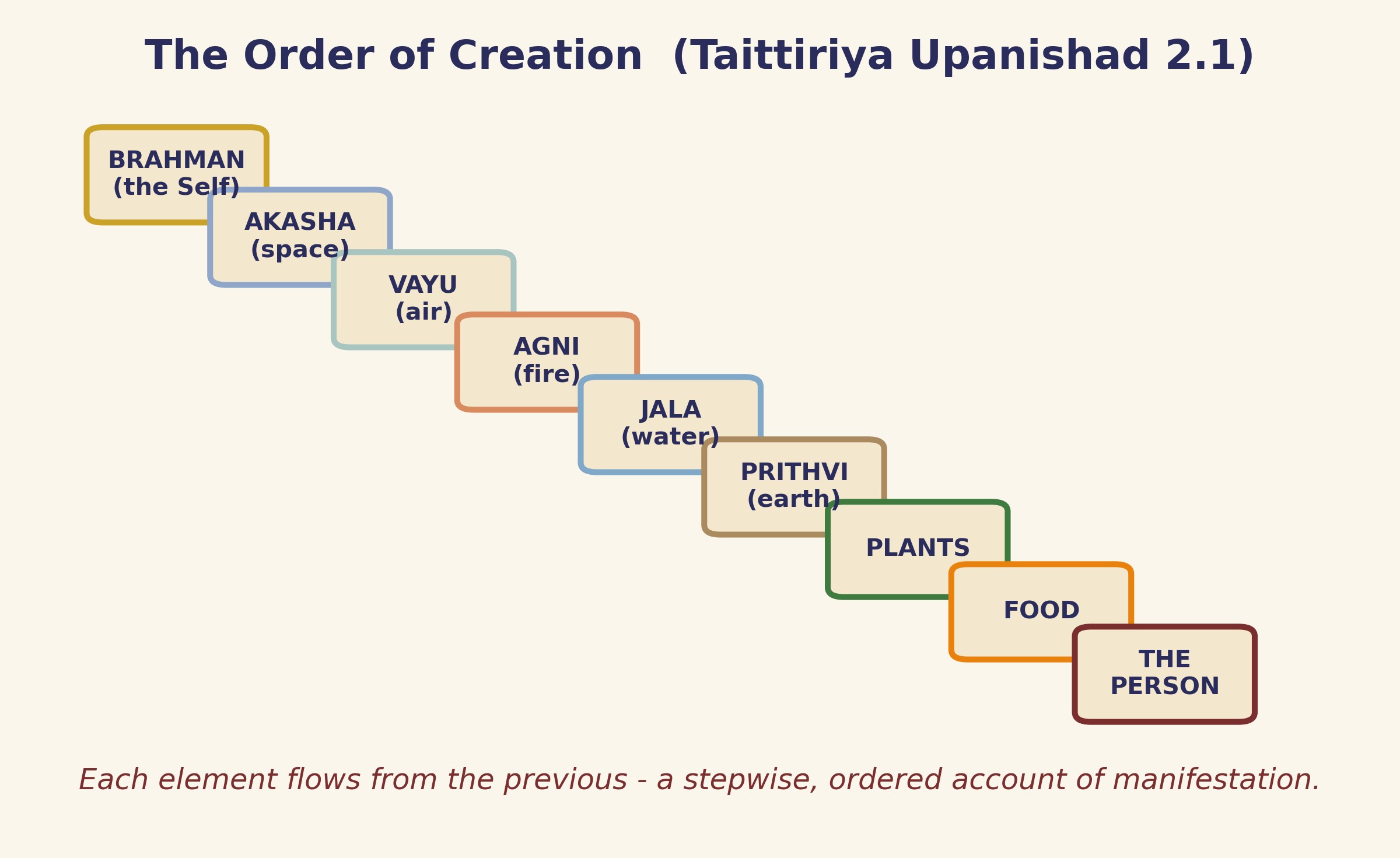
Observe the character of this account: it is ordered, gradual, and moves from subtle (space) to gross (earth), then up through life (plants, food) to the human person. The Puranas fill in the account with the cosmic mind, the senses, the devas, the rishis, and the living kingdoms. Whatever one’s view of its literal truth, it is a graded unfolding — not a magic trick — and that habit of thinking in ordered stages is a genuinely science-friendly instinct.
From the pages of history: the sky-watchers
The tradition did not only imagine the heavens; it measured them. In 499 CE the astronomer Aryabhata — twenty-three years old — set down a treatise proposing that the earth rotates on its axis, giving remarkably accurate values for pi and the length of the year, and eclipse-prediction methods that worked. Brahmagupta after him wrote the rules for calculating with zero, treating nothing as a number, one of the strangest and greatest leaps in human thought. The jyotisha tradition kept calendars precise enough to schedule rituals to the hour across centuries. None of this proves the yuga numbers of the Puranas — the honest note above stands — but it tells you the civilization that imagined kalpas also produced working astronomers of the first rank, and saw no conflict in doing both. Reverence upstairs, mathematics downstairs, one house.
The ten descents — and a famous resonance, held honestly
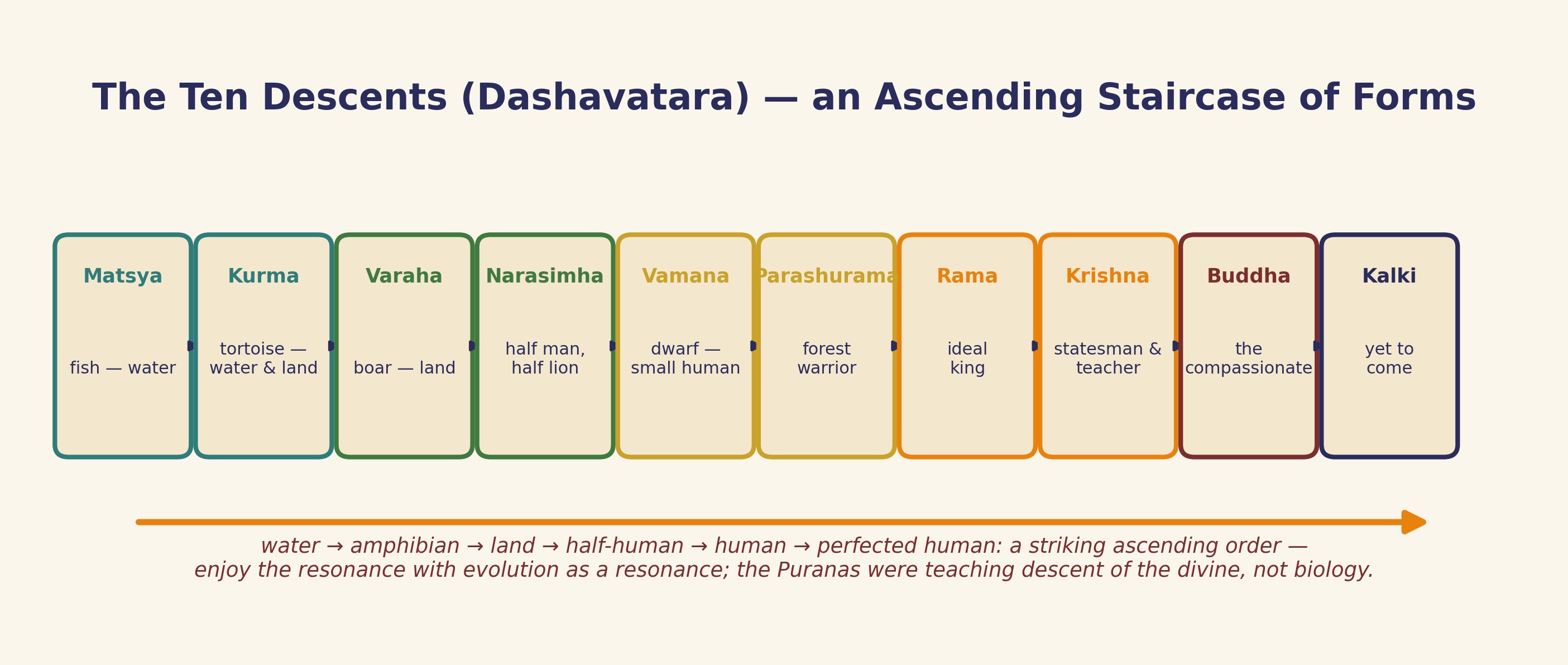
One Puranic sequence belongs in this chapter because you will certainly meet it in debates: the Dashavatara, the ten descents of Vishnu, in their traditional order, Matsya the fish, Kurma the tortoise (at home in water and on land), Varaha the boar, Narasimha the man-lion, Vamana the dwarf-human, then Parashurama, Rama, Krishna, Buddha, and the yet-to-come Kalki. Read the staircase: aquatic life, amphibian, land mammal, half-animal-half-man, small human, and then ascending grades of humanity toward the perfected. Nineteenth-century readers — including some startled Western scholars — noticed at once how strikingly the order tracks the broad arc of evolutionary ascent, composed many centuries before Darwin. Now apply this book’s discipline, because this is a perfect training example. What the sequence is: a genuinely remarkable resonance. The tradition’s imagination once again running in a strangely modern order, worth telling anyone. What it is not: a biology textbook. The Puranas were teaching the descent of the divine into the world’s ascending forms, not natural selection, and turning the resonance into a proof would only hand your challenger an easy win. Say it the honest way, ‘my tradition imagined the divine entering the world through an ascending staircase of forms, and the staircase happens to climb in the right order; make of that what you will’. And you will find it lands harder than any overclaim ever could.
The Debate Hall
“If time is a wheel and everything repeats,” the challenger shrugs, “why try at anything? Cyclic time makes effort meaningless.”
The reply
Tell that to a farmer. Seasons are cyclic too. And no farmer concludes that sowing is pointless because spring will come again; the cycle is precisely why his timing and effort matter. Within every turn of the great wheel, the law of karma runs at full strength: your choices compound, your practice accumulates, your jivatma advances or drifts. The cycles change the container, not the stakes. If anything, the wheel is kinder to effort than the arrow: in a one-shot cosmos, a ruined life is simply ruined; on the wheel, no sincere effort is ever lost (Gita 2.40). The account carries forward. From its cosmology this tradition derived neither despair nor complacency. It derived patience.
The wheel of time
Time, in this tradition, is cyclical, a wheel, not an arrow with one throw. The units nest like boxes: four yugas (Satya, Treta, Dvapara, Kali) make one Mahayuga of 4.32 million years; 71 Mahayugas make one Manvantara, the reign of one Manu, each with its own council of Saptarishis who guide that era; 14 Manvantaras make one Kalpa — a single day of Brahma, 4.32 billion years — followed by a night of equal length; and Brahma lives a hundred such years before the whole cycle dissolves and begins again (Vishnu Purana 1.3; echoed in Bhagavad Gita 8.17). Tradition places us in the Shveta-Varaha Kalpa, the seventh (Vaivasvata) Manvantara, its 28th Mahayuga, in the Kali yuga, deep inside a vast, turning wheel.
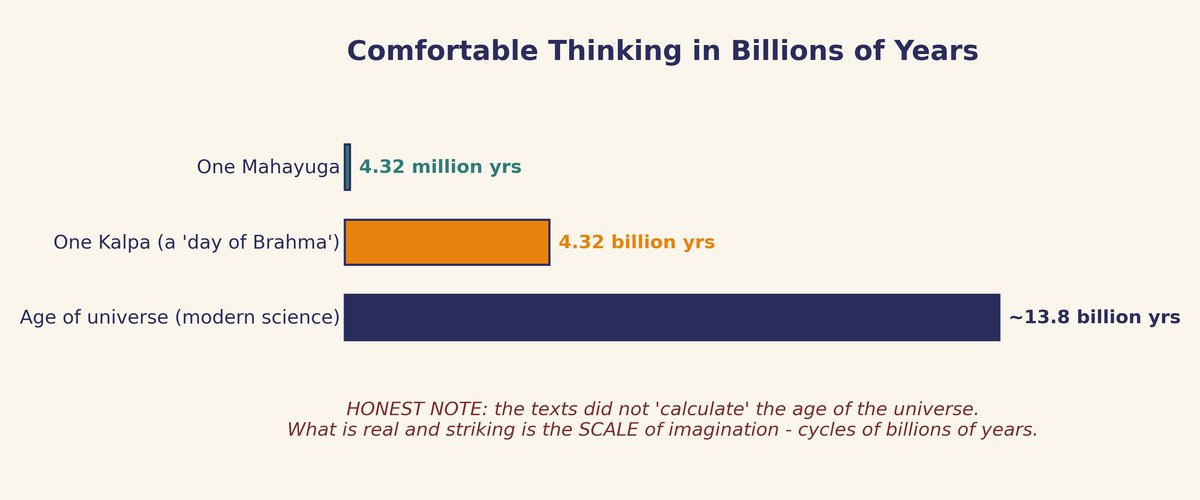
The honest point, read it twice. The texts did not “calculate the age of the universe”; the numbers are cosmological doctrine, not measurements. What is genuinely striking is the scale of imagination: this tradition was comfortable thinking in billions of years and endless cycles of creation and dissolution at a time when most of the world pictured a small, young, one-time cosmos. I personally didn’t buy into the yuga cycles theory but admire the true thing — the vastness of the vision — and never stretch it into a false thing (“the rishis knew modern cosmology”). The true thing is impressive enough.
A voice worth knowing here: the astronomer Carl Sagan — no friend of loose claims — observed in Cosmos that Hinduism is the one great ancient tradition whose cosmic time-scales correspond to those of modern scientific cosmology, with cycles running from an ordinary day to a lifetime of Brahma longer than the age of the universe. He was not saying the rishis measured the cosmos; he was saying their imagination was built to the right size. And he said it with respect. Both halves of that sentence let a Hindu stand taller.
Meera’s notebook
- Creation in ordered steps: space → air → fire → water → earth → plants → food → me (Taittiriya 2.1).
- 4 yugas → mahayuga → manvantara → kalpa (a day of Brahma). Scale of imagination, not calculation. Sagan tipped his hat.
- Aryabhata, age 23: earth rotates, pi, working eclipse math. Reverence upstairs, mathematics downstairs.
- Dashavatara: fish → tortoise → boar → half-man → human → perfected. Resonance to enjoy, never a proof to sell.
- Cycles don’t kill effort, ask a farmer. Seasons return; sowing still matters. The wheel teaches patience.
Meera fell asleep on the terrace mat and had to be walked down, half-dreaming of wheels inside wheels. In the morning she announced her conclusion over idlis: “The universe is very big and very old, and I am very small and very stressed about Friday’s exam.” Thatha laughed. “Then tonight’s chapter arrives exactly on time. Your ancestors built an entire technology for the second problem.” ❖
Check your understanding
- Recite the creation order of Taittiriya 2.1 from Self to person.
- Assemble the time-units: 4 yugas = ______; 71 of those = ______; 14 of those = ______ (a day of ______).
- What is the honest way to speak about the kalpa numbers and modern cosmology?
- What is the honest way to present the Dashavatara–evolution resonance?
- Reflect: How does imagining time as a vast wheel — rather than a short line — change how big your problems feel?