
Chapter 6
Devathas and the Fourteen Lokas
The storm arrived properly at dinner, white lightning, the kind that turns the whole sky into a photograph. “Grandma said ‘Indra is busy tonight,’” Meera reported at the lamp, “and my physics book says ‘charge separation in cumulonimbus clouds.’ Thatha, they can’t both be right.” Thatha raised one eyebrow, which she had learned meant the opposite. “Can’t they? Tonight: how one reality wears many faces, what the shining ones can and cannot do for you. And the famous evening a sage was asked, in public, to count the gods.”
One Supreme, many powers
Sanatana Dharma teaches one Supreme reality — Paramatma, Brahman — and many devathas: the shining powers, the energies and functions of the One at work in the cosmos. The sun’s power, the fire’s power, the rain’s power, the wind’s power, each is personified, honored, and related to as a devata. This is not a contradiction of “one truth”; it is its administration. The way white light is one, and a prism shows it as seven colors without adding a single new lamp to the sky. Ask a physicist how many forces there are and watch the same ladder: dozens of everyday forces… reducible to four fundamental interactions… which theory labors to unify into one field. Counting down from many to One, done honestly, is not confusion, in physics or in the Upanishad, it is the signature of understanding. The most striking proof comes from the Upanishad itself, in a famous dialogue where the sage Yajnavalkya is asked how many gods there are. He begins with the ritual count — three hundred and three, and three thousand and three — and then, pressed again and again, reduces it: thirty-three... six... three... two... one and a half... and finally:
“Katama eko deva iti? ... Pranah iti, sa brahma.”“‘Which is the one God?’ ... ‘The life-breath, and that is Brahman.’”, Brihadaranyaka Upanishad 3.9.1–9 (condensed)
Many powers, one source, stated inside the shruti itself. The classical thirty-three are the 8 Vasus (powers of nature), 11 Rudras (powers of life-force), 12 Adityas (powers of the sun through the year), plus the two Ashvins, and the popular phrase “33 koti devas” uses koti in its sense of “categories/types,” though it is often read as “330 million,” a poetic way of saying the divine functions are countless.
The devathas within you
Here is the most beautiful part, straight from the Aitareya Upanishad’s account of creation: the devathas do not only live somewhere far away. They entered the human body and function there. Fire (Agni) became speech and entered the mouth; Wind (Vayu) became breath and entered the nostrils; the Sun (Aditya/Surya) became sight and entered the eyes; the Directions became hearing and entered the ears; and Indra is invoked in the strength of the limbs (Aitareya Upanishad 1.2.4). Every time you see, speak, breathe, or act, the tradition says, the cosmic powers are working through you. Your own body is the first temple.
Why pray to devathas — and what they can and cannot do
The tradition’s teaching is practical: when the devathas are honored, dharma flourishes and nature stays in balance. The rains come, the earth yields, society is healthy. Worship of the devas is one of the five daily gratitudes (Chapter 13). The Vedas and Upanishads describe many upasanas — meditative approaches to the divine, popularly counted as 108 — each suiting a different temperament. And the tradition is refreshingly honest about limits: the devathas can bestow knowledge, protection, and favorable conditions, but they cannot erase your karma, at most its fruit may be delayed. The moral law stands above even the shining ones; your choices remain yours.
The hierarchy, and where to read more
The traditional order runs: Parabrahman / Paramatma, the one source; the Trimurti — Brahma (creation), Vishnu (preservation), Shiva (dissolution) — as the three great cosmic functions; the Loka-palas, the eight guardians of the directions (Indra, Agni, Yama, Nirriti, Varuna, Vayu, Kubera, Ishana); and the hosts of devas. The 33 categories and their countless expressions. For details, the tradition’s richest sources are the Puranas (especially the Vishnu Purana, Bhagavata Purana, and Devi Bhagavata), the Vedic Samhitas for the hymns to each deva, and the Agamas for how each is worshipped in temples.
Two sophistications of this system deserve open admiration. First, the ishta-devata principle: the tradition does not force one form on every temperament, each person may approach the One through the aspect that speaks to their own heart, whether Shiva’s stillness, Devi’s power, Vishnu’s care, or Ganesha’s friendliness. Personalized spirituality, designed into the system from the start, thousands of years before anyone spoke of personalization. Second, ecology: because the devathas are the powers of nature honored as persons. The sun, the rain, the rivers as goddesses, the Earth herself hymned in the Bhu Sukta, reverence for the environment is not an add-on to this tradition; it is its default setting. The modern world is re-learning, under the name ‘sustainability,’ a reverence this civilization institutionalized at its foundation.
The devathas a family keeps close: kula, grama, and ishta
Above we walked the grand hierarchy, from Paramatma down through the Trimurti and the guardians of the directions. But a living tradition is not only cosmic; it is intimate. Ask most Hindu families and you will find that, out of that vast host, three devathas in particular are kept close, each answering a different question about who you are and where you belong. Learning these three is the quickest way to understand how the tradition is actually practiced in a home, not just described in a book.
Your kula-devata is the deity of your kula, your family line, your ancestry. This is the form of the Divine that your forefathers held as the protector of the whole lineage, passed down like a family name, often tied to a specific ancestral temple the family has returned to for generations. You do not choose your kula-devata any more than you choose your surname; you inherit it. Honoring the kula-devata, especially at weddings, namings, and other turning points, is a way of keeping faith with everyone who came before you in the relay of Chapter 4, saying in effect: I know whose line I stand in, and I have not let the lamp go out.
Your grama-devata is the deity of your grama, your village, town, or place. Almost every traditional settlement in India has a presiding devata (very often a form of the Mother, the Devi) who is felt to guard that particular soil, its harvest, its health, and its people. Where the kula-devata answers ‘whose family am I?’, the grama-devata answers ‘what land holds me?’, binding a whole community together around a shared protector and a shared festival, so that a place is never merely a place but a household of neighbours under one divine roof.
And your ishta-devata is the deity of your own heart, ishta means ‘cherished’ or ‘chosen.’ This is the one tier you select for yourself: the form of the One that most naturally draws your love and devotion, whether Rama or Krishna, Shiva or Devi, Ganesha or Hanuman, Murugan or your own family’s beloved form. It may match your kula-devata or it may not; the tradition leaves it gloriously free, because it trusts that different hearts are moved by different faces of the same infinite reality (recall the ishta-devata principle above, and the adhikari-bheda of Chapter 2). Your ishta-devata is who you turn to first in a hard moment. The personal doorway through which the whole of the Divine becomes near.
See the quiet brilliance of the three together: the kula-devata roots you in your ancestry, the grama-devata roots you in your place, and the ishta-devata roots you in your own heart, lineage, land, and love, each given a face. One tradition, three anchors, and a child who knows all three grows up knowing exactly who they are, where they stand, and whom they love, without ever being told the One behind all three is anything less than One.
Reading the forms: iconography is a language
“Thatha, why does Ganesha have an elephant’s head? Honestly?” Meera asked it half-wincing, braced for a story she’d have to defend at school. Thatha’s answer surprised her: “Wrong question first. Ask instead: what does the form say? Every murti is a sentence, Meera, written in a visual alphabet. Tonight I teach you to read.”
Take Ganesha and read him as a composition. The great head: think big, wisdom outsized. The small eyes: concentrate, see fine detail. The vast ears and the small mouth: listen much, speak little, advice every teacher on earth gives, here cast in form. The trunk, strong enough to uproot a tree and precise enough to lift a needle: adaptable power. The large belly: digest everything life serves, sweet and bitter. The mouse at his feet: desire - small, quick and ridden. The remover of obstacles is himself a diagram of how obstacles are removed. Read Saraswati the same way: seated on a white lotus (purity rising from the mud of the world), the veena in her hands (knowledge must be practiced, like music, not merely owned), a book and a japa-mala (learning and contemplation, both), the swan at her feet, which in legend can separate milk from water: discrimination, the scientist’s own virtue, as the vehicle of the goddess of learning.
Pick one murti or picture in your own home and decode it like a sentence: list every element — posture, hands, objects, vehicle, expression — and ask what each SAYS. Check your reading with an elder, then teach it to someone younger. You now read a language most people only look at.
The fourteen lokas
The Puranas picture the universe as the Brahmanda — the “cosmic egg” — with fourteen lokas, levels of existence. Earth (Bhu-loka) sits in the middle; six lokas rise above (Bhuvar, Svar, Mahar, Jana, Tapa, Satya. The higher ones the dwelling of devas and sages), and seven descend below (Atala down to Patala). A sincere devotee, the tradition teaches, can rise after this life to the loka of the devata they worshipped, though all lokas, even the highest, remain within samsara; only self-knowledge carries one beyond the egg altogether.
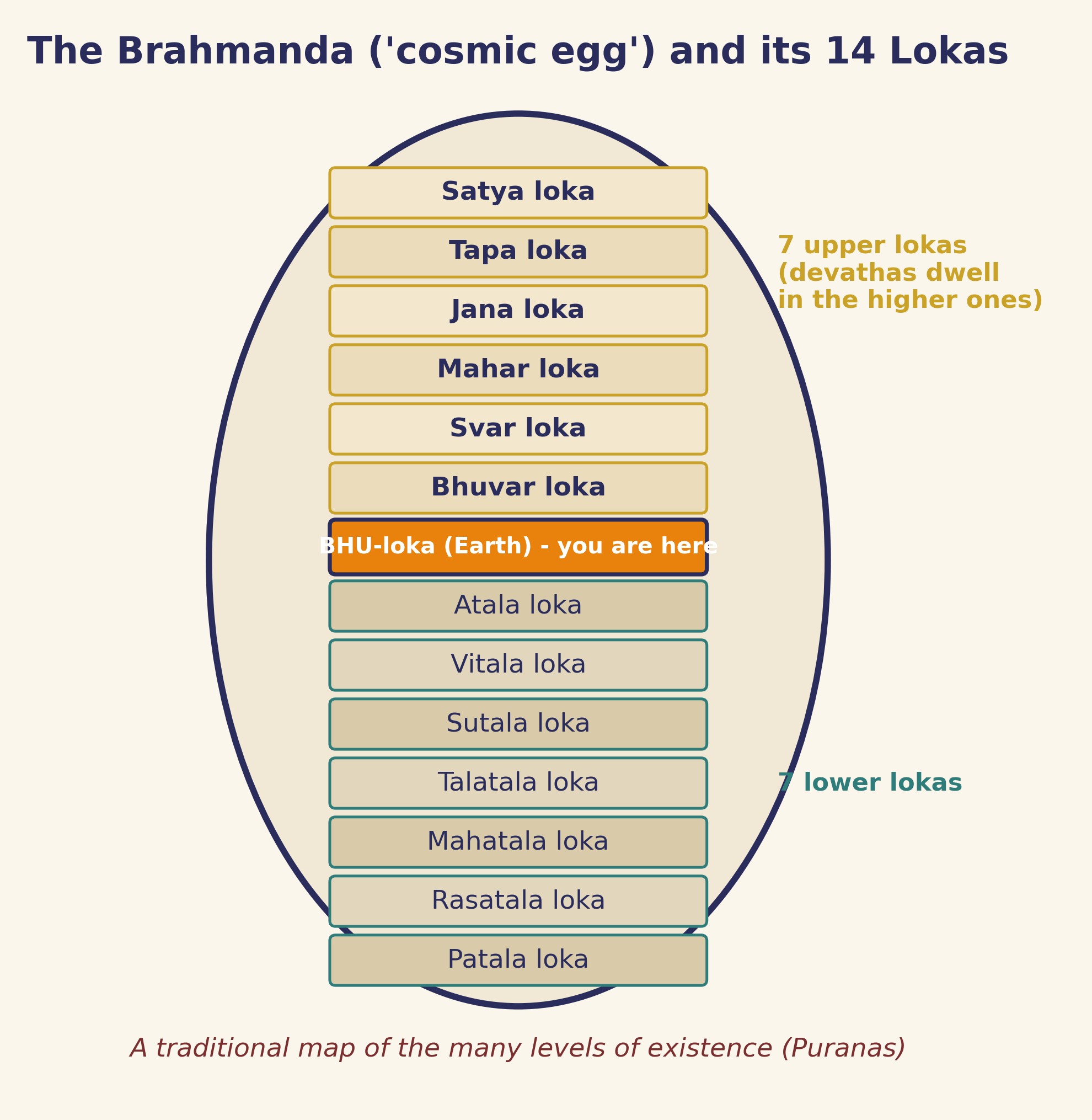
How should a scientific mind hold the lokas? As the tradition’s map of the many levels of existence — a cosmological and contemplative model from the Puranas — not as astronomy that a telescope could photograph. The Puranas themselves layer physical, subtle, and symbolic meanings. You can treasure the map, and the moral geography it teaches (higher living rises, lower living sinks), without confusing it with a NASA chart. The tradition’s deepest voice, the Upanishad, points past all fourteen levels anyway, to the one Self beyond every world.
Tonight, notice one act of seeing, one of speaking, one of breathing. And recall: Surya in the eyes, Agni in the speech, Vayu in the breath. For one minute, treat your own body as the first temple.
Meera’s notebook
- One light, many colors: devathas are the prism of the One. Yajnavalkya counted down to ONE, in public.
- The devas are in me: Surya in the eyes, Agni in speech, Vayu in the breath. My body = first temple.
- Even gods can’t erase karma, the moral law outranks everyone. My choices stay mine.
- Murtis are sentences in a visual language: Ganesha = listen much, speak little, tame the mouse of desire.
- Three devathas a family keeps close: KULA (my ancestry’s deity), GRAMA (my place’s deity), ISHTA (my own heart’s chosen one). Lineage, land, love, three anchors, still One behind them.
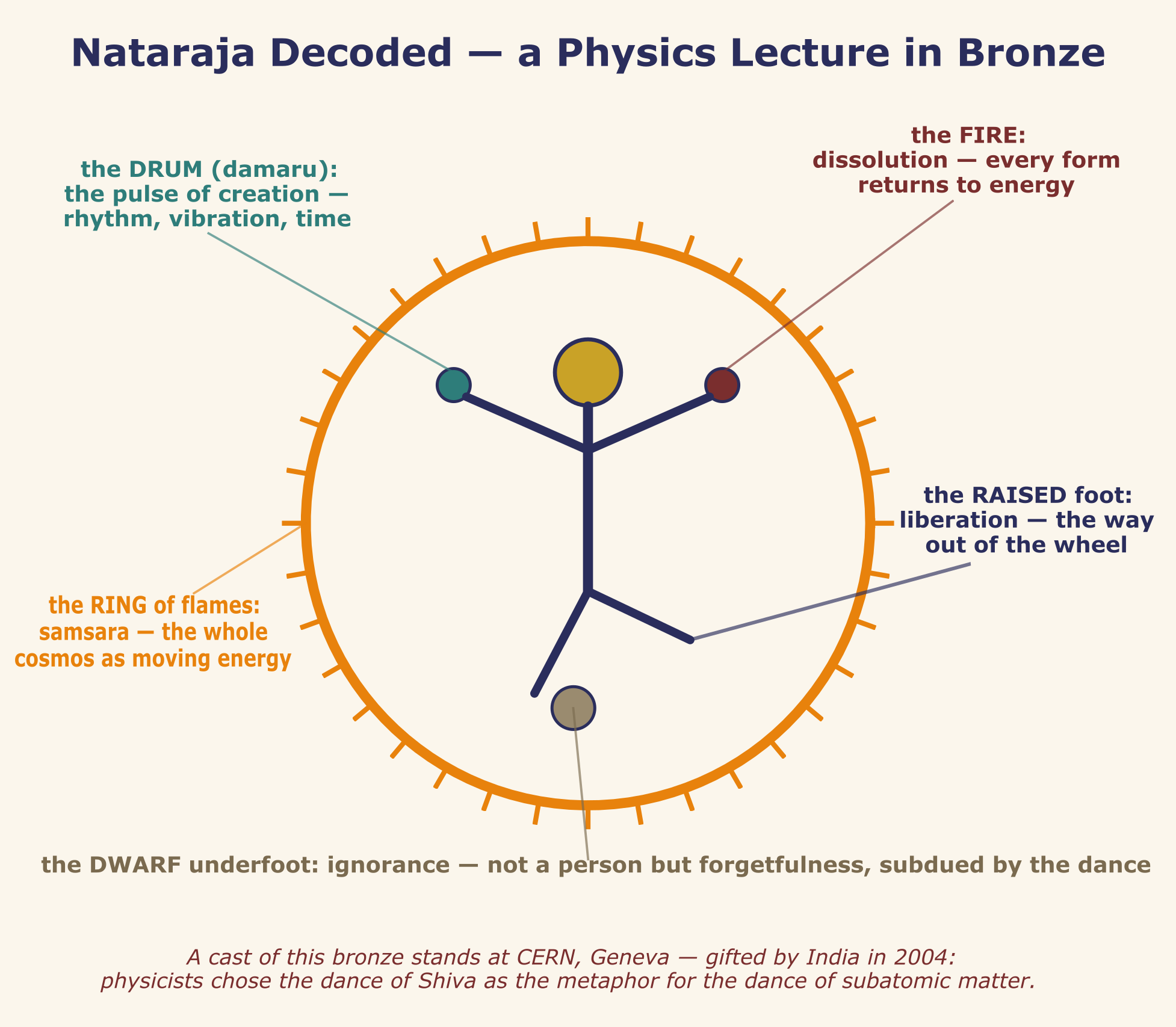
- Nataraja: drum = creation, fire = dissolution, ring = the dancing cosmos, raised foot = the way out, hand = fear not.
- A Nataraja stands at CERN. The physicists chose OUR image for the dance of matter.
The storm had moved on; the air smelled washed. “So Grandma and the physics book are describing the same lightning from two windows,” Meera said slowly, testing the weight of it. Thatha nodded. “And tomorrow we open the biggest window of all. And look at where everything, gods and clouds and granddaughters, came from, and how long the whole show has been running.” ❖
There is no beginning or it began with big bang? Stay curious!
Check your understanding
- In Yajnavalkya’s dialogue, the count of gods ends at what number, and what does that teach?
- Name three devathas and where the Aitareya Upanishad says they function in your body.
- What can devathas give, and what can they not remove?
- Name the three devathas a family keeps close, kula, grama, and ishta, and what each one roots you in.
- How many lokas are there, and where does Earth sit?
- Decode two elements of the Nataraja image.
- What stands at CERN, and why did physicists choose it?
- Reflect: Why might it be wise for a tradition to say even the gods cannot erase your karma?