
Chapter 5
Core Concepts: Jivatma, Karma, and the Goals of Life
On the morning walk Meera found a snake’s skin by the compound wall, papery, complete, and empty. “It died?” she asked, keeping a careful distance. Thatha picked it up and held it to the light so the sun shone through the scales and “It moved out. The snake that wore this is somewhere in the hedge right now, wearing a newer one. Tonight I will show you the oldest idea your ancestors ever tested, that you and I do exactly the same thing, only more slowly, and with better luggage.”
5.1 The wheel of life and death
Start with something you already know. Everything around you that is born also dies. The leaf, the sparrow, the tree, and one day even the stars. Now hold the question the rishis refused to put down: when the body stops, does the person who lived in it stop too?
The tradition begins its answer with an observation you can repeat tonight. Every night in deep sleep you disappear completely, no thoughts, no dreams, no “me.” And every morning someone wakes up who remembers being you. Something crossed the gap. The rishis reasoned: what carries you through the small nightly gap also carries you through the larger one. The body is a garment; the wearer is not stitched into it.
“Na jayate mriyate va kadachit…”
“The Self is never born and never dies… it is not slain when the body is slain.”
, Bhagavad Gita 2.20
“Vasamsi jirnani yatha vihaya…”
“As a person discards worn-out clothes and puts on new ones, so the Self discards worn-out bodies.”
, Bhagavad Gita 2.22
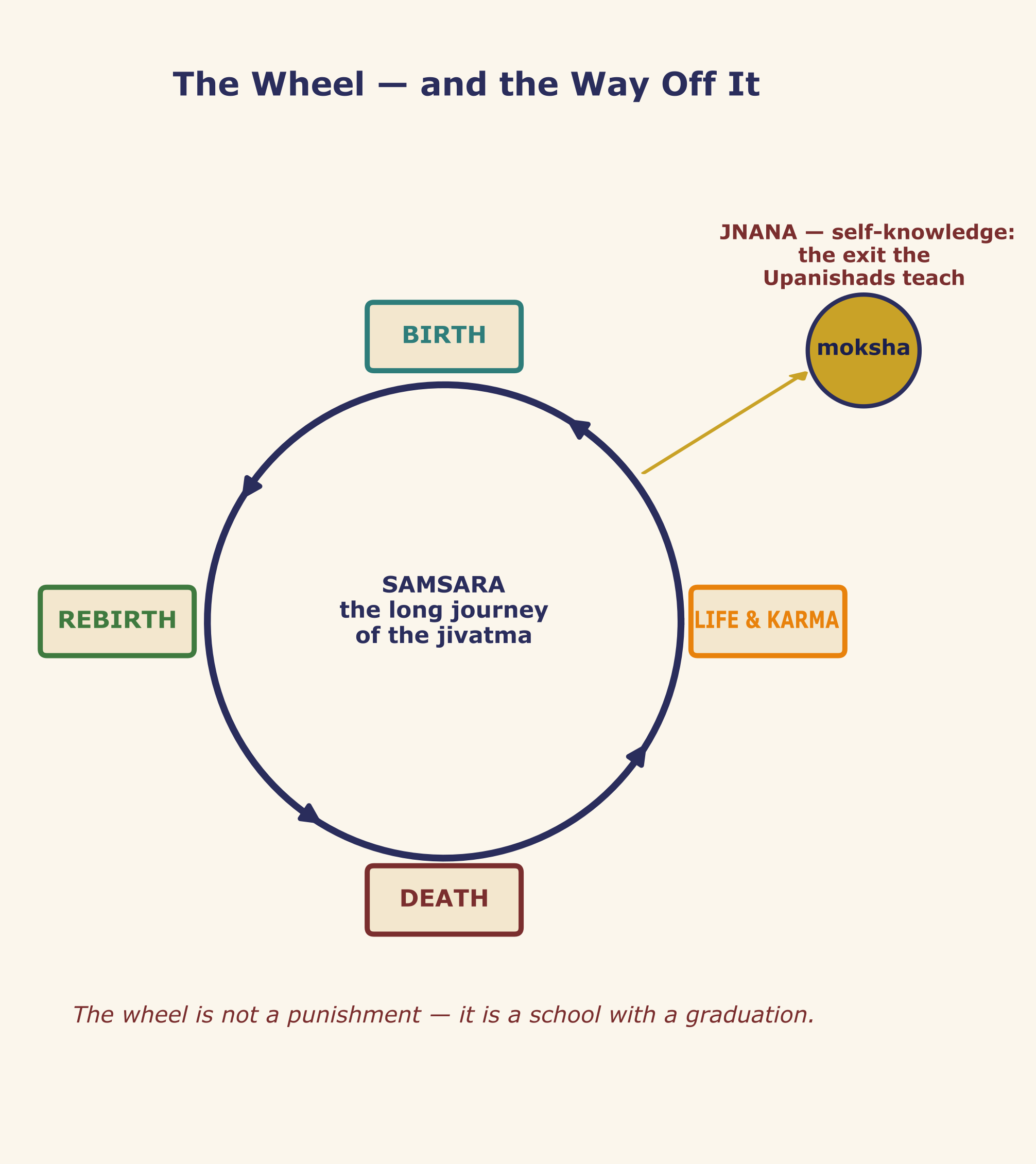
This long journey of the Self through many bodies — birth, life, death, birth again — is called samsara, and the tradition pictures it as a wheel. But look carefully at the picture: the wheel has an exit. The cycle is not a trap built to punish you; it is a school built to finish you. Graduation is called moksha, and the door out is jnana — self-knowledge — which is exactly the knowledge this chapter starts assembling.
5.2 The atma takes a body
When the Self, the atma, is wearing a body, the tradition gives it a special name: jivatma, the embodied self. The snake in the hedge and the skin on the wall, in one word.
But how does the atma take a body? Not at random. Between bodies, the tradition says, a subtle carrier travels with it, the sukshma sharira, holding the mind, the tendencies, and the unfinished account of past action. This bundle draws the jivatma toward the birth that fits what it carries: this womb, this family, this era. Like water, which is one and the same everywhere yet takes the shape of every vessel that receives it, the one Self takes the shape of each body it enters.
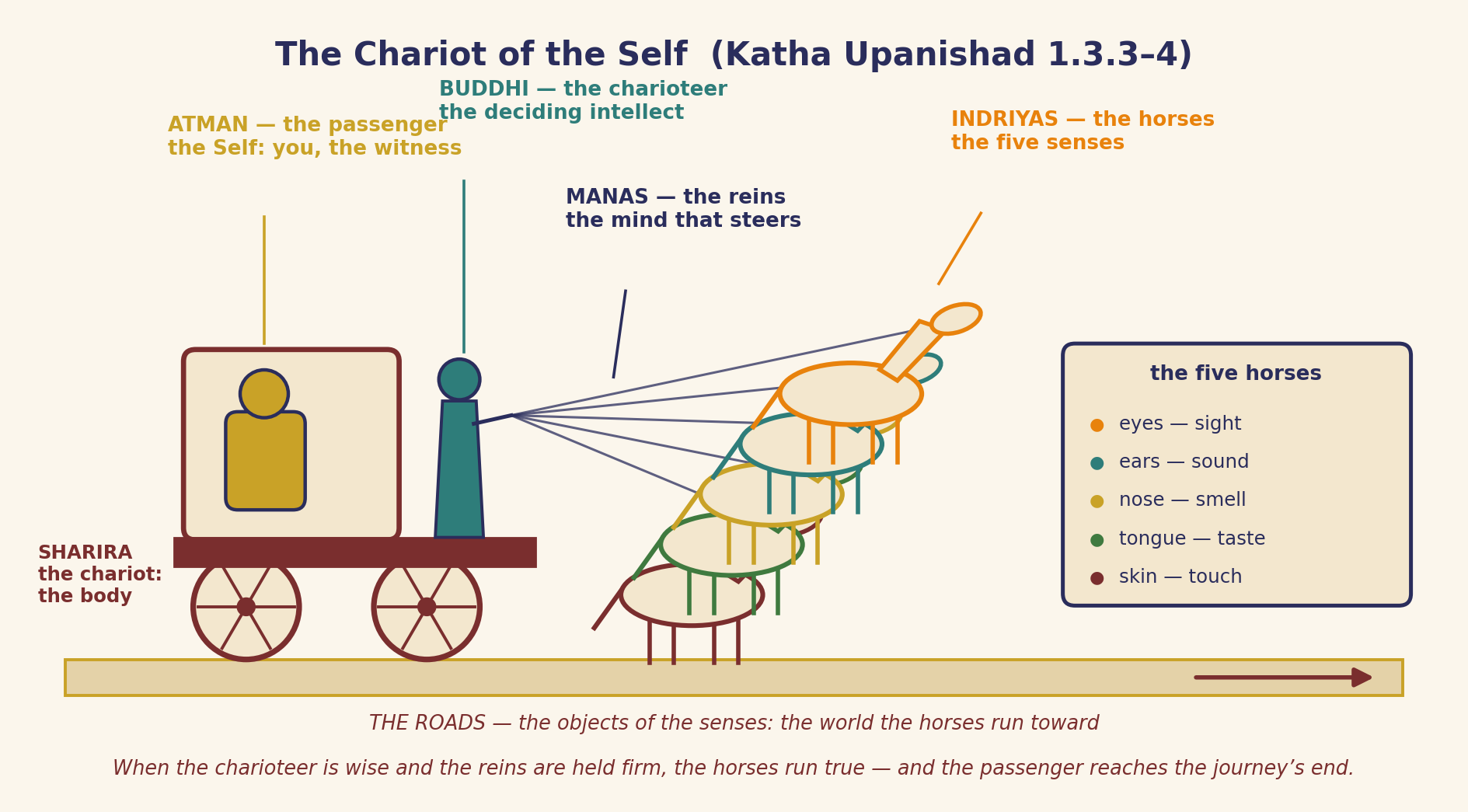
Once embodied, the person works like a well-designed vehicle, and the tradition analyzed the machinery with real precision. The inner instrument, antahkarana, has four aspects: manas, the mind that receives sensations and feels; buddhi, the intellect that weighs and decides; chitta, the memory-store; and ahamkara, the “I-maker” that stamps everything as me and mine. Behind all four shines the Atman, the pure witness. The Katha Upanishad packs this entire psychology into one unforgettable image:
“Atmanam rathinam viddhi, shariram ratham eva tu…”
“Know the Self as the rider of the chariot, the body as the chariot itself; know the intellect as the charioteer, and the mind as the reins. The senses, they say, are the horses; the objects of the senses are the roads.”
, Katha Upanishad 1.3.3–4
5.3 More than the body: the five koshas
Now run a small experiment on your own speech. You say “my hand,” “my breath,” “my thoughts,” “my understanding.” If you observe carefully, the word “my” is doing important work. Whatever you can call mine, you are standing slightly behind it. The owner is never the property. We are not just the physical body; observe closely, and you find that “you” comes in layers, each one subtler than the last, each one watched by something behind it.
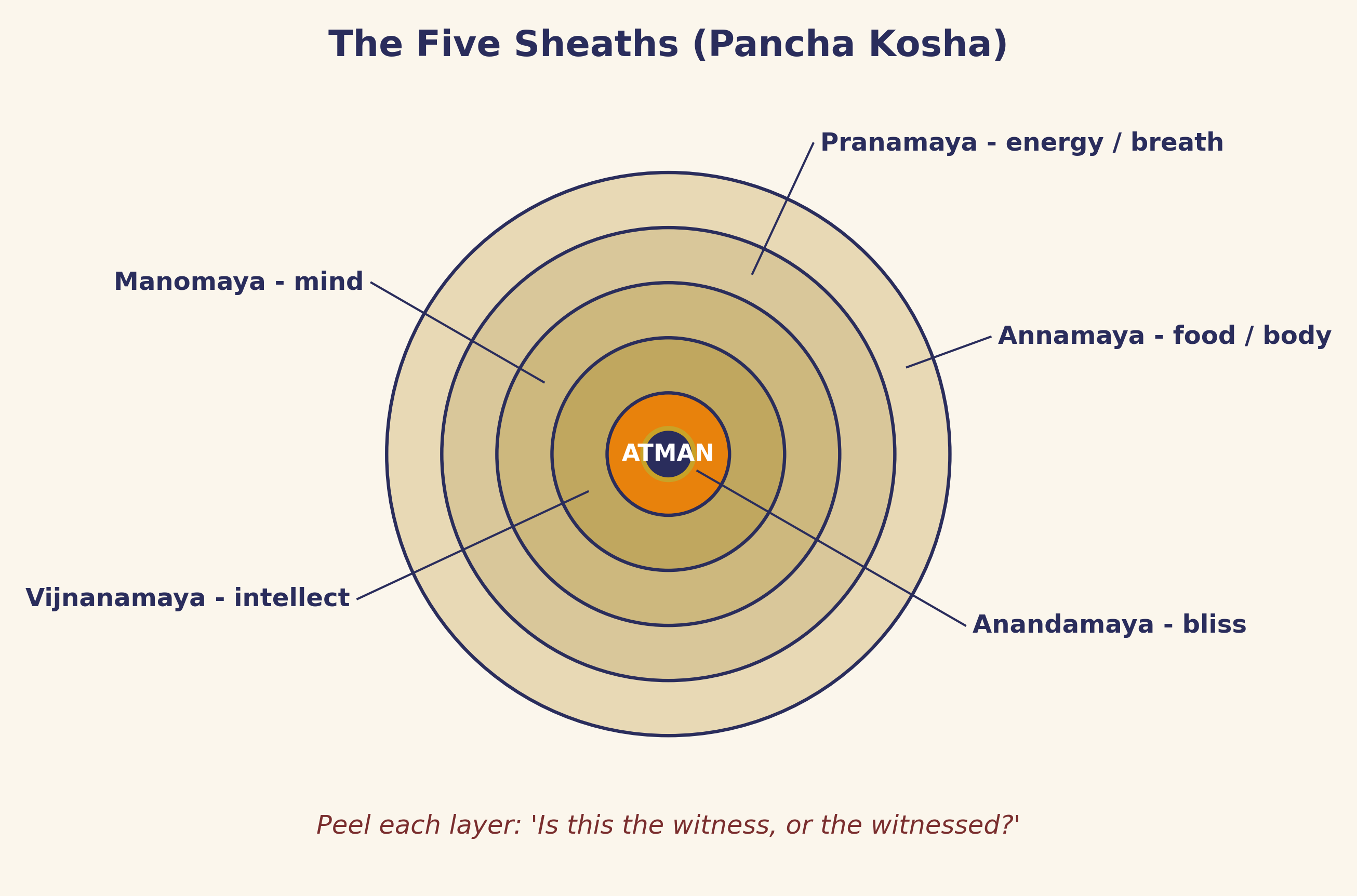
This map has a precise origin. It comes from the Taittiriya Upanishad (Brahmananda Valli, 2.1–5), one of the oldest systematic analyses of a human being ever recorded. And the Upanishad tells us how the map was discovered. The boy Bhrigu goes to his father, the sage Varuna, and asks to be taught Brahman. The ultimate reality. Varuna does not lecture; he gives a method: “Seek it through tapas, disciplined inquiry.” Bhrigu investigates and concludes: food is the ultimate, everything is born from food, lives by food, returns to food. He reports back. Varuna sends him to look deeper. Bhrigu finds prana. The life-energy. Deeper still: mind. Deeper: understanding. Deeper: bliss. Five layers, each discovered by refusing to stop at the previous one. That is the purpose of the kosha map: it is not an anatomy chart. It is a research method, perhaps the first recorded program of introspective science: peel a layer, ask “am I this?”, and go deeper.
Here are the five, in Bhrigu’s order. Annamaya kosha, the food body: built and rebuilt entirely from what you eat; if you were only this layer, which version of it would be the real you? Pranamaya kosha, the energy body: breath, hunger, circulation, healing, the difference between anatomy and a living being. Manomaya kosha, the mind layer: thoughts, emotions, likes and dislikes, changing weather that shifts faster than the body ever could. Vijnanamaya kosha, the knowing layer: the intellect that understands, judges, and decides, the one that watches the mind’s weather and says “this is just a mood.” And anandamaya kosha, the bliss layer: the deep peace of dreamless sleep, no objects, no thoughts, and yet you wake and say “I slept happily.” Someone enjoyed that peace. Who?
Behind all five stands the answer to that question: the Atman, not a sixth layer, but the witness in whose light all five layers appear. The koshas are the clothing; the Atman is the wearer. The snake, and the skin.
“Annad vai prajah prajayante…”
“From food, truly, are all creatures born; by food they live, and into food they return.”
, Taittiriya Upanishad 2.2
, a two-minute experiment
Take the layer tour. Pinch your arm, that is annamaya. Hold your breath ten seconds and feel the pressure build, pranamaya. Watch the next thought arrive uninvited, manomaya. Notice that you just judged that thought as silly or fine, vijnanamaya. Now recall how good deep sleep felt last night, anandamaya. At every step, ask one question: am I this, or am I the one noticing this? You have just repeated Bhrigu’s experiment.
, where the map ends and the claim begins
The koshas are a teaching map, not organs a scanner will find, no surgeon has ever excised a manomaya kosha. But notice what the map actually claims: that a human being can be studied layer by layer, from the gross to the subtle, by disciplined observation. Modern psychology’s own layers — body, affect, cognition, metacognition — rhyme with it remarkably well. Take the method seriously; hold the diagram lightly.
5.4 The gunas — three states of being
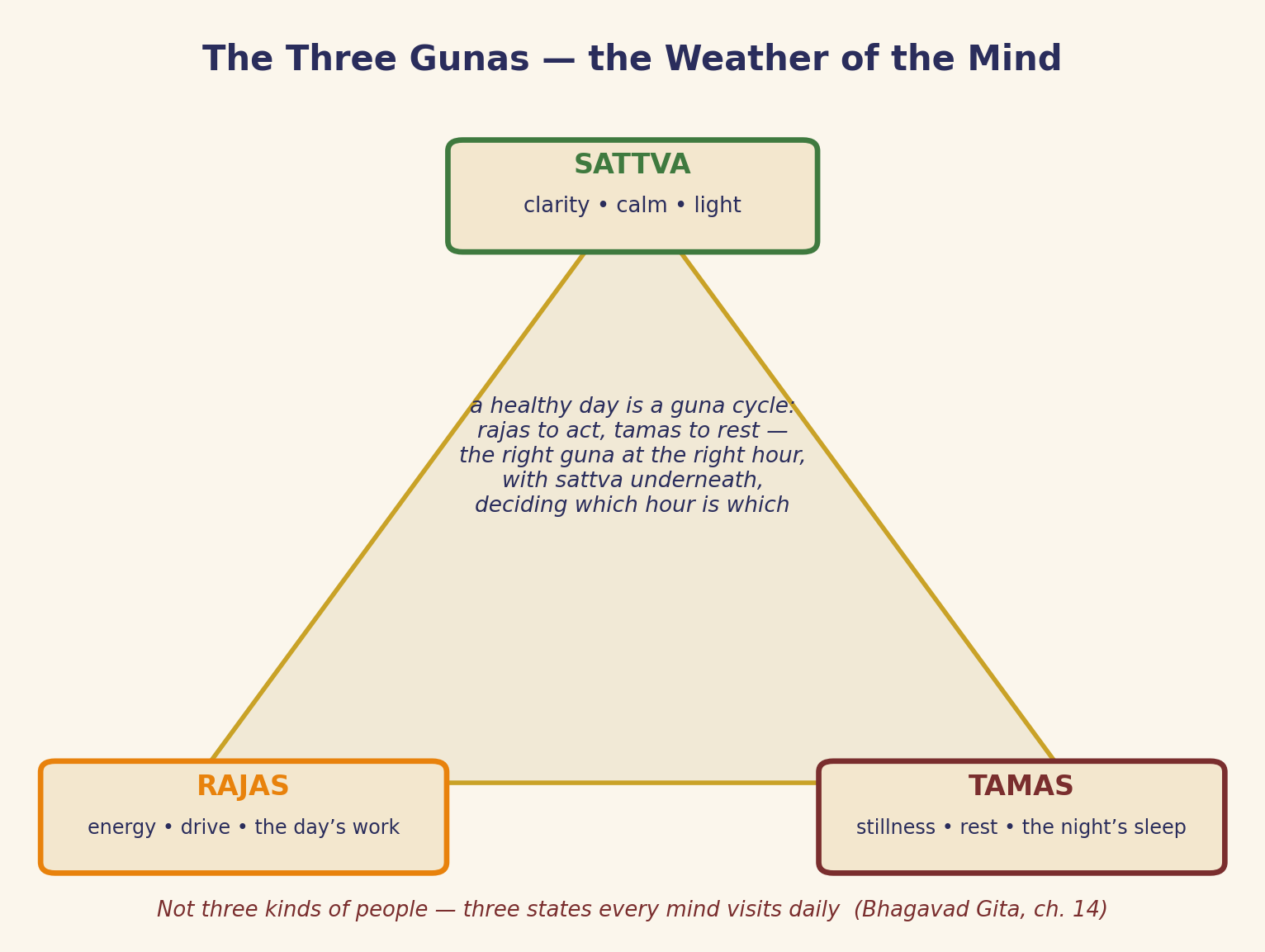
If the koshas are the layers, what are the layers woven from? The tradition’s answer: prakriti — nature — which everywhere expresses itself in three strands, the gunas. Sattva: clarity, calm, light. Rajas: energy, motion, drive. Tamas: heaviness, stillness, rest. These are not three kinds of people. They are three states of being, and every mind visits all three every single day.
Now correct the mistake almost everyone makes on first meeting them. It is tempting to rank the three — sattva good, rajas suspect, tamas bad — and conclude that a spiritual person should aim at sattva alone. But sattva alone does not move the world. Without rajas, nothing is cooked, built, defended, healed, or even carried to the table; without tamas, nothing digests, recovers, or sleeps. Rajas and tamas are not the enemies of life. They are life’s engine and life’s brake, and no vehicle runs on clarity alone.
Your own body already proves this, on a schedule science can measure. Modern biology calls it the circadian rhythm; the tradition would recognize it instantly as guna-time. The morning’s quiet clarity is sattva. The day’s push of energy and work is rajas doing its proper job. The night’s shutdown into sleep is tamas doing its proper job, sleep is not a failure of alertness; it is tamas on duty, at the correct hour. The art the Gita teaches is therefore not the abolition of two gunas but timing: the right guna at the right hour, with sattva always underneath, as the quiet supervisor that decides which hour is which. The surgeon’s intense drive at ten in the morning and her deep sleep at ten at night are both, in this sense, sattvic decisions.
“Sattvam rajas tama iti gunah prakriti-sambhavah…”
“Sattva, rajas, and tamas, these gunas, born of prakriti, bind the imperishable dweller within the body.”
, Bhagavad Gita 14.5
“Yuktahara-viharasya, yukta-cheshtasya karmasu, yukta-svapnavabodhasya…”
“For one measured in food and recreation, measured in effort and action, measured in sleep and waking, yoga becomes the destroyer of sorrow.”
, Bhagavad Gita 6.17
The Debate Hall
“If sattva is the highest guna, then surely a perfected person should be one hundred percent sattva, always serene, never fired up, never asleep past sunrise.”
The reply
The Gita itself refuses that picture. Its hero is not put to sleep by wisdom, Krishna spends eighteen chapters sending Arjuna into rajas-filled action, and the same text praises regulated sleep and measured effort (6.17). It even warns that sattva, clung to, binds. The golden chain is still a chain (14.6). The ideal is not a sattva statue; it is a jivatma that deploys each guna at its proper hour and is enslaved by none, and finally, says Krishna, goes beyond all three: gunatita (14.22–25). Until that day, the working rule stands: rajas for the day’s work, tamas for the night’s rest, sattva holding the roster.
5.5 Karma — the law of stored impressions
Karma literally means “action.” But the law of karma is really about what actions leave behind. Walk across a lawn once and the grass springs back, no trace. Walk the same line every day for a year and you have made a path: now your own feet find it without asking. The mind is that lawn. Every action, and every intention behind an action, leaves a faint impression. The tradition calls it a samskara. Repeat the action and the impression deepens into a groove, a vasana, a tendency. Enough grooves, and you have what everyone calls a character: the map of paths a person walks without noticing they are choosing.
Now widen the lens, because the tradition makes a larger claim. The account book does not open at birth and close at death. The subtle body — the same carrier from section 5.2 — transports the stored impressions from life to life. Karma, in the full teaching, is stored impressions from several lives, not merely this one’s. This, the tradition says, is why children arrive already different, with talents no one taught them and fears no one gave them: the luggage came with the traveler.
The stored account has three tenses, and the tradition explains them with an archer. Sanchita karma is the full quiver, everything gathered across many lives, waiting. Prarabdha karma is the arrow already in flight. The portion allotted to this life: this body, this family, this era; no archer can recall an arrow mid-air, which is why some circumstances simply must be lived through. And agami karma is the arrow on the string right now, not yet released, entirely in your hands.
That third arrow is where free will lives, and the tradition is emphatic about it. The circumstances you were born into may be the fruit of old karma; what you do inside those circumstances is free will. And it writes the next chapter. You are never merely a passenger of your past; the pen is in your hand now. The Gita compresses this into the most practical sentence in the whole book:
“Karmany evadhikaras te ma phaleshu kadachana.”
“You have a right to your action alone, never to its fruits.”
, Bhagavad Gita 2.47
Control what is yours, effort, method, intention. Release what was never yours. The outcome, which depends on a thousand causes beyond you. And note the quiet privilege in the teaching: human birth is the precious doorway, because only here, with developed free will, can the jivatma consciously choose which arrows to shoot, and consciously turn toward the exit on the wheel.
, where the map ends and the claim begins
Karma across lifetimes is a claim no laboratory can currently test. But the near end of the law is measurable, and modern neuroscience has measured it: repeated actions physically rewire the brain — the field calls it neuroplasticity — and habits observably harden into character within a single life. The tradition watched that verifiable law operate, and extended it past the horizon of birth and death. You need not accept the far end tonight; take the verifiable end into the laboratory of your own habits, and see whether the law holds where you can watch it.
, a two-minute experiment
Pick one small action — ten pushups, one page of reading, one shloka — and do it at the same time every day for two weeks. Watch for one specific change: the effort drops. Around day ten your feet find the path without being told. You are watching, in real time, a samskara deepen into a vasana. Now consider: every habit you already have was once day one of this experiment, whether you were paying attention or not.
5.6 The four goals of life
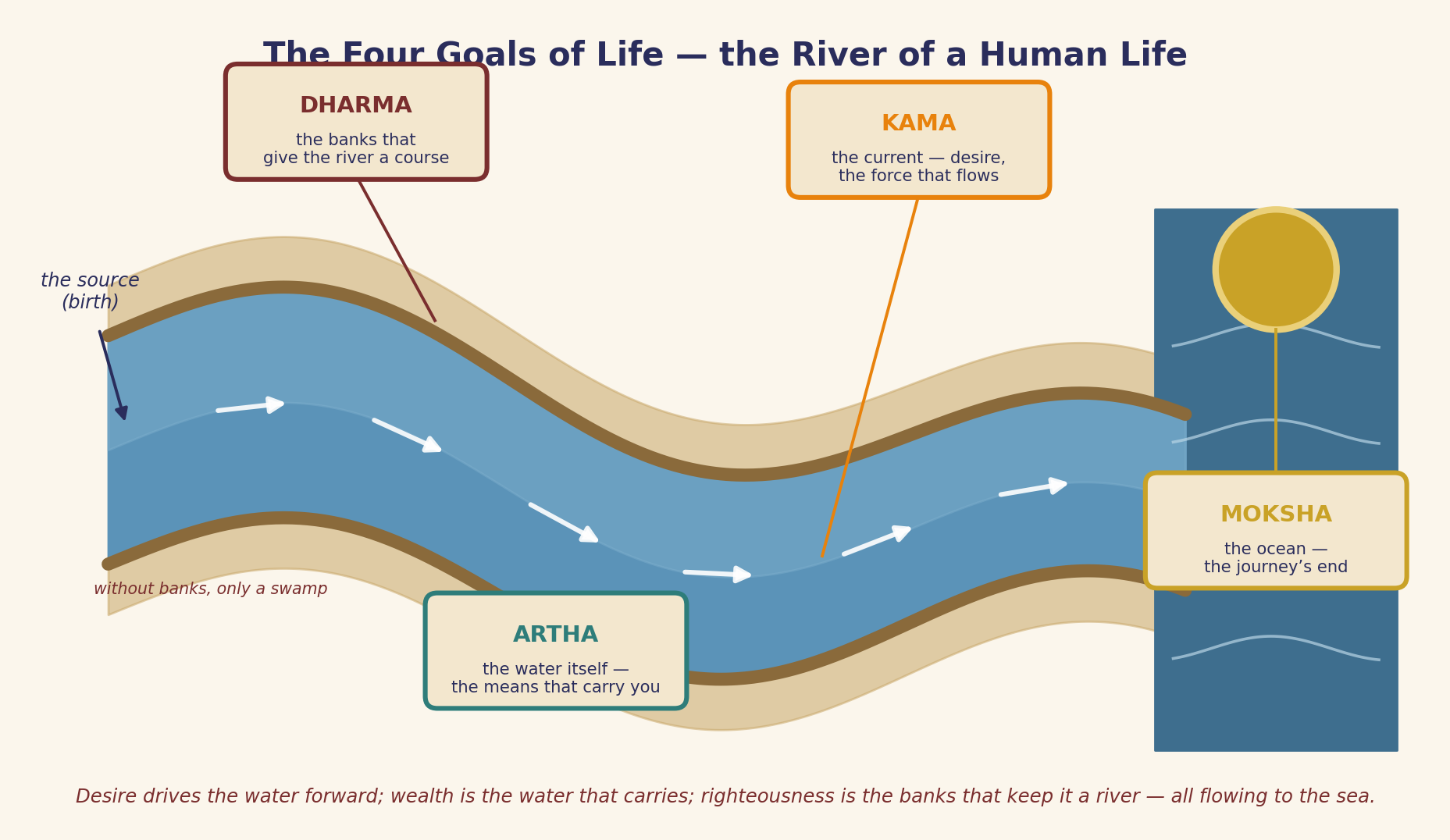
Finally, the tradition answers the question every young person eventually asks: what is a life for? It gives not one answer but four legitimate aims, the purusharthas, and the clearest way to see how they fit together is to picture a river running from birth to the sea.
Kama is desire: the current, the force that makes the water move at all. Artha is wealth and resources: the water itself, the volume that actually carries you somewhere. Dharma is righteousness: the two banks that hold the water to a course, for without banks, moving water is not a river but a flood, spreading everywhere, causing devastation and never reaching its destination. And moksha is liberation: the ocean at the river’s end, the destination every stretch of the current is already heading toward.
What is missing from this picture is important: guilt. Desire and wealth are not sins here, a river needs both its current and its water, or nothing flows. They are honored goals, provided they run between the banks of dharma and keep the sea in view. The tradition welcomes the force and the flow; it simply insists that they stay within the right boundaries and point toward the right destination.
, no right answer, just sit with it
Tonight, as you lie down, try to catch the exact handover, the moment rajas surrenders the day to tamas. You will fail; everyone does. But ask the question anyway: who was supervising the handover?
Meera’s notebook
- The snake didn’t die. It moved out. Gita 2.22 in a single image on the compound wall.
- I am not the layers; I am the one reading them. Five koshas, one reader, Bhrigu found them by refusing to stop.
- Sleep is not laziness. It is tamas on duty at the correct hour, and sattva keeps the duty roster.
- Karma = impressions in storage, some from very old chapters. My habits are paths I am paving for a future me.
- The arrow in flight cannot be recalled. The one on the string is mine.
Meera studied her own hand for a long moment, as if seeing the tenant instead of the house. “So the body is a rented vehicle, the mind has weather, and I arrived with luggage.” “Old luggage,” Thatha agreed, folding the snake skin into his notebook like a pressed leaf. “And the good news of the entire tradition is this: the traveler can repack.” ❖
Is the wheel is a school or is it a punishment?
Check your understanding
- What survives the gap of deep sleep every night, and why does the tradition use this observation to point at what survives death?
- What is the difference between atman and jivatma? What carries the jivatma between bodies?
- In the chariot image, identify the passenger, the charioteer, the reins, the horses, and the roads.
- Name the five koshas in order and say what each is “made of.” In which Upanishad does the map originate, and what method did Bhrigu use to discover it?
- Why can sattva alone not run the world? Explain using the circadian-rhythm comparison. And say what role sattva still plays over the other two gunas.
- Define samskara and vasana. Then explain sanchita, prarabdha, and agami karma using the archer’s image.
- “You have a right to your action alone, never to its fruits.” What does this verse ask you to control, and what does it ask you to release?