
Chapter 4
The Rishis: Our First Grandfathers
The album’s last page had the oldest photograph in the house: a stern man in a turban, Meera’s great-great-grandfather, 1911. “That is as far back as the pictures go,” Thatha said, “but not as far back as the family goes. When the priest asks our gotra at a ceremony and I answer, I am giving the name of a grandfather so far up this line that the album for him would be the size of a library. Tonight I introduce you to him, and to what his generation did for the world.”
Who is a rishi?
A rishi is a seer. The composers of the Vedic hymns are not called authors but mantra-drashta, “seers of the mantra.” A drashta is one who sees something already there. The claim is that the rishis did not invent the truths; they discovered them, the way an astronomer discovers a star that was always shining. Their instrument was the purified mind, sharpened by tapas (disciplined austerity) until it could perceive what an agitated mind cannot:
“Drishyate tv agryaya buddhya sukshmaya sukshma-darshibhih.”“It is seen by a sharp and subtle intellect, by those of subtle vision.”, Katha Upanishad 1.3.12
How the rishis come into the story of creation
In the account given by the Puranas, after Brahma received the Vedic knowledge and brought forth the worlds — earth, plants, animals — he created from his own mind a generation of extraordinary beings. Some were rishis, the mind-born sons (manasa-putras): names like Marichi, Atri, Angiras, Pulastya, Pulaha, Kratu, Vasishta, and Bhrigu appear at the very head of the line. Others were Prajapatis, “lords of progeny” — progenitors like Daksha — whose task was to people the worlds.
These two lines then joined. The rishis wed the daughters of the Prajapatis, and from those unions came the generations that spread across the earth, including, ultimately, humanity. This is why the tradition says, quite literally, that the rishis are our great-great-grandfathers: not distant saints to admire from afar, but the first fathers of our own family line. That is the reason we need to know about them, a person should know their own grandparents.
A day in the forest schools
Come and see what their world was like, because it explains everything after it. An ashram at dawn: cows being milked, the fire-altar tended, and lines of students, princes and potters’ sons side by side, chanting the day’s portion until it sits in the memory like a stone set in a ring. Lessons under trees: grammar, astronomy, medicine, archery, and always the questions behind the questions. Visitors arriving, kings, sometimes, with disputes no court could settle; rival sages, sometimes, with arguments that would run for days while the students listened, learning that disagreement done well is a form of love for the truth. This was the world’s first university system, run on reverence and firewood, and it produced the library of Chapter 3.
The king who became a rishi
And seership was earned, not inherited. The tradition tells the story of Vishvamitra to make sure nobody forgets it. He began as a king, mighty and proud, who tried to seize by force what the rishi Vasishta possessed by tapas. And failed so completely that he understood, in one humiliation, which of the two powers was real. He renounced his throne and undertook austerities so fierce they are said to have shaken the heavens; he stumbled, raged, fell, and began again, age after age of effort, until at last Vasishta himself, his old rival, called him brahmarishi. The man who began by envying a sage ended as the seer of the Gayatri mantra, the most recited verse on earth. Remember that whenever anyone tells you the tradition’s summit is closed or hereditary: its most famous seer clawed his way up, and the mantra millions chant at sunrise is his.
The rishikas: the grandmothers of the line
And the line has grandmothers as well as grandfathers, named, honored, and canonical. The Rig Veda itself credits women among its seers: Lopamudra, Agastya’s wife and a mantra-drashta in her own right; Ghosha, who overcame illness and composed hymns; Vishvavara, Apala, Romasha, the tradition counts a score or more rishikas whose verses sit inside shruti with full authority. Add the philosophers you will meet in Chapter 14 — Gargi, who cross-examined the greatest sage of the age in open court, and Maitreyi, who chose philosophy over property — and the judge you will meet in Chapter 17, Ubhaya Bharati, umpiring the era’s greatest debate. When a challenger declares that ancient traditions silenced women wholesale, you hold a specific, documented answer: this one put women’s words inside its holiest texts and women’s judgment over its greatest arguments. History elsewhere may be what it was; the shruti’s own roster is what it is.
Two more grandfathers deserve their stories. Agastya, honored across the south as a father of Siddha medicine and Tamil learning, is remembered as the sage who crossed the Vindhya mountains southward when others would not. The tradition’s way of recording that knowledge deliberately traveled, binding north and south into one civilization of learning; the mountain, the legend says, bowed to let him pass and awaits his return, still bowed. And Bharadvaja, whose gotra millions carry, is the hero of a teaching every student should hear: granted three full lifetimes to master the Vedas, he spent all three in study. And was then shown three mountains of what remained, with a handful taken from each: this much have you learned. Even the greatest scholar of the line was taught that knowledge is an ocean and humility is the swimmer’s stroke. A family that tells that story about its own founder is a family that will never confuse learning with arrogance.
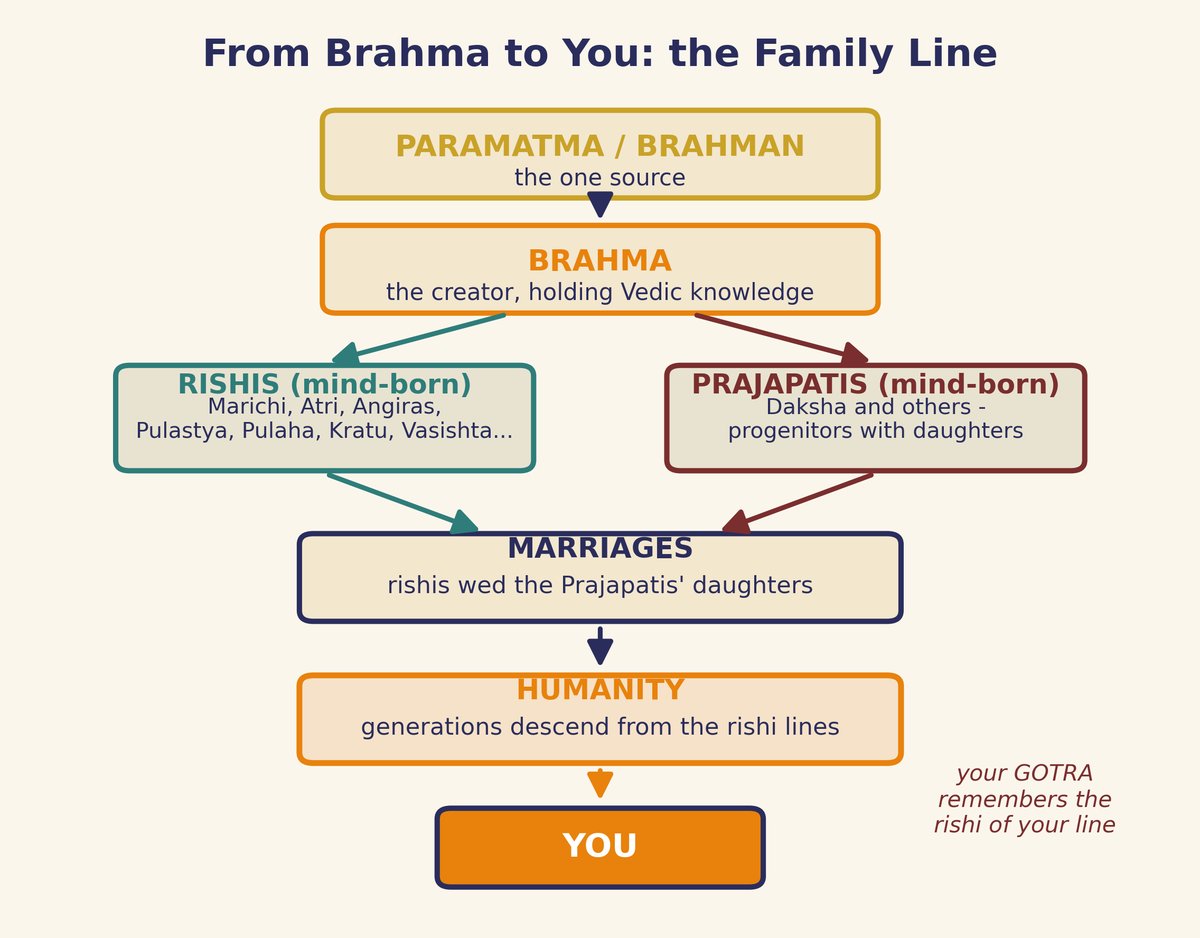
The roots of our line — and the gotra system
The tradition preserves this family memory in a living institution: the gotra. To this day, millions of Hindu families carry the name of the rishi at the head of their paternal line, Atreya (from Atri), Angirasa (from Angiras), Bharadvaja, Kashyapa, Vasishta, Kaushika (from Vishvamitra), Gautama, and many more. When a family recites its gotra in a ceremony, it is reciting its claimed line of descent from a specific seer, kept alive across thousands of years. In the tradition’s language: we still carry the seed of the rishis in us, and it is our responsibility to remember them, offer them water, and read their knowledge.
A word of scientific honesty about “carrying the rishis’ DNA.” The gotra system is a genuinely ancient and remarkable lineage-recording institution, one of the oldest continuous genealogical customs on earth, and geneticists have even studied gotra communities. But no laboratory can verify descent from a specific named sage of the distant past; that part is the tradition’s sacred family memory, not a genetics result. Hold it the way you hold your own family tree beyond the reach of records: with reverence and honesty at once. The duty of remembrance does not depend on a DNA test.
The Debate Hall
“Be serious,” says the challenger. “Descended from sages in myths? Next you will show me a family tree going back to a fairy tale.”
The reply
Separate the two claims and answer each honestly. Claim one — the genealogical detail of the remote past — this book has already flagged: no laboratory reaches that far, and the tradition’s account is held as sacred family memory. But claim two is checkable and remarkable: that for a hundred-odd generations, real families have actually organized marriage, ceremony, and identity around named rishi lineages, that is not myth; that is your own grandmother reciting your gotra at your cousin’s wedding last year. The institution is verifiably ancient and verifiably alive. And ask the challenger this in return: his culture keeps portraits of grandparents three generations back and calls it heritage; this one keeps the name of the founding teacher of the whole line and calls it gotra. Which is strange, remembering more, or remembering less?
And here is a strong point too few people know. The gotra rule is exogamous, one traditionally marries outside one’s own gotra. Whatever account one gives of its origin, look at its effect: an entire civilization, generation after generation for thousands of years, systematically avoiding close-kin marriage, exactly what modern genetics recommends for healthy populations. A single institution that preserves ancestral memory, binds families to the seers, and quietly encodes sound population genetics is something to explain with pride, never with apology.
What the rishis contributed
They received and transmitted the Vedas. As mantra-drashtas they heard/saw the mantras in deep meditation and passed them to humanity with astonishing fidelity, an unbroken oral chain of memorization (still practiced today) that preserved texts letter-perfect for millennia.
They protected the world through tapas. In the tradition’s account, the accumulated spiritual power of the rishis’ austerities upholds and shields the world. They are pictured as the quiet guardians whose discipline steadies the cosmic order.
They founded the sciences. Ayurveda descends through rishi lineages (Atreya’s school shaped the Charaka Samhita); Patanjali systematized yoga; Panini perfected grammar; Kanada reasoned about atoms; Agastya is honored across the south as a father of Siddha medicine and Tamil learning.
They taught and guided. Their forest ashrams were the first universities; kings and children alike sat near them, the literal meaning of “Upanishad.”
The Saptarishis — and the seers of every age
Every cosmic era has its council of seven great seers, the Saptarishis, who guide that age. For the current era the traditional list is: Vasishta, Vishvamitra, Atri, Jamadagni, Kashyapa, Bharadvaja, and Gautama. Other towering sages of earlier cycles include Agastya, Atreya, and Richika. The sky itself honors them: the seven stars of the Great Bear constellation are called the Saptarishi mandala in Indian astronomy.
And the line of seers never closed. In recent centuries the tradition recognizes the same fire in new lamps: Adi Shankara (8th century CE), who unified Vedanta and re-established the four mathas; and in the 20th century, Ramana Maharshi of Arunachala, whose single question, “Who am I?”, is the Upanishadic method distilled to three words. Seership, the tradition insists, is not a closed chapter of history but a living possibility.
Ask your parents or grandparents for your family’s gotra. Look up the rishi it names. You will be reading about the figure your own family has remembered as its founding grandfather for perhaps a hundred generations.
Meera’s notebook
- Rishi = seer (mantra-drashta), not author. Discovered, like gravity, not invented.
- Brahma → rishis + Prajapatis → marriages → humanity → me. The gotra remembers the line.
- Gotra exogamy = sound genetics run for a hundred generations. Pride, not apology.
- Vishvamitra EARNED brahmarishi, the summit is open. His Gayatri greets every sunrise.
- The line has grandmothers: Lopamudra, Ghosha, Gargi, Maitreyi, inside shruti itself.
- Bharadvaja: three lifetimes of study, three mountains left. Knowledge is an ocean; humility is the stroke.
Meera looked at the 1911 photograph again, then past it, at the blank page where the older pictures would never be. “Thatha, what did they discover, our grandfathers? About us, about what we are inside?” Thatha lit a second lamp. “Now,” he said, “we open the engine room.” ❖
Report honestly what you find; claim nothing you have not verified.
Check your understanding
- What does mantra-drashta mean, and why does it matter that rishis are “seers,” not “authors”?
- Trace the traditional line: Brahma → ______ and ______ → marriages → ______. Why are rishis called our great-great-grandfathers?
- Name the seven Saptarishis of the current era.
- Name two recent sages mentioned in this chapter and one thing each is known for.
- Name two rishikas whose hymns sit inside the Rig Veda.
- What does Bharadvaja’s three-lifetimes story teach?
- Reflect: What changes in how you see the rishis when you think of them as family rather than as distant heroes?