
Chapter 3
The Library of Knowledge
The cupboard opened with a breath of camphor and old paper. Inside: cloth-wrapped bundles, red and ochre, a Gita smaller than Meera’s palm, a Ramayana thick as her arm, loose pages of Sanskrit in her great-grandmother’s hand. “Is this all of it?” she whispered. Thatha smiled. “This? This is one shelf of one house. The library you belong to has no walls. Tonight: how it is organized, which part answers which kind of question. And the astonishing story of how it survived without paper at all.”
Not one book — an entire library
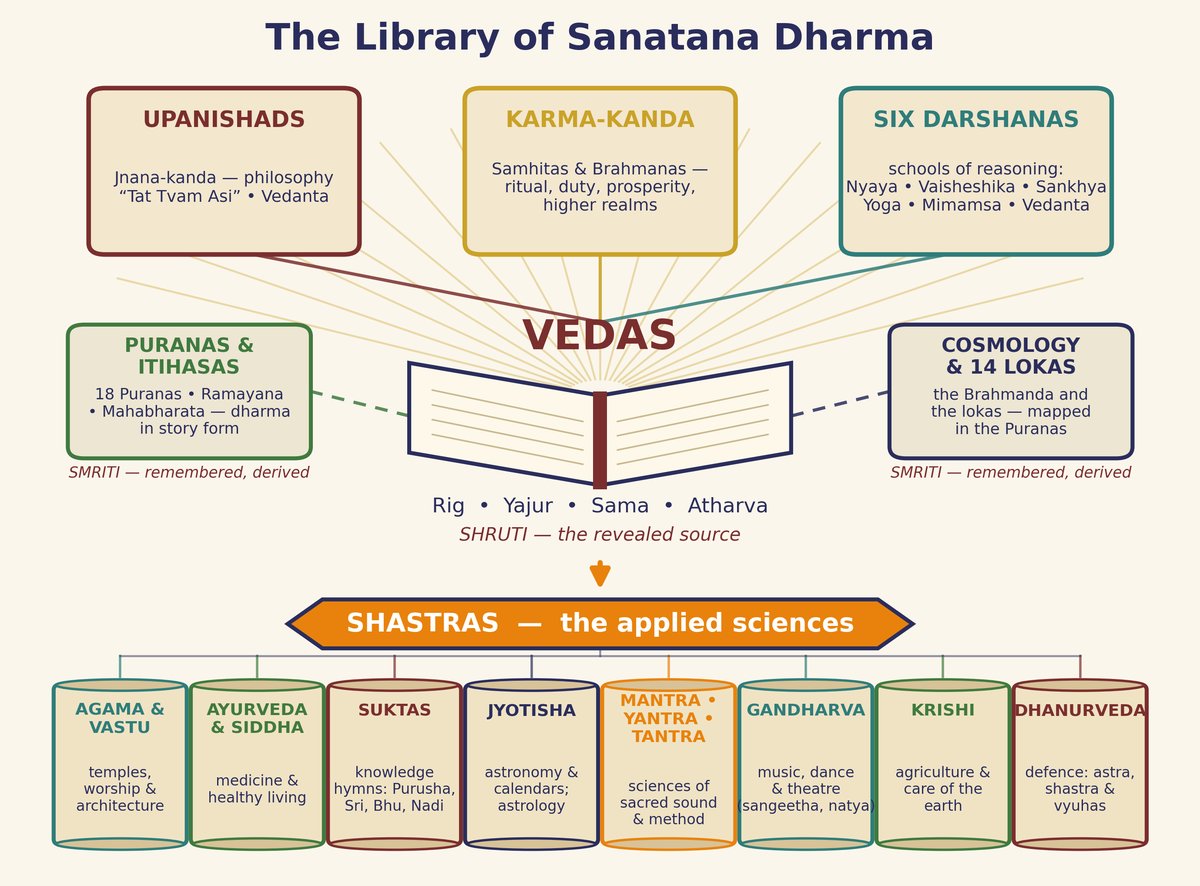
Hinduism stands apart because it is not founded on one prophet or one scripture. Its foundation is the Vedas, held by the tradition to be revealed by Paramatma to sages in deep meditation, heard by the rishis and passed to humanity. The tradition even says the Vedas are not only for Earth but for the entire Brahmanda (cosmos): it is with this knowledge that Brahma is said to have shaped the universe, planets, plants, animals, and humans. All later Hindu literature, Puranas, Itihasas, philosophies, sciences, and arts, is understood as extracted and elaborated from the Vedas.
Even the arrangement has a story. Tradition holds that the seer Krishna Dvaipayana looked at the ocean of hymns and organized it into four collections for four kinds of ritual voice. And earned forever the title by which the world knows him: Veda Vyasa, ‘the divider of the Veda.’ Each Veda then grew its own personality. The Rig is the poet: a thousand hymns of dawn and fire and wonder. The Sama is the musician: Rig verses set to melody. The tradition’s insistence that truth should be not only spoken but sung, and the ancient root of Indian classical music. The Yajur is the engineer: precise procedures, the ritual’s working manual. The Atharva is the householder: remedies, protections, the concerns of ordinary life. The Veda to which Ayurveda stands closest. Four voices, one revelation: the library was a choir before it was a bookshelf.
The structure of each Veda
Each of the four Vedas — Rig, Yajur, Sama, Atharva — has four layers:
Samhitas , the mantras, hymns, and prayers.
Brahmanas , explanations of rituals and how to perform them.
Aranyakas , the “forest treatises,” contemplative bridges between ritual and philosophy.
Upanishads , the philosophical teachings, the crown of each Veda.
Which part gives which knowledge?
Here is the key map, and it uses the two-fold division we met in Chapter 2. The tradition itself divides each Veda into two functional portions:
The Karma-kanda (portion of action) , the Samhitas and Brahmanas. This is the materialistic and practical knowledge: rituals for prosperity, health, rain, protection, family well-being, and an ordered society. It teaches how to live well in the world. This is the apara vidya, the “lower” (worldly) knowledge of Mundaka 1.1.4–5.
The Jnana-kanda (portion of knowledge) , the Aranyakas and above all the Upanishads. This is the philosophical knowledge: what is the Self, what is Brahman, what happens at death, how is liberation attained. This is the para vidya. The higher knowledge “by which the imperishable is realized.”
So when you want philosophy, you open the end of the Veda — which is exactly why the philosophy is called Vedanta, “the end of the Veda.” When you want the knowledge of living — health, duty, prosperity, ritual. You look to the earlier portions and to the applied sciences that grew from them.
The applied sciences that grew from the Vedas
Around the four Vedas the tradition grew a complete curriculum. The Upavedas (“auxiliary Vedas”) carry the materialistic and practical sciences: Ayurveda (medicine, linked to the Rig/Atharva Veda) and its southern sibling Siddha; Dhanurveda (the science of defence — astra and shastra — the released and the held weapon, and the battle formations called vyuhas); Gandharvaveda (the arts, sangeetha shastra for music and natya/nrutya shastra for dance and theatre); and Sthapatyaveda (architecture and design, from which Vastu comes). The six Vedangas (“limbs of the Veda”) include Jyotisha, astronomy and calendar science, which produced works like the Surya Siddhanta and the samhitas of Varahamihira, alongside grammar, phonetics, meter, etymology, and ritual geometry (the Shulba Sutras, which contain early geometry). The Vaisheshika Sutras of Kanada reason about atoms (anu) and categories of matter, an early physics of its kind.
The six darshanas: one summit, six base camps
The expanded library diagram named the six darshanas — the classical schools of philosophy — and they deserve a proper introduction, because together they show a civilization thinking at full stretch. Darshana means ‘a way of seeing’: six lenses ground for one reality. Nyaya is the school of logic. It built the formal five-step syllogism and the theory of valid knowledge (the pramanas of Chapter 9), and every other school had to survive Nyaya’s cross-examination to stay in business. Vaisheshika is the school of nature’s inventory. It analyzed the world into categories and atoms (anu), reasoning its way to indivisible particles two thousand years before chemistry weighed them. Sankhya is the school of the great map. It charted how one unmanifest nature (prakriti) unfolds into mind, senses, and elements, watched by pure consciousness (purusha); its vocabulary of the gunas powers half the Gita. Yoga is Sankhya’s laboratory wing, Patanjali’s eight limbs turning the map into a method. Mimamsa is the school of the sacred act. The deep analysis of Vedic ritual, duty, and the power of the word; and Vedanta, ‘the end of the Veda,’ is the school of the summit itself. The Upanishadic inquiry into Brahman that this whole book walks. Six rival faculties, arguing for centuries in mutual citation and cross-examination: less a religion’s dogma than a university’s catalogue, which is exactly the point.
One more marvel guards the whole library: the language it is written in. Sanskrit is built from verbal roots (dhatus) that combine by explicit rules, so precisely that Panini’s grammar could specify the entire language in about four thousand formal rules, a structure so algorithm-like that computer scientists have repeatedly studied it as a natural-language model of formal systems. Every technical term this book has taught you, dharma from dhri, ‘to uphold’; yoga from yuj, ‘to yoke’; veda from vid, ‘to know’, carries its own etymology like a label sewn inside. (You may meet the claim that ‘NASA declared Sanskrit the best language for computers’, that particular story is an internet legend; let it go, because the truth is grander: the grammar itself, not a rumor about it, is the documented wonder.)
Try the six lenses yourself. Take one ordinary object — a cup of water — and ask the six darshanas’ questions of it: how do I KNOW it’s there (Nyaya)? what is it MADE of (Vaisheshika)? how did it UNFOLD from causes (Sankhya)? how does attending to it change MY mind (Yoga)? what DUTY does it involve, who filled it, whom should it serve (Mimamsa)? and what is it, finally, an appearance OF (Vedanta)? Six honest questions, one cup: you have just used the whole catalogue.
On the philosophical shelf sit the 108 Upanishads, the Brahma Sutras, the Bhagavad Gita, and the great non-dual classics Shankara’s school treasures: the Mandukya Karika of Gaudapada (Shankara’s grand-teacher), the Yoga Vasishtha, the Ashtavakra Gita, and the Ribhu Gita. The knowledge hymns, Purusha Suktam, Sri Suktam, Bhu Suktam, Nadi Suktam, compress cosmology and reverence for earth and rivers into chant. The mantra sciences (mantra, yantra, and tantra shastras) systematize sacred sound, diagram, and method. The 18 Puranas carry cosmology and devotion in story form, and the two Itihasas — Ramayana and Mahabharata — carry dharma in epic form.
The library’s guardians: a technology of memory
The library also came with a technology built to protect it. The Vedas were preserved orally. And not casually. The tradition engineered recitation patterns (pathas) in which every hymn is chanted forward, backward, and in interlocking sequences (krama, jata, ghana), so that any slip anywhere is instantly exposed by the mismatch. This is redundancy and error-checking — the core ideas of modern information theory — engineered millennia before those words existed, and it is how the texts crossed thousands of years letter-perfect without paper. Scholars worldwide regard it as the most successful text-preservation feat in human history.
And the library’s own demands created sciences. To keep the sacred language exact, Panini composed the Ashtadhyayi — roughly four thousand interlocking rules generating the whole of Sanskrit — a formal grammar so rigorous that modern linguists study it with open admiration. To build ritual altars, the Shulba Sutras worked out early geometry, including the relation later named after Pythagoras. To time the rituals, astronomy grew into the Siddhantas. And from this same civilization came the decimal place-value system and the zero (crowned by Aryabhata and Brahmagupta), the digits every calculator on earth uses today.
So when someone asks what your tradition gave the world, you may answer plainly: the numerals in every phone and calculator, a grammar modern linguistics still marvels at, altar geometry older than Pythagoras’ fame, and the most successful memory-preservation system ever devised. None of that is legend or boast, all of it is documented, mainstream scholarship.
One river of time
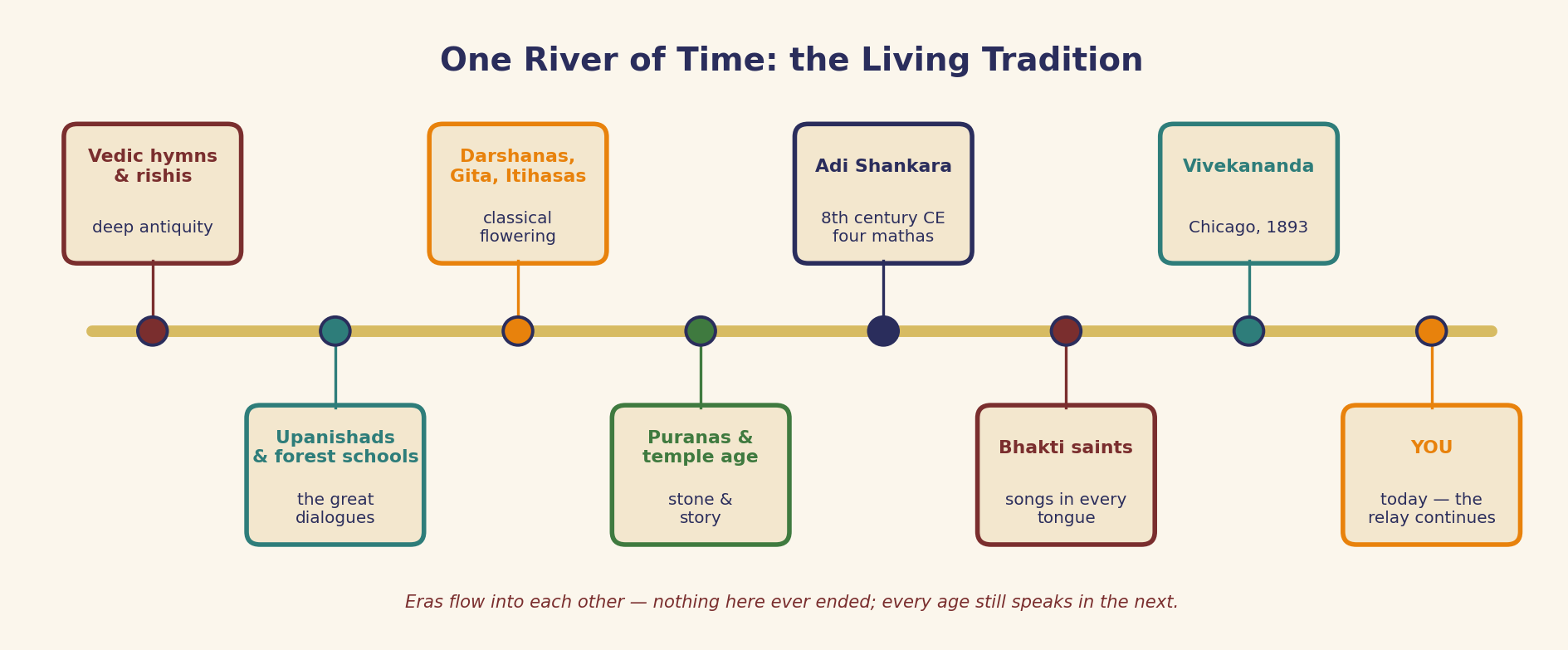
It helps, before going further, to see the whole river at once, because every later chapter of this book lives somewhere on this map, and nothing on it ever really ended. The hymns are still chanted; the Upanishads are still argued; Shankara’s mathas still teach; the Bhakti songs are still sung in a dozen languages; and the relay’s newest runner is reading this sentence.
The Debate Hall
“An oral tradition?” the challenger laughs. “Have you played the telephone game? Whisper a sentence around a classroom and it comes back mangled. Thousands of years of whispering, your texts must be mush.”
The reply
The telephone game has one rule: whisper once, no checking. The Vedic schools ran the opposite rules: recite aloud, in groups, daily, for years, and recite each text a dozen ways at once. In jata-patha the words are chanted forward and backward in braided pairs; in ghana-patha, in patterns so interlocked that a single wrong syllable anywhere collides with its own echo and exposes itself. Then test the result: when the texts finally were written down, manuscripts collected from opposite ends of the subcontinent — communities separated by a thousand miles and a thousand years — agree with one another to an accuracy that stuns textual scholars. The telephone game explains why casual transmission fails. The patha system is what engineers build when failure is not an option.
Two cautions for a scientific reader. First, a few works in popular lists, the Vaimanika Shastra on flying machines is the famous example, are of disputed or modern origin; scholars date it to the early 20th century, not antiquity. A scientific Hindu cites the undisputed core and lets the doubtful cases stay doubtful. Second, calling Jyotisha “astronomy and astrology” is accurate history: the observational astronomy (eclipse prediction, calendars) was genuinely advanced; predictive astrology is a far more complex field. It remains an important, living part of the tradition, and the tradition itself holds that accurate prediction demands exceptional expertise, which is rare in any age. Keep the observational science and the predictive art distinct in your mind, honor each for what it is, and you will never be embarrassed.
Make a two-column page: “Knowledge for living” and “Knowledge for liberation.” Place five texts from this chapter into the correct column. You have just reproduced the tradition’s own filing system, apara and para vidya.
Meera’s notebook
- Four Vedas, four layers each; karma-kanda teaches living, jnana-kanda teaches liberation.
- Vyasa = ‘the divider of the Veda.’ Rig the poet, Sama the musician, Yajur the engineer, Atharva the householder.
- The patha systems are error-checking, the telephone game comparison actually proves OUR point.
- Panini: ~4,000 rules generating a whole language. Zero and the decimal system: ours, in every calculator.
- Six darshanas = six base camps on one summit. A university catalogue, not a dogma.
- The NASA story is a legend, drop it; the real grammar is the documented wonder. Honest > viral.
Meera held the little Gita a long time before wrapping it back in its cloth. ‘Heard by the rishis,’ the texts kept saying. “Thatha, these rishis. Who exactly were they? Did they have families? Did they have… us?” Thatha’s eyes shone. “Fetch the photo album,” he said. “Tomorrow we talk about your grandfathers.” ❖
Check your understanding
- Name the four layers of each Veda, in order.
- Which portion of the Veda gives materialistic/practical knowledge, and which gives philosophical knowledge?
- Match: Ayurveda, Dhanurveda, Gandharvaveda, Sthapatyaveda, to medicine, defence, arts, architecture.
- Why is the philosophy called “Vedanta”?
- Name the six darshanas and give one line for each.
- What is the honest verdict on the ‘NASA declared Sanskrit best for computers’ story?
- Reflect: Why is it a strength, not a weakness, for a tradition to admit some famous texts are of doubtful origin?