
Chapter 2
Religion, Spirituality, and the Spiritual Religion
“Thatha, who is doing it right. You or Grandma? She has the puja and the bells and the flowers. You just… sit.” Thatha laughed so hard the lamp flickered. “You have just asked the question this tradition answered more carefully than any other on earth. Come. Let me tell you about a boat.”
The three words, carefully defined
Religion, in everyday language, means the outer structure: festivals, temples, rituals, community, holy days, rules of conduct, what you can see from the outside. Spirituality means the inner search: the direct, first-person effort to know what you truly are and what reality truly is.
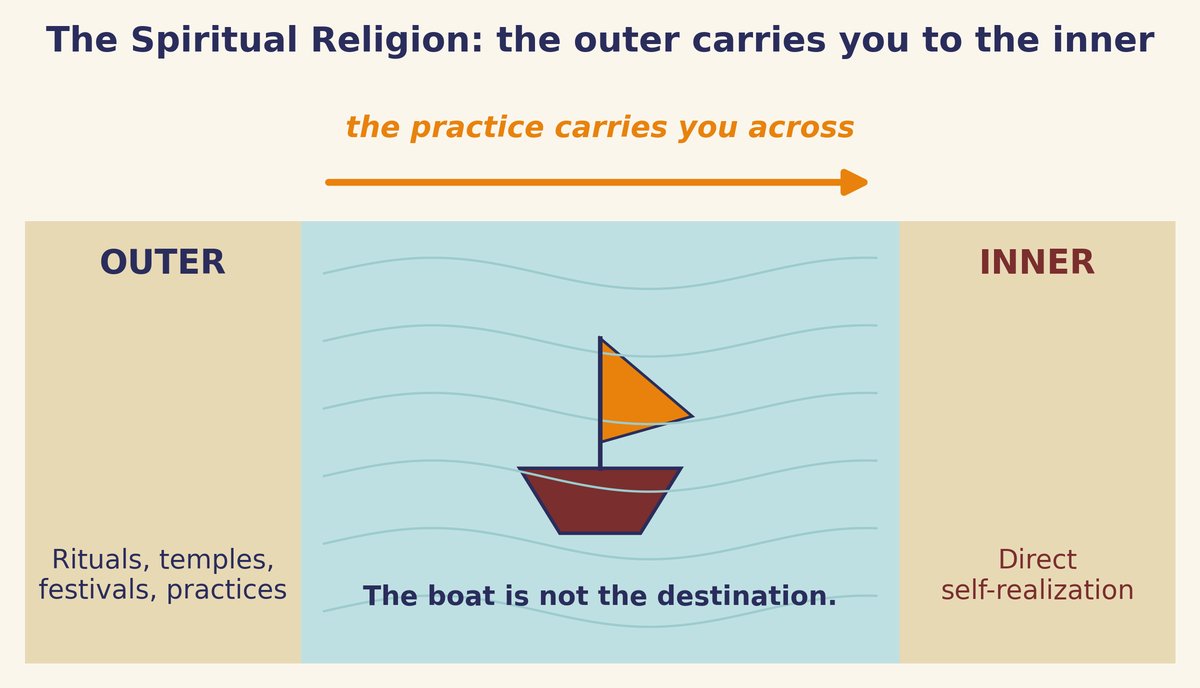
Most traditions lean to one side. What makes Sanatana Dharma unusual is that it was built to be a spiritual religion, an outer structure whose entire purpose is to carry you to the inner discovery. The rituals are not the destination; they are the boat.
Picture an old ferryman on a wide river. Travelers ask him: is the boat necessary? He says: to cross, yes. They ask: is the boat the far shore? He says: mistake the boat for the shore and you will live your whole life on the water, polishing planks. They ask: then shall we burn the boat and swim? He says: many have drowned proving that the river is real. The tradition’s genius is the ferryman’s answer, honor the boat, use the boat, love the boat even; and remember always what it is for. Grandma’s bells and Thatha’s silence are the same journey at two points of the river.
A teaching for every student: adhikari-bheda
Behind the boat lies one of the tradition’s quietest strokes of genius, with a technical name worth learning: adhikari-bheda, ‘difference in readiness.’ The same truth, the teachers held, must be offered differently to differently prepared students, exactly as arithmetic is not taught with the textbook of calculus. So the tradition built a graded staircase and put a door on every step: stories for the child, rituals for the householder, philosophy for the inquirer, silence for the sage, all pointing at the same summit. This is why Hinduism can look bewilderingly multiple from outside: the visitor is seeing every grade of one school at once and mistaking it for many schools. And it is why nobody is ever turned away. There is no entrance exam to a staircase; you simply begin on the step where you stand. Modern educators call this ‘differentiated instruction’ and consider it progressive. Your tradition considered it obvious, several thousand years early.
What the shastra says
“Dve vidye veditavye... para caivapara ca.”“Two kinds of knowledge are to be known, the higher and the lower.”, Mundaka Upanishad 1.1.4
The text then says the lower knowledge (apara vidya) includes even the Vedas, grammar, and ritual — the whole body of organized learning — while the higher knowledge (para vidya) is that by which the imperishable is realized (Mundaka 1.1.5). A tradition willing to call its own books “lower knowledge” is not afraid of inquiry. We will use this same two-fold division in the next chapter to organize the entire library.
And one thing crowns both kinds of knowledge: rituals, teachings, and even the highest scriptures are incomplete without a sense of universal belonging, the spirit the tradition names Vasudhaiva Kutumbakam, the conviction that the whole world is one family.
“Ayam bandhur ayam neti ganana laghu-chetasam; udara-charitanam tu vasudhaiva kutumbakam.”“‘This one is my kin, that one a stranger’, so count the small-minded. For the noble-hearted, the whole earth is one family.”, Maha Upanishad 6.71–72
Adi Shankara’s example
Shankara is famous for the path of Jnana (knowledge), yet he personally composed dozens of devotional hymns and reorganized temple worship across India. Why would a philosopher of the formless absolute write loving songs to deities with form? Because he understood the spiritual religion perfectly: outer practice purifies and steadies the mind so the inner knowledge can dawn. He used the boat without mistaking it for the far shore.
From the pages of history
History put this design to the harshest of tests. Through centuries of invasion and upheaval, the outer structure — temples, festivals, family rites — acted as the ark that carried the inner knowledge. When universities burned, the texts survived in memorized recitation; when public worship was suppressed in one region, the household lamp kept the flame; when scholars were scattered, wandering sannyasis carried Vedanta village to village in songs the humblest farmer could sing. Traditions that were only inner vanished when their few adepts died; traditions that were only outer hardened into empty shells. This one, being both, bent and endured, and that endurance is not luck. It is architecture.
The Debate Hall
“Be honest,” says the challenger, “most ritual is empty repetition, people mumbling words they do not understand.”
The reply
Some is. And the tradition itself says so first: the Mundaka Upanishad ranks mere ritual as lower knowledge, and the Gita ranks knowledge above rote sacrifice (4.33). But do not confuse a practice with its laziest practitioners. A chemistry lab performed carelessly is also empty repetition; the remedy is not to abolish laboratories but to teach what the experiment is for. Ritual is embodied learning. The body kneeling teaches humility faster than a lecture on humility; a daily offering teaches gratitude to hands too young for philosophy. The design brief is written into the word itself: these are kriyas, things done, so that one day the meaning can become things known.
Meera’s notebook
- Religion = the outer structure. Spirituality = the inner search. Ours was built as both: a spiritual religion.
- The boat is not the destination, but the boat to get to the destination. Grandma and Thatha: same river, two points.
- Even the Vedas are called ‘lower knowledge’ next to realization (Mundaka 1.1.4), a tradition unafraid of itself.
- Adhikari-bheda: a door on every step of the staircase. Nobody is turned away; you start where you stand.
- Vasudhaiva Kutumbakam, the whole world is one family. The highest teaching needs the widest heart.
“So the boat carries you,” Meera said. “But Thatha, who built the boat? Where are the plans?” Thatha stood and beckoned her inside, to the old teak cupboard she had never seen opened. “Tomorrow,” he said, “I show you the shipyard.” ❖
You must ask everything.
Check your understanding
- In your own words: religion is the ______ structure; spirituality is the ______ search.
- The Mundaka Upanishad places even the Vedas in which category?
- (a) para vidya (higher)
- (b) apara vidya (lower)
- (c) neither
- What is adhikari-bheda, and why does it make Hinduism look ‘multiple’ from the outside?
- Reflect: Name one outer practice in your family. What inner quality might it be pointing toward?