
Chapter 17
Standing for Yourself and the Dharma, With Knowledge and Grace
It happened at lunch, with an audience. “So explain the caste system,” the boy said, in the tone of one laying down a trump card. And Meera — to her own astonishment — felt no anger arrive at all. She heard herself ask, curious: “Sure. What exactly do you think we believe?” And the conversation that followed was, both of them later admitted, the most interesting one either had had that year. That evening she reported it to Thatha almost casually. He listened with the expression of a coach watching a student land something in competition for the first time. “Now,” he said, “the full armory. And the story of the man who invented this way of arguing.”
Sooner or later someone will challenge you about your tradition. Respond the way Shankara would: with knowledge, confidence, and respect, never anger, shame, or contempt.
Rule 1: Knowledge is the real defense
Most criticism targets caricatures, and you now hold the grounded answers. “Too many gods?” → one reality, many powers, and Yajnavalkya himself reduced the count to One (Brihadaranyaka 3.9; Rig Veda 1.164.46). “Idol worship?” → a murti is a doorway, not the limit (Gita 12.5). “Just superstition?” → a tradition that opens with “Now, the inquiry” (Brahma Sutra 1.1.1) and calls even its own scriptures “lower knowledge” (Mundaka 1.1.4–5) is the opposite of blind belief.
Two harder challenges deserve equally confident answers. “Why revere cows and rivers?”, A civilization that treats what feeds it and what waters it as sacred is practicing ecological gratitude; the modern world is painfully re-learning that stance under the name sustainability. What looked ‘primitive’ to nineteenth-century critics looks farsighted now. And then the hardest challenge of all, the one thrown at every young Hindu sooner or later, “doesn’t your religion have caste?” It deserves far more than a slogan, so give it a section of its own.
The hardest question: varna, caste, and an honest reckoning
Answer this one slowly and candidly, because most of what a challenger believes about it braids together two different things, a foreign word, and a colonial filing system. And because the parts that were unjust deserve honesty rather than defense. Pull the strands apart and you can meet every one of them standing tall.
First: varna is not caste
Begin by separating two things the English word ‘caste’ crushes together. Varna is the shastric idea: a fourfold ordering of society by temperament and function — the scholar-teacher, the ruler-protector, the trader-producer, the worker who serves — and the Gita is unambiguous that it is defined by quality and action, ‘guna-karma-vibhagashah’ (Gita 4.13), not by birth. The tradition proves it with its own heroes: Vishvamitra, born a king, became a brahmarishi by tapas (Chapter 4); Satyakama was accepted for study on his truthfulness when he could not name his father (Chapter 14); Valmiki, the adi-kavi who composed the Ramayana itself, is remembered as a hunter before he became a sage; Vyasa, who arranged the Vedas, was the son of a fisherwoman. A tradition that lets a hunter write its epic and a fisherwoman’s son edit its scripture is plainly not a sealed hierarchy of birth. Varna, honestly read, was built with doors.
Where the word ‘caste’ came from
Now the word itself, because it carries a history most people never learn. ‘Caste’ is not an Indian word at all. There is no such term in any shastra, in any Indian language. It comes from casta, a Portuguese and Spanish word meaning ‘lineage’ or ‘breed,’ which European traders and missionaries carried with them and pressed onto a society they were only beginning to see. So the very first thing to do is give the challenger the real word back.
Across the Indian languages — Sanskrit, Hindi, Bengali, Marathi, Tamil, Telugu, Kannada and more — the word that the foreign ‘caste’ clumsily gestures at is jati. And jati simply means ‘kind’ or ‘community’ — a born-into group — and in practice it overwhelmingly meant a community of shared occupation. This is the heart of the matter, and it is the part the colonial word erased: what Europeans filed as a rigid ranked ‘caste’ was, on the ground, a jati, a working trade-community. Weavers, potters, goldsmiths, ironsmiths, farmers, merchants, carpenters, physicians: each craft formed a community that lived together, trained its own young, and married within, because that is how a skill and a clientele were kept alive before schools, guild-halls, or trade unions existed.
Read that way, jati was, above all, a livelihood system. And a remarkably secure one. A child born into a weaver’s jati was born into a trade, a workshop, a network of customers, and a guaranteed place in the economy; the community was at once your school, your professional guild, your insurance, and your social safety net. Europe knew exactly the same arrangement and left it fossilized in its own surnames: every Smith, Weaver, Potter, Mason, Baker, and Taylor in an English phone book is the descendant of a trade passed down a family line. The guild system doing what jati did. Seen honestly, then, jati was occupational, communal, and locally fluid, a guild-like web that assured people work and belonging, not the sealed, nationwide ladder of pure rank that the imported word ‘caste’ conjured up in European minds and then, tragically, helped create.
How a filing system hardened into a cage
Here is the part of the story that is documented and decisive. The rigid, ranked, all-India ‘caste system’ that critics attack was substantially hardened into that shape under colonial administration. When the British set out to count and govern the subcontinent — above all through the great censuses from 1871 onward — they required every person to be filed into one fixed, ranked caste, and their officials wrote at the time about how slippery the task was: communities gave different answers in different decades, claimed different ranks, and often identified themselves by village, trade, or sect rather than by any neat pan-Indian caste. Fluid, local, overlapping identities were flattened into a rigid national hierarchy and then stamped onto law, land, and opportunity. Serious historians of the period (the work of scholars such as Nicholas Dirks and Bernard Cohn is standard here) describe this as, in large part, the making of a system, not the neutral recording of an ancient one. The takeaway a young Hindu can state plainly: the rigid caste hierarchy the world condemns is not the varna of the shastra, and its hardest edges were institutionalized comparatively recently. It is documented in no scripture, prescribed by no rishi, and owned by no Sanatana teaching.
Untouchability: origin, and an honest reckoning
And now the gravest strand, which this book will not skate over. There is a real argument, worth understanding, that untouchability began not as a rank of birth but as a set of purity-and-pollution rules around particular kinds of work — handling waste, the dead, or slaughter — in an age with no germ theory, when distance from certain materials was the only known hygiene. A telling piece of evidence for the occupational origin is that the taboo could attach to the work rather than the bloodline: even persons of brahmin birth in certain professions involving contact with the dead or with bodily matter could be treated as untouchable for the duration of that work. That points to pollution-of-occupation, not a simple hierarchy of birth, which is a genuine and important distinction.
But honesty cuts both ways, and this is where a thoughtful young Hindu earns real respect. Whatever its origin, untouchability hardened over time into a hereditary cruelty that inflicted deep and lasting suffering on real human beings. And no account of its beginnings erases that. The tradition’s own answer is not denial; it is Rule 4 (Chapter 12): a custom that fails the tests of shastra and compassion stands condemned, however old it is. And notice who did the condemning, from inside the tradition, with its own scriptures in hand: the Bhakti saints who declared the divine reachable by anyone of any birth; Basavanna and Narayana Guru; Ambedkar, who quarried the tradition’s own deepest principle — the oneself in all — into a constitution that outlawed untouchability outright. The Upanishad had said it at the very root: the same Atman dwells in every being (Isha 6). A tradition whose scripture supplies the exact weapon used to destroy its own worst abuse is not a tradition to apologize for. It is one to reform in the confidence that reform and faithfulness are, here, the same act.
There is a further piece most critics never see, and it turns the picture almost inside out. Alongside the corrupted, hereditary cruelty there ran a genuine and honorable discipline of ritual purity, what many traditions call madi or soucha, practiced most strictly by the very people the caricature imagines as oppressors: saints, temple priests, and serious sadhaks. Before certain rituals, a practitioner keeping madi will bathe, wear freshly washed clothes, cook and eat in a purified state, and — crucially — not allow themselves to be touched by anyone not in the same prepared condition, because contact would break the charged, sanctified state they have carefully built. This was self-imposed on the holiest, not imposed by them on the lowly; a great many of these disciplined practitioners were themselves saints and high achievers who held themselves to a far higher frequency of purity than they ever asked of anyone else.
Read with modern eyes, the logic is containment protocol. A specialist working with static-sensitive electronics grounds themselves and refuses ungrounded contact; a high-voltage lineman wears insulated protective clothing and will not let an unequipped bystander touch them mid-work, not out of contempt for the bystander, but to protect both of them and to keep the delicate operation intact. The person keeping madi is doing the ritual equivalent: “please don’t touch me right now” can mean I am holding a charged state that your contact would break, and the discipline guards us both. Distinguishing this voluntary, temporary, self-directed sanctity-discipline from the hereditary social cruelty is essential. The tradition conflated them at its worst, and honesty requires pulling them apart again: one is a lineman’s insulation, the other is a wall that should never have been built.
So stand up straight on this hardest of questions, and give the honest, three-part answer: the varna of the shastra is defined by quality and action, not birth, and its own heroes climbed and crossed it. The rigid ‘caste system’ the world attacks is a later, largely colonial hardening of fluid trade-communities, named with a Portuguese word, filed by a foreign census, prescribed in no scripture. And untouchability, whatever its hygienic origins, became a real cruelty that the tradition’s own saints and reformers tore down using the tradition’s own highest teaching. You are not defending an indefensible thing; you are reclaiming an honest history from a lazy caricature, and doing it, as always, with knowledge and grace.
Rule 2: Argue the way Shankara argued
His debates had one rule: whoever holds the better-reasoned position, the other honestly accepts it. Truth, not victory. Stay calm; ask questions back (“What exactly do you think we believe?”); concede fair points, that is strength.
From the pages of history: the young man who argued a civilization awake
Shankara’s life reads like a parable about the power of reasoned speech. Born in Kaladi in Kerala, he lost his father young and was a renunciate by boyhood, tradition says his mother’s consent came at a river, in a crisis, with a crocodile’s grip releasing only when she cried her yes. He walked north to find his guru Govindapada, mastered the teaching, and began composing commentaries of such clarity that they remain the reference point twelve centuries later. Then he did something remarkable: instead of settling into a monastery, he walked the length and breadth of the land challenging the greatest scholars of every school to public debate, the digvijaya, the ‘conquest of the directions,’ waged without a single soldier.
The most famous of those debates tells you everything about the rules of engagement. His opponent was Mandana Mishra, the era’s mightiest defender of pure ritualism, and the agreed umpire was Ubhaya Bharati, Mandana’s own wife, herself a scholar so respected that both men accepted her verdict in advance. Consider that arrangement for a moment: the highest-stakes intellectual contest of the age, judged by a woman, on the sole criterion of better reasoning. The debate ran for days; garlands, the story says, were hung on both debaters, and the judge watched whose flowers wilted, whose composure and arguments were failing. When Mandana was defeated, Bharati is said to have challenged Shankara herself before conceding the field. Mandana accepted the outcome the vada way: he became Shankara’s disciple. The loser of the great debate became one of the tradition’s great teachers, because in vada, losing to the truth is a promotion.
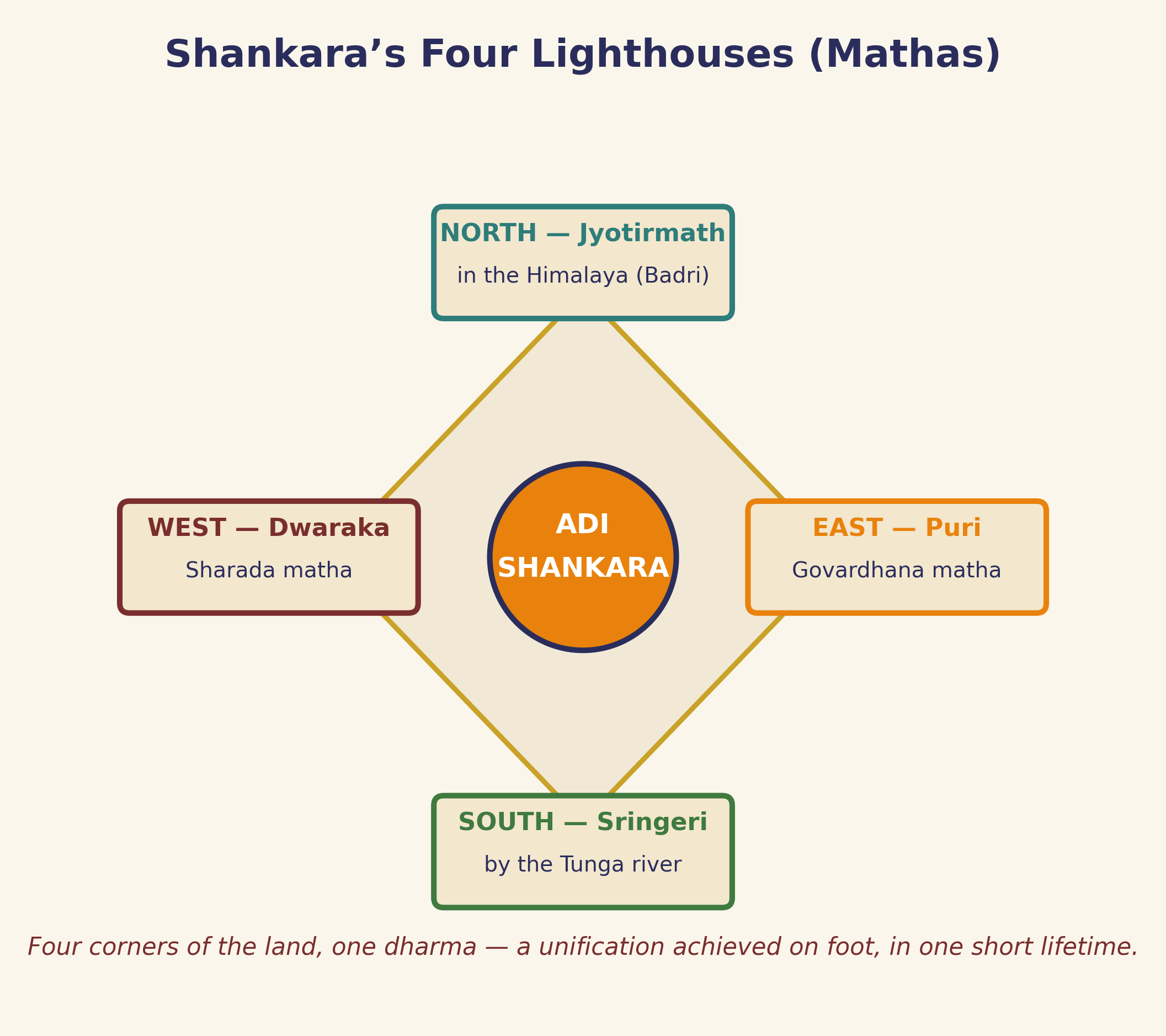
Before he died — by tradition at just thirty-two — Shankara planted institutions to outlast him: four mathas at the four compass-points of India, Sringeri in the south, Dwaraka in the west, Puri in the east, Jyotirmath in the Himalayan north, binding the subcontinent into one dharmic map that still functions today. A boy from a Kerala village, one lifetime, no army, no funding, no printing press: commentaries still studied, hymns still sung, monasteries still teaching, a method of honest debate still — as of this evening, in Meera’s school lunchroom — winning. That is what standing for the dharma looks like at full power.
Know your arguments — and know which argument you are in
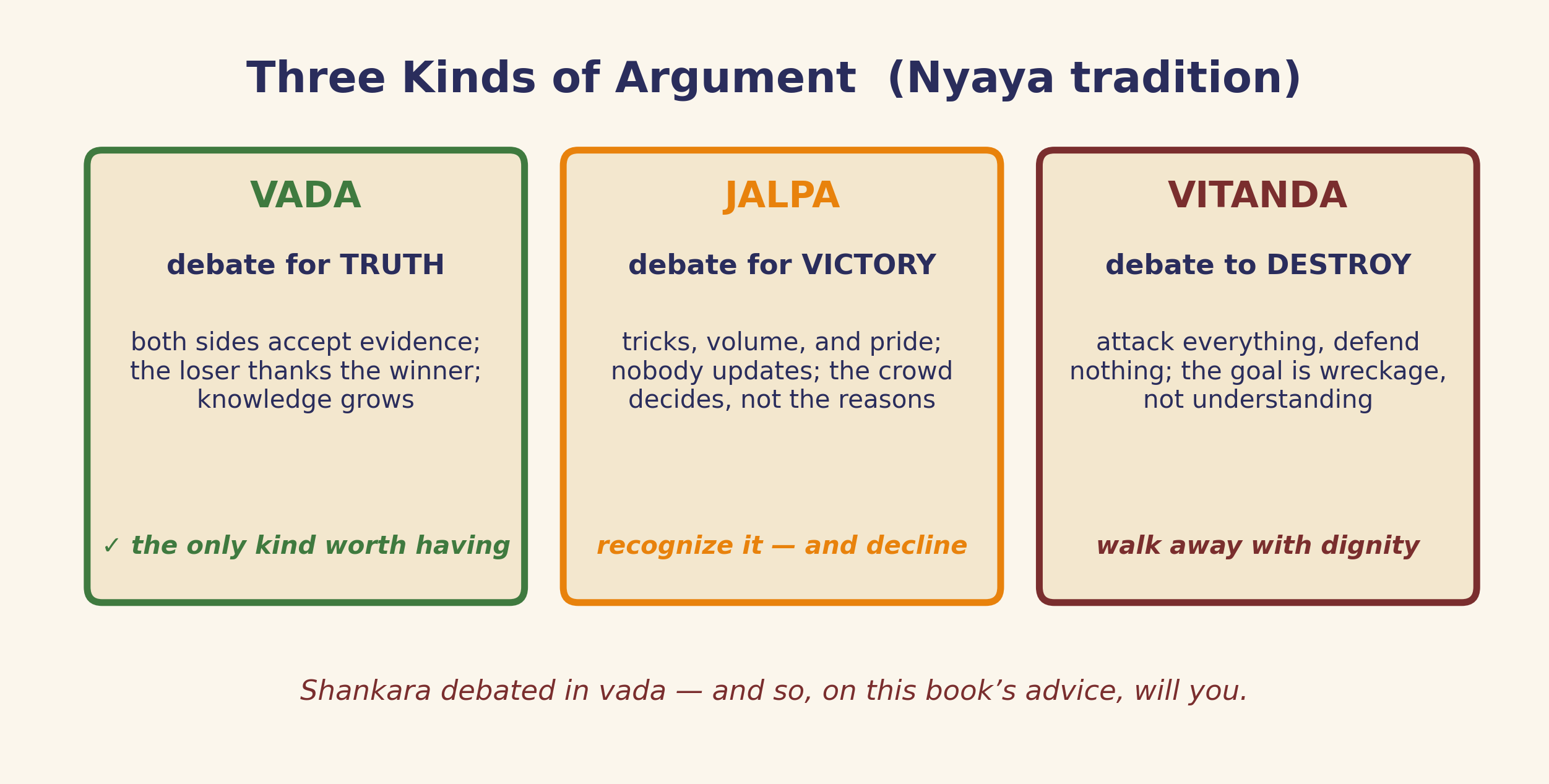
The Nyaya tradition, ever precise, classified arguments themselves into three kinds. And the classification is a weapon of self-defense. Vada is debate for truth: both sides accept evidence, and the loser gains knowledge. Jalpa is debate for victory: tricks, volume, and pride. Vitanda is debate for demolition: attack everything, defend nothing. The rule of the wise is simple: give your best in vada, recognize jalpa and decline the bait, and walk away from vitanda with your dignity intact. You owe truth your effort; you owe wreckers nothing. Before any hard conversation, ask the diagnostic question: which of the three is this? The answer tells you whether to engage your mind, your patience, or your feet.
The Debate Hall
“One more,” says the challenger, “and it’s a serious one. Doesn’t Hinduism oppress women?”
The reply
Answer it in three honest layers. Layer one. The scriptures’ own roster, which you now know by name: rishikas composing hymns inside the Rig Veda itself; Gargi cross-examining Yajnavalkya in open assembly; Maitreyi choosing philosophy over property; Ubhaya Bharati umpiring the age’s greatest debate; and the divine itself worshipped as Mother — Devi, Durga, Saraswati, Lakshmi — with nine nights of the year given to her honor: this is not the scripture of a tradition that considers women incapable of wisdom or unworthy of worship. Layer two. The honest concession, which strengthens rather than weakens you: later social history includes real injustices against women, as it does in every old civilization, and Rule 4 applies in full, custom is answerable to shastra and to compassion, and customs that fail that test deserve to fall. Layer three. The self-correction, from inside: the reformers who fought those injustices — for education, against child marriage, for widows’ dignity — repeatedly argued from the tradition’s own texts and precedents, Gargi and Maitreyi in hand. A tradition whose scriptures supply the ammunition against its own later abuses is a tradition worth defending, because defending it and reforming it are the same act.
And keep one more arrow, because the question behind many challenges is really this one: ‘If your dharma is so great, why doesn’t it try to convert everyone?’ Turn the question over and it becomes the answer. A tradition holding ‘truth is one, the wise call it variously’ (Rig Veda 1.164.46) has no theological need for conversion: the other person’s sincere path is already headed for the same sea. Hinduism therefore never fielded missionaries with quotas, never made salvation contingent on membership, and never taught that the unconverted are lost, a restraint almost unique among world traditions, and the exact opposite of insecurity. The dharma does not recruit, Meera’s Thatha would say, for the same reason the ocean does not advertise: everything flowing sincerely is already on its way.
Rule 3: Defend the dharma, never attack another’s faith
If truth is one and the wise call it by many names, you cannot in good conscience treat another sincere tradition with contempt. A Hindu who mocks another’s faith has misunderstood the very verse that makes Hinduism great. Defend with dignity; never with hatred.
Rule 4: Distinguish “my culture” from “the dharma”
Some things defended in religion’s name are local custom, accumulated habit, or injustice that crept in over centuries, not the teaching of the Upanishads. If a practice cannot be defended from the shastra and from basic compassion, you are allowed, encouraged, to question it. That is the tradition’s own method of self-correction.
Rule 5: Protect your own mind first
If a conversation turns cruel, step away with dignity: “I’m happy to talk about this when we can both be respectful.” You owe no one a debate in bad faith.
The deepest confidence is Vivekananda’s kind: abhih, fearlessness. You stand in a tradition of logicians and universities, mathematicians and grammarians, temple engineers and poet-saints, fearless questioners and living sages. The oldest continuously practiced spiritual civilization on earth, whose ideas the modern world keeps rediscovering and adopting. Stand accordingly: calm, informed, generous, and unafraid.
Meera’s notebook
- First move, always: ‘What exactly do you think we believe?’ Half the attack dissolves in the answer.
- Diagnose the argument before joining it: vada → engage; jalpa → decline; vitanda → walk.
- Shankara: Kaladi to four mathas by thirty-two, armed with nothing but reasoning, judged, at the summit, by a woman scholar.
- Caste ≠ varna: varna is by guna+karma (Gita 4.13), with doors, Valmiki the hunter, Vyasa the fisherwoman’s son.
- ‘Caste’ is Portuguese (casta); what they saw was jati, trade-guilds; the rigid ranked system was largely a colonial hardening, in no shastra.
- Untouchability likely began as occupation-hygiene (even some brahmins in certain work were excluded). But it became a real cruelty, torn down from INSIDE by the tradition’s own saints and its own ‘one Self in all.’
- The women answer, three layers: the shruti’s own roster → the honest concession → the self-correction.
- We never fielded missionaries. The ocean doesn’t advertise. Abhih: calm, informed, generous, unafraid.
- Madi / soucha = a voluntary purity-discipline the saints kept on THEMSELVES, not on others, bathe, fresh clothes, “don’t touch me right now” because contact breaks the charged ritual state. Like an electrician grounding themselves or a lineman’s insulated gear: “don’t touch me” can mean I’m protecting us both, totally different from the hereditary cruelty, which the tradition wrongly blurred together.
“Thatha,” Meera said, after a long quiet, “we’ve done the books, the seers, the gods, the practices, the defense… but you never actually answered the biggest one. What is it all for? What am I for?” Thatha looked at her for a moment, and then at the lamp. “Pack a bag,” he said. “For the last big chapter, we go to the sea.” ❖
Check your understanding
- Give a calm one-sentence answer to “Why so many gods?” using Yajnavalkya’s dialogue.
- Why is conceding a fair point strength rather than weakness?
- What is the difference between defending the dharma and defending every custom?
- Define vada, jalpa, and vitanda, and the right response to each.
- Give the three-layer answer to ‘doesn’t Hinduism oppress women?’
- Reflect: Recall a disagreement. How would “debate for truth, not victory” have changed it?