
For skeptics
Before You
Roll Your Eyes
a skeptic’s notes on a book I fully intended to dismiss
Quick disclosure: I’m the wrong person for this. Hindu family, sure — but I stopped going to the temple years ago, I skip the family pujas, and when relatives start on “our culture,” I check my phone. I don’t believe in anything I can’t verify. I opened this book to win an argument with my dad.
I’m writing this because the argument did not go the way I planned.
This is what got past my defenses — with receipts. Every answer below is quoted or taken straight from the book. If nothing here lands, close it, you’re free, I’ll say I tried. But read it before you roll your eyes away.
01
The first rule broke my whole strategy
My strategy was simple: religion books demand belief, I refuse, game over. Page one of the prologue, a fifteen-year-old girl comes home angry because a friend mocked her family’s faith and she had no answers. Her grandfather doesn’t give her a lecture. He gives her a rule.
“You must ask everything. That is the first rule of this house and, as you will discover, the first rule of this dharma. Its foundational sentence is an inquiry, and its greatest teachers were children who could not be bribed out of a question.”
— from the book
And when she admits she got angry and then went silent, he says:
“Anger and silence are what we reach for when we do not know. So we will fix the not-knowing.”
— from the book
When was the last time anyone told you your questions were the point — not a phase they were waiting out?
A tradition whose opening move is “interrogate me” is a different animal from the one I’d been ignoring. I kept reading, mostly to find the catch.
02
It says the quiet part out loud
Every religion book has a moment where it asks you to just... take its word. I was waiting for it. Instead, the grandfather lays down the ground rules for the whole book — and they read like a research methods class:
“Everything I teach you, I will show you where it is written; we will always say plainly whether a thing is a teaching, a practice, or a resonance; and we will never, ever pretend a poem is a proof — because the poems are magnificent enough without pretending.”
— from the book
Read that last clause again. A book about spirituality announcing, up front, that it will not smuggle poetry across the border as evidence. It then spends nineteen chapters actually keeping that promise — there are bright-colored “HONEST NOTE” boxes throughout whose entire job is to flag what’s claim, what’s practice, and what’s just a beautiful idea.
What would you be willing to read if you knew it had promised, in writing, not to con you?
03
Nobody is in charge. Nobody.
Here’s what I never got told as a kid: this tradition has no founder, no single book, no headquarters, and no one with the authority to excommunicate you. The book calls it a library, not a book — shelves of scripture, philosophy, law, epics, and science, stacked over thousands of years, much of it arguing with the shelf below it.
There are six classical schools of philosophy inside it that openly disagree with each other — including one ancient school that was flat-out atheist about a creator and still sat inside the tradition. Debate wasn’t heresy. Debate was the sport.
The book even teaches the rules of that sport: honest inquiry where you must state your opponent’s case in its strongest form before answering it. There’s a recurring box called THE DEBATE HALL where the hardest attack on each idea gets aired — the telephone-game attack, the ‘isn’t this just fatalism’ attack, the idol-worship attack — and answered without flinching.
You’ve been rebelling against a religion with no pope. Who exactly were you rebelling against?
04
The telephone game argument (I lost)
This was my best material. Oral tradition? Thousands of years of whispering? Your texts must be mush by now. The book stages exactly this attack — a challenger laughing about the telephone game — and then answers it. This is the passage that actually annoyed me, because it’s good:
“The telephone game has one rule: whisper once, no checking. The Vedic schools ran the opposite rules: recite aloud, in groups, daily, for years — and recite each text a dozen ways at once... so interlocked that a single wrong syllable anywhere collides with its own echo and exposes itself. Then test the result: when the texts finally were written down, manuscripts collected from opposite ends of the subcontinent — communities separated by a thousand miles and a thousand years — agree with one another to an accuracy that stuns textual scholars.”
— from the book
And the kill shot:
“The patha system is what engineers build when failure is not an option.”
— from the book
Error-correcting redundancy, designed three thousand years before checksums. I came for the mush; I left having learned a data-integrity protocol.
05
The wheel isn’t a threat
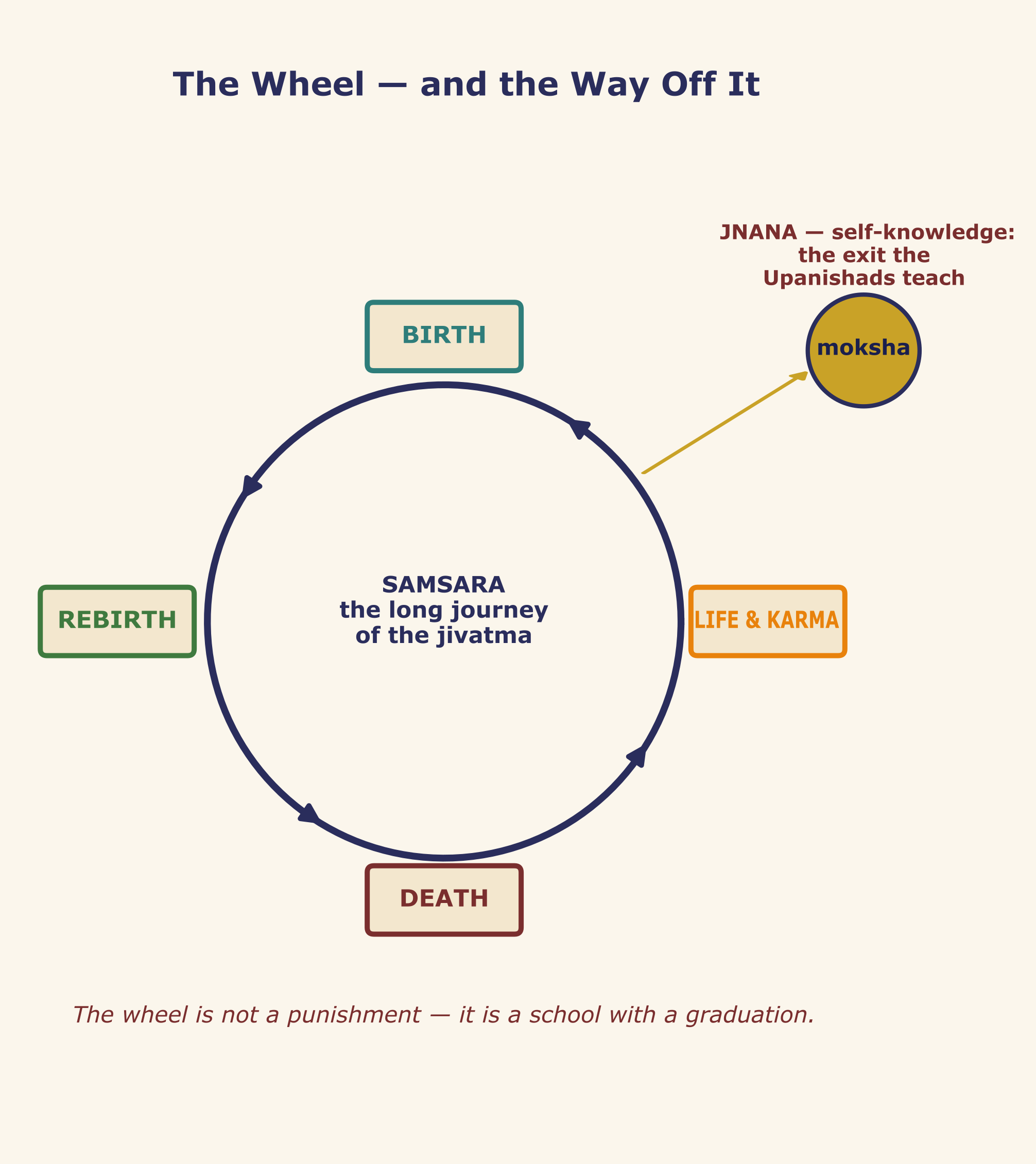
Rebirth was always sold to me as a scare: behave, or you’ll come back as something worse. The book reframes it in one line that I have not been able to shake:
“The wheel is not a punishment — it is a school with a graduation.”
— from the book
Birth, life, death, rebirth — not a sentence being served, but a curriculum being completed. And the exit isn’t begging or luck. Look at the diagram: the arrow off the wheel is labeled knowledge. Self-knowledge is the graduation requirement. Whatever you make of the metaphysics, notice the design: a system whose escape hatch is understanding is a system built by people who valued understanding above fear.
06
Karma without the guilt trip
I assumed karma was a cosmic courtroom — sky-judge, ledger, punishments. Here’s the book’s actual definition:
“Karma literally means “action.” But the law of karma is really about what actions leave behind.”
— from the book
Walk across a lawn once, nothing. Walk the same line every day and you wear a path — then the path starts choosing your feet for you. That’s the mechanism: actions leave residues, residues become tendencies, tendencies become character, and character walks you into your next situation. No judge required. It’s closer to habit science than to hellfire — psychologists would call it reinforcement; the tradition mapped it a few thousand years earlier and extended the ledger past one lifetime.
Forget the afterlife for a second. Is there a single habit in your life right now that isn’t proof of this mechanism?
07
You’re allowed to want things
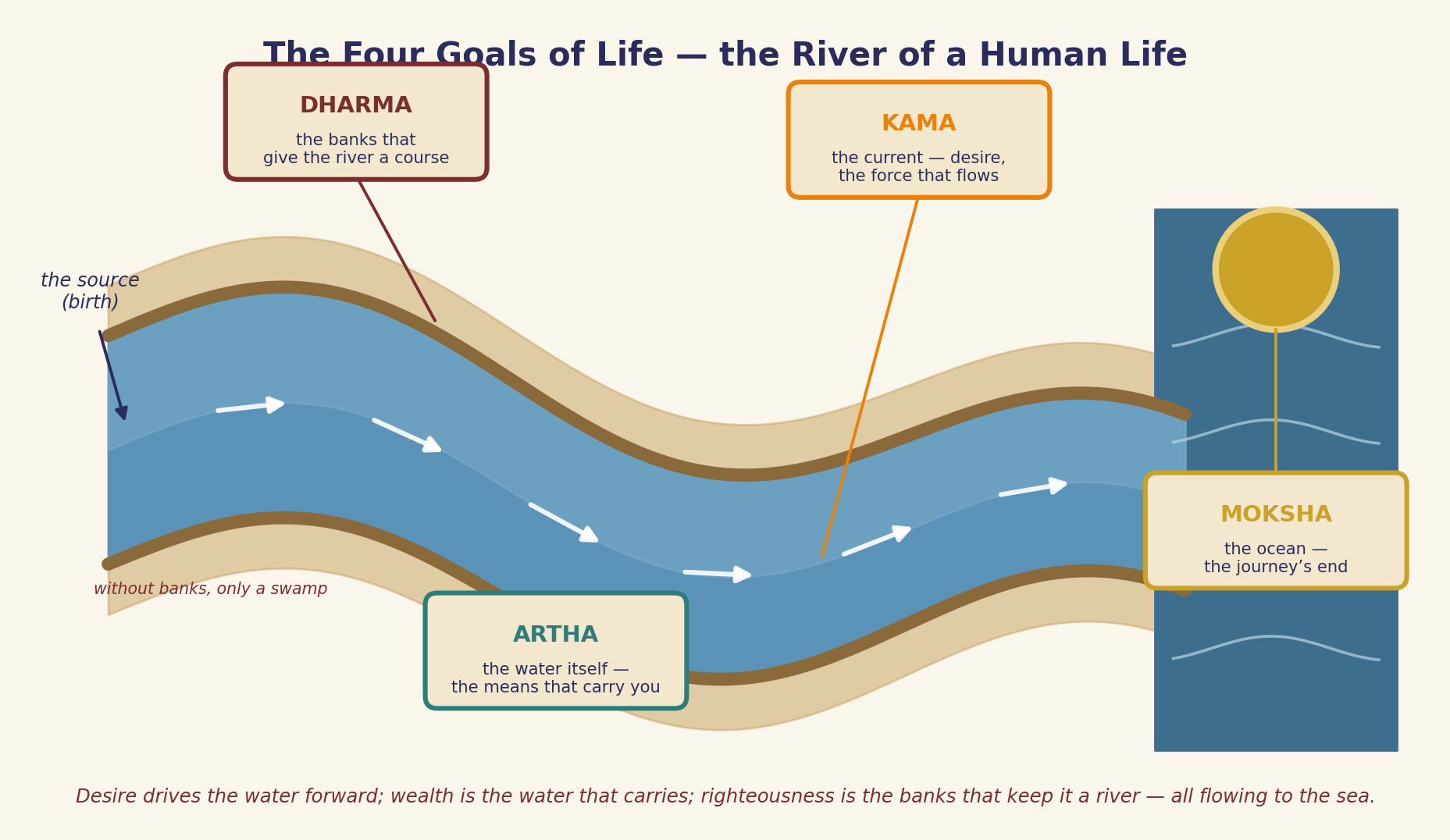
I expected the usual menu: desire is bad, money is bad, renounce everything, feel guilty meanwhile. Instead the tradition lists four legitimate goals of a human life — and two of them are pleasure and wealth. The picture is a river: desire is the current, wealth is the water, ethics are the banks, freedom is the ocean it’s all flowing toward. Then this:
“Notice what is missing from this picture: guilt. Desire and wealth are not sins here — a river needs its current and its water.”
— from the book
Want things. Earn things. Enjoy things. Just keep the river between its banks so it doesn’t become a flood. That’s the whole rule. I genuinely did not know my own tradition said this.
08
The dreamless sleep problem
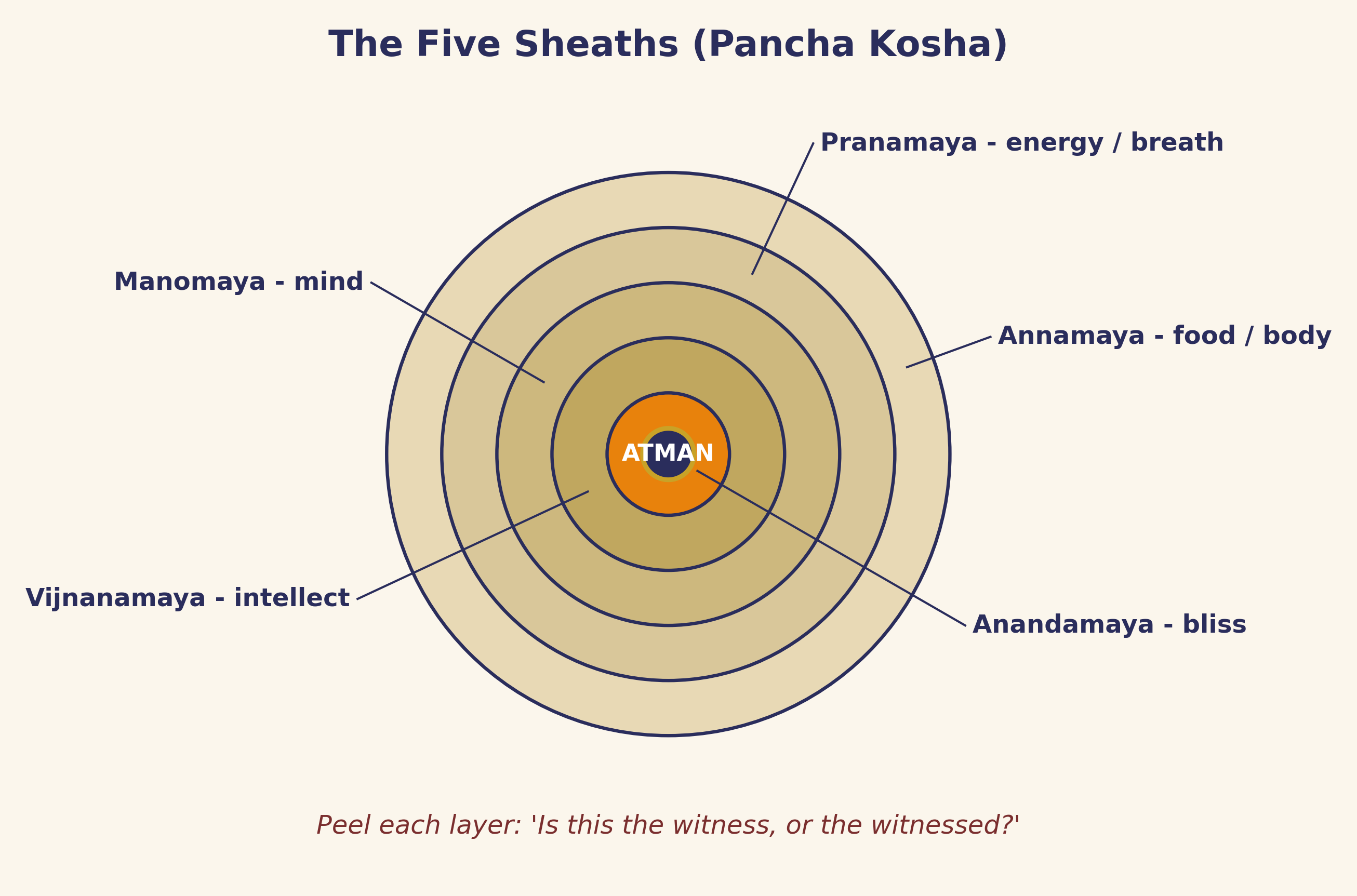
Here’s the one that got under my skin. Some nights you sleep with no dreams — no thoughts, no images, no you, as far as you can tell. And yet you wake up and say, “I slept so well.” The book pounces on that sentence:
“The deep peace of dreamless sleep — no objects, no thoughts, and yet you wake and say “I slept happily.” Someone enjoyed that peace. Who?”
— from the book
Think about it seriously for one minute. If you were fully absent, who is filing the report that it was pleasant? Something in you was present and watching even when your mind was switched off. The book’s five-layer map of a person — body, energy, mind, intellect, bliss — exists to chase down that witness. You don’t have to buy the answer. But you should sit with the question, because ‘nobody’ doesn’t explain your own memory of a good night’s sleep.
09
The dancing statue is a physics poster
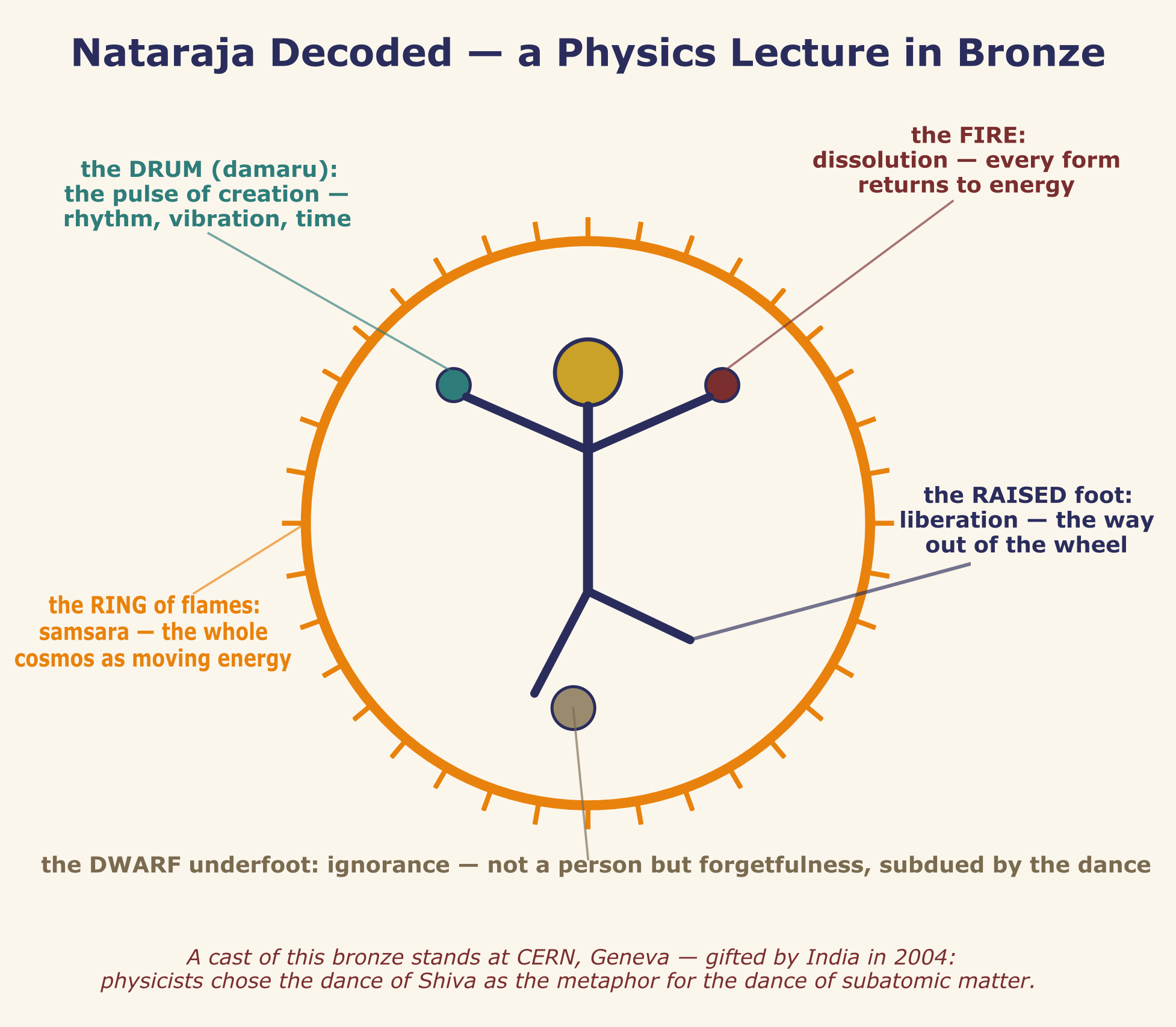
That bronze dancing figure in your grandparents’ cabinet — Nataraja — turns out to be a compressed diagram. The drum in one hand: the pulse of creation, rhythm, vibration, time. The fire in the other: dissolution, every form returning to energy. The ring around the whole dance: the cosmos itself as moving energy. The dwarf underfoot isn’t a demon — it’s forgetfulness, being subdued by the dance.
Nothing in the frame is static. Matter dancing, energy cycling, forms appearing and dissolving — as a summary of how the universe actually behaves, a physicist would have notes, not objections. There’s a reason a two-meter Nataraja stands outside CERN. Your family owned the poster before you owned the textbook.
How much of what you dismissed as ‘idols’ did you ever actually decode?
10
The chapter that polices its own fans
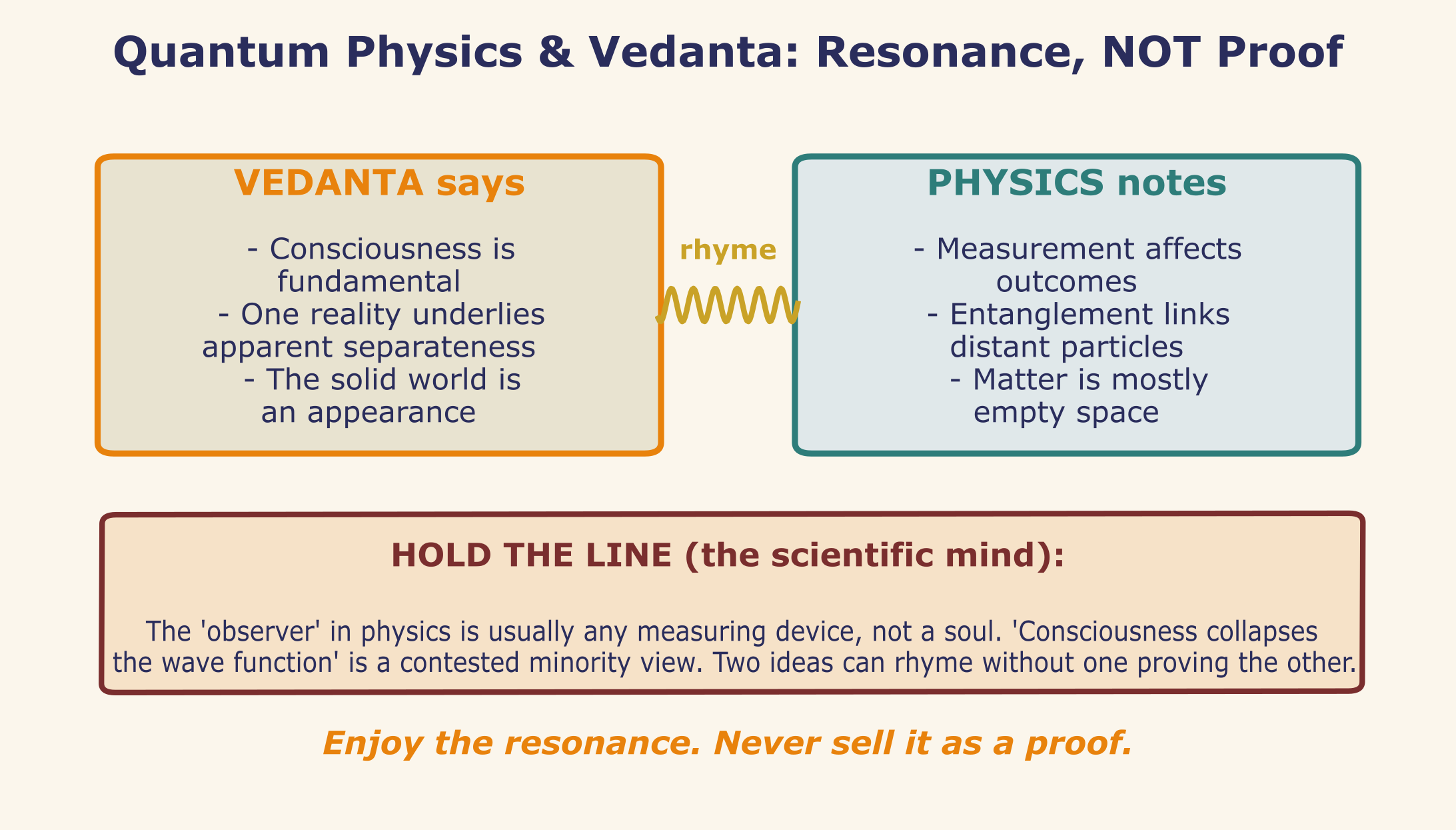
You’ve heard the hype: quantum physics proves Vedanta, consciousness collapses reality, the ancients knew. I braced for a whole chapter of it. Instead, the book builds the comparison honestly — yes, both say the solid world isn’t what it seems; yes, the rhymes are enjoyable — and then turns around and disciplines its own side:
“The ‘observer’ in physics is usually any measuring device, not a soul. ‘Consciousness collapses the wave function’ is a contested minority view. Two ideas can rhyme without one proving the other.”
— from the book
And the verdict, in six words:
“Enjoy the rhyme; never sell it as a proof.”
— from the book
A book that tells its own believers to stand down earns the right to be heard. This is where I stopped skimming.
11
“No scan shows a chakra” — the book said it, not me
Chakras, energy channels, kundalini — peak eye-roll territory, right? Here’s the book’s own honest note on the subject:
“It is not an anatomy chart; no scan shows a chakra.”
— from the book
Its actual claim is more careful and more interesting: the yoga map is a working model of inner experience — a map refined over centuries by practitioners describing what disciplined attention finds from the inside. And the practices built on that map keep passing modern tests: slow breathing measurably calms the nervous system; the alternating nostril cycle the yogis described is a documented physiological rhythm; the focus techniques are now standard issue in sports psychology and therapy, minus the credit.
Use the map for practice; report honestly what you find; claim nothing you haven’t verified. That’s the book’s own instruction. It’s more scientific method than most wellness content you scroll past daily.
12
Battlefield sports psychology
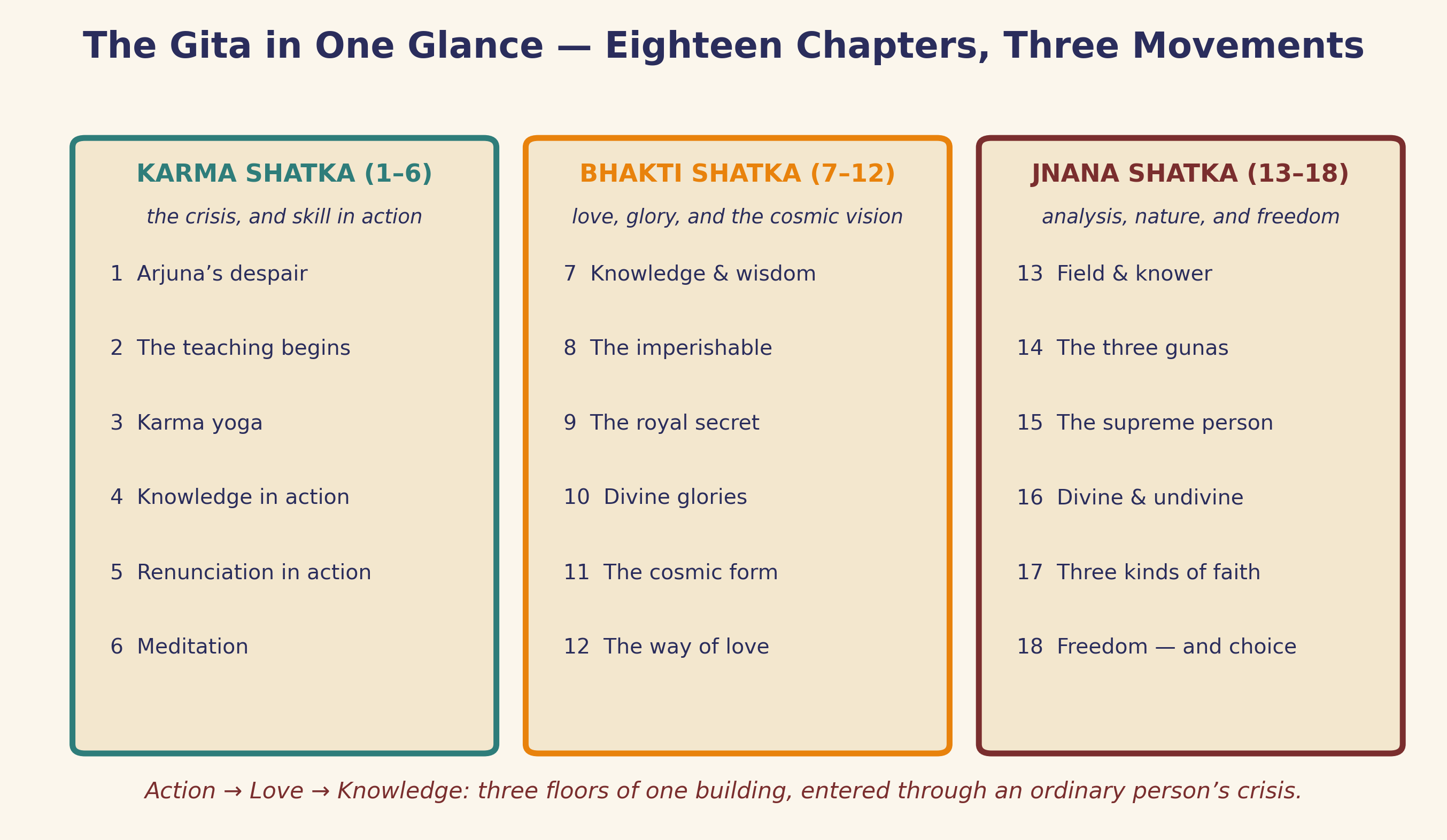
The Bhagavad Gita: I assumed it was a sermon. It’s a crisis intervention. The greatest warrior of his age has a panic attack in the middle of a battlefield — hands shaking, bow dropped, frozen by a question you’ve asked yourself: what’s the point of doing everything right if it might not work out? The answer he gets is pure performance psychology:
“Watch a great batsman on ninety-nine. The one who is thinking about the century gets out; the one who plays the next ball as just the next ball reaches the hundred... full engagement with the action, zero anxiety about the outcome — not because you don’t care about outcomes, but because anxiety about them is sand in the engine of the action itself.”
— from the book
Sports psychologists teach this today as ‘process focus.’ The Gita taught it on a battlefield, to a man whose hands were shaking — and it steadied him. And the line that finished me:
“Detachment from fruits is not caring less. It is caring so cleanly that nothing leaks into fear.”
— from the book
13
Feeding crows is a gratitude protocol
My grandmother put rice out for crows every morning. I filed it under superstition. Turns out it’s one of five daily debts the tradition asks a household to repay — to the teachers who left you knowledge, to nature that keeps you alive, to the ancestors you’re built from, to fellow humans, and to animals. Five directions of gratitude, practiced daily, so that being alive never curdles into entitlement.
In the book, the girl figures out the same thing about her own grandmother, and writes in her notebook:
“Grandma’s crows were bhuta-yagna all along. Now the duty is mine — and mornings feel different.”
— Meera’s notebook, from the book
Strip the vocabulary away and look at the design: a daily, structural practice that trains a person to notice they received everything before they earned anything. You can call that religion. An engineer would call it character infrastructure, scheduled to run every morning.
What’s your daily protocol for not becoming entitled? Exactly.
14
“There is no beginning”
Back to the girl and the lamp, where it started. She pulls her chair in and says fine — start at the beginning. Her grandfather’s reply is the best last line of a first chapter I’ve read in a while:
““There is no beginning,” he said, delighted. “That is the first lesson.””
— from the book
Here’s where I’ve landed, for whatever it’s worth. I still don’t ‘believe.’ The book, weirdly, doesn’t need me to — it never once asked. What it did was answer every cheap shot I had prepared, with sources, and then ask me better questions than the ones I came in with. Who enjoyed your dreamless sleep. What your habits are quietly building. Why the escape from the wheel is labeled knowledge and not obedience.
This whole tradition survived four thousand years without a pope, a headquarters, or a single mandatory belief — on the strength of people who could not be bribed out of a question. You, of all people, are its target audience.
Worst case: you lose a weekend and win your next argument with your parents using their own sources. Best case is more interesting.
Open it at any Debate Hall box and try to beat it. I couldn’t.