
Chapter 19
How do I Practice This Beautiful Tradition?
Thatha rose before dawn as he had for sixty years. And found the lamp already lit. Meera sat on her own asana beside his, eyes closed, breath long, the water for the rishis in its small copper cup at her side. He stood in the doorway a full minute, an old man watching four thousand years arrive safely in a fifteen-year-old, and then took his seat beside her. Nothing needed to be said, so, for once, nothing was.
What does it mean to be a ‘practicing Hindu’?
Here a young reader deserves an honest answer to a question that troubles many: am I doing this right, what actually makes someone a practicing Hindu? And the honest answer is itself revealing. There is no single checklist, no one prayer that must be said, no rite of membership you either passed or failed. Like everything else in this tradition, the daily practice is a suggestion, a dinacharya offered, not a border patrolled. And the tradition trusts you to fit it to your own life, temperament, and stage. That looseness is not vagueness; it is the adhikari-bheda of Chapter 2 applied to a whole life: the door is on every step, and you practice from the step where you stand.
It helps to see the contrast plainly, without a word of disrespect to anyone. In several great traditions, ‘practicing’ has a defined threshold and a moment of entry, a Christian is baptized and professes a creed; a Muslim declares the shahada and keeps the five pillars; conversion is a real event, a line crossed, a membership begun. The practitioners are mandated 5x prayers, Sunday masses, so on and so forth. These are coherent and beautiful designs, and this book honors them. But Sanatana Dharma is built on a different foundation, and it is worth understanding why it neither converts others nor issues membership cards: if ‘truth is one and the wise call it variously’ (Rig Veda 1.164.46), then there is no outside to bring people in from, and no single form everyone must adopt. You are not asked to join; you are invited to practice. And the practice is measured not by a boundary you crossed but by a direction you are heading. One who wakes with gratitude, works with skill, harms none, repays the debts, and turns a little more toward the light each day is practicing, whatever the details of their lamp.
And because it is a whole life, not a fixed rule, the practice is meant to change shape with your ashrama, the season of life from Chapter 18. The brahmachari, the student, practices mostly as svadhyaya and self-discipline: study as worship, the body kept strong and clean, the senses trained, the mind sharpened, dharma in this season is largely learning. The grihastha, the householder, practices through the world rather than apart from it: the five yagnas run at full strength, work becomes karma yoga, raising a family and serving society is itself the offering. The busiest season and, the tradition insists, the one that carries all the others. The vanaprastha loosens the grip, mentoring more and managing less, turning the attention inward as the outer duties are handed on. And the sanyasi lets even those forms fall away, keeping only the essence. Same dharma, four different daily shapes, which is why you should never measure your practice against someone in a different season of life. The student and the grandfather are on the same road, walking the stretch that is theirs.
Hear the most freeing truth in this whole book: you have to ‘do’ nothing to be a Hindu. The practices in this chapter are gifts offered, not tolls collected. Some of the tradition’s most revered figures, realized sanyasis of certain lineages, and the avadhutas of old, keep no rituals at all, follow no fixed dinacharya, offer no formal puja: they have passed beyond the scaffolding, resting in the direct, living sense of union with all that is, and abiding steadily in that state. That, too — fully, unquestionably — is practicing the dharma; it is, in fact, the destination the rituals were rowing toward all along (the boat and the shore of Chapter 2). So never let anyone — including the anxious voice in your own head — tell you that you are not ‘Hindu enough’ because you missed a rite or skipped a chant. The tradition sets the bar exactly where it belongs: in your heart’s orientation, not on a checklist. Feel the universal connection, live truthfully and kindly, turn a little more toward the light, and you are already home.
Morning: the dinacharya, unhurried
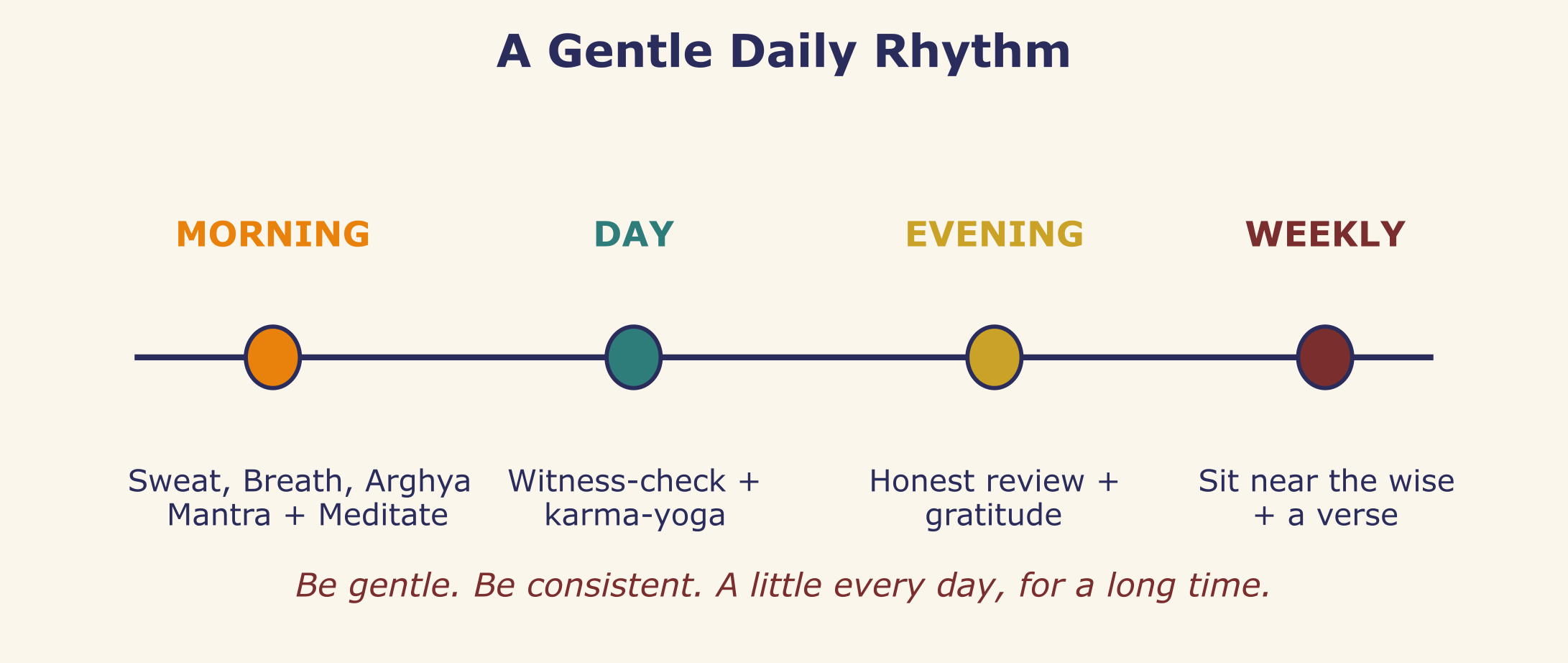
The tradition calls the day’s ordered rhythm dinacharya — literally ‘the conduct of the day’ — and its first and wisest instruction is about the hinge on which everything else turns: how you wake. Here is the fuller morning, in the shape countless households have kept it. Pick what fits; grow into the rest slowly.
Wake before the sun, gently. The tradition prizes the brahma-muhurta, the quiet hour before dawn, as the mind’s clearest. And modern chronobiology agrees the pre-dawn window is low in distraction and rich in calm. But the manner matters more than the minute: do not lurch awake to an alarm and a screen. Lie still for three slow breaths, and before the day’s worries rush the gate, meet it with thankfulness, the old custom is to look at your own two open palms and silently greet the day as a gift newly given, resolving to meet whatever comes with a steady, positive mind. You are setting the weather of the whole day (Chapter 5’s gunas) in its first ten seconds; set it toward sattva. Offer the day as you rise: ‘May I act well and release my grip on the results’ (Gita 2.47).
Move and breathe. Then give the body its due before the mind’s work begins: a few unhurried yogasanas to loosen the night out of the limbs and steady the spine (‘sthira-sukham asanam,’ Yoga Sutras 2.46), and a few rounds of pranayama, the nadi shodhana of Chapter 8, or simply a slow, lengthened exhale. This is not exercise for its own sake; it is tuning the instrument, warming the body, balancing the channels, and settling the breath so the mind that follows is already quiet. A few minutes is plenty.
Bathe, then offer water. A bath is the body’s sandhya. The small daily fresh start, cleanliness as the threshold of anything sacred (recall the shoes at the temple door, Chapter 11). Then, facing the rising sun, offer arghya — water lifted and let fall — to Surya the visible devata, and with the same grateful gesture to the devatas and to the rishis of your line (your daily Deva and Rishi Yagnas from Chapter 13; if your family keeps tarpana, this is its moment). You now know the layered logic of that beautiful practice from Chapter 12, morning light on the skin, still posture, steady breath, and gratitude, three healthy behaviors and one devotion packaged into a single act. Recite the great prayer as the water falls: ‘Asato ma sad gamaya…’ (Brihadaranyaka 1.3.28).
Sit, mindfully. Only now, body clean and calm, sit on your asana and give the mind its own portion of the morning, a few unhurried minutes of stillness. Silently repeat Aum, returning gently each time the mind wanders (the Mandukya opens by declaring all of reality is folded into this one syllable, Mandukya 1), or simply watch the breath enter and leave. Do not rush to end it; this quiet is not the warm-up to the day, it is the day’s foundation. Rise from it into the world.
During the day
When a strong feeling arises, ask: “Am I this feeling, or the one noticing it?” (the chariot model). Do one task with full attention and without anxiously checking the outcome, effort fully given, result released. Perform one small yagna, feed a creature, help a person, thank an elder. And speak only what is true and kind: “Satyam eva jayate”, “Truth alone triumphs” (Mundaka 3.1.6).
Evening (5 minutes)
Review the day without harshness: where did I act from steadiness, where from agitation? No guilt, clear observation, the way a scientist reviews the day’s data. Name three things you are grateful for. Sleep in your customary direction, with the ritual consistency that serves rest.
Weekly / family
Sit near the wise: read one short Upanishadic dialogue or Gita verse with a parent or elder and discuss it. The original meaning of “Upanishad,” and your weekly Rishi Yagna. Visit a temple and run the Chapter 11 experiment: notice your mind before and after.
Everything in this book becomes real only through small, repeated practice. Here is a quick and gentle routine, pick what fits and grow slowly. The tradition values steadiness over intensity: a little, every day, beats a lot, once.
The year as a wheel: why festivals
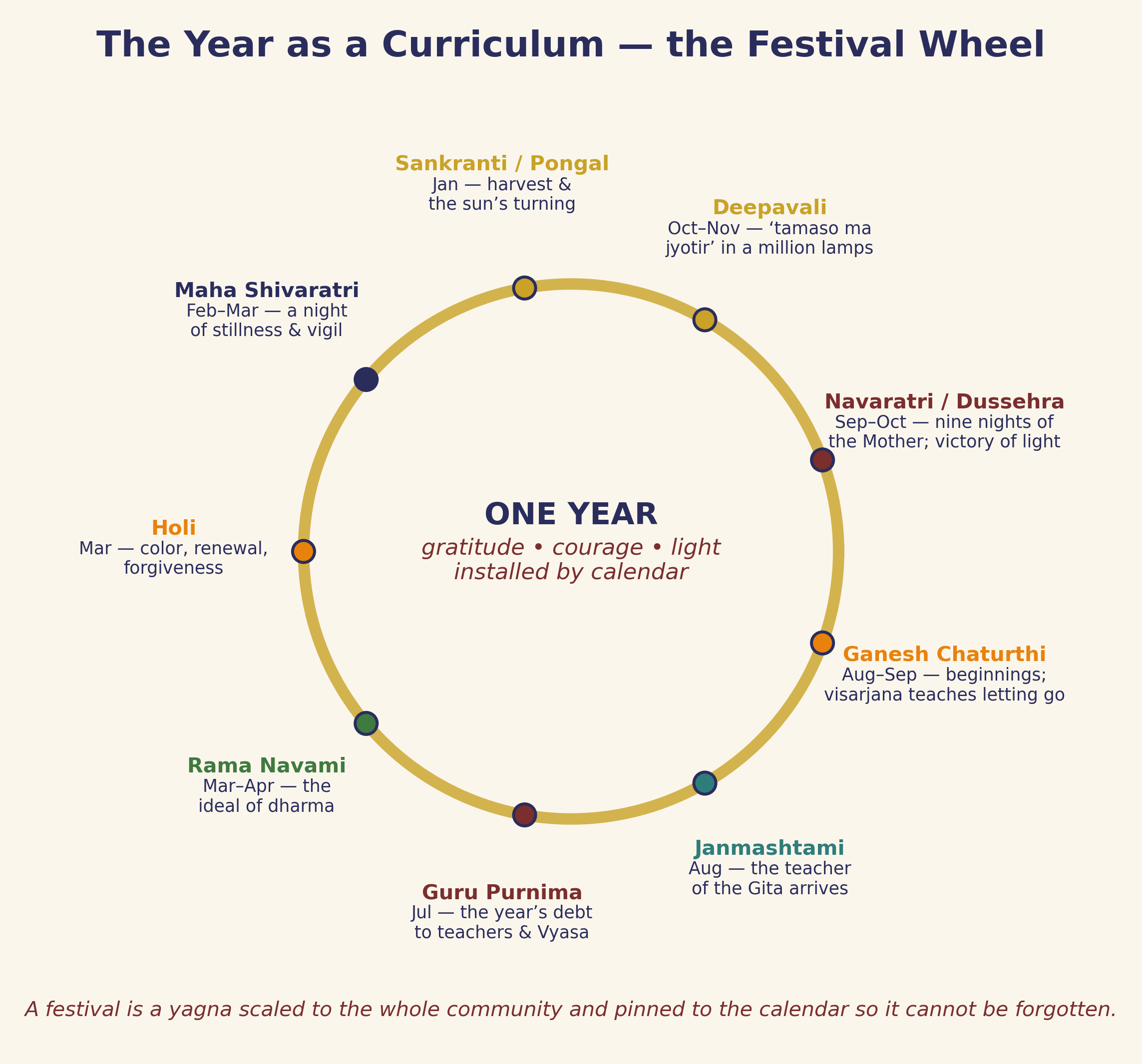
Beyond the day’s rhythm, the tradition tuned a whole year of them. And now you can read the festivals as the engineering they are. Navaratri devotes nine nights to the divine as Mother and to the victory of light in ourselves; Deepavali rehearses it at civic scale, every household physically enacting ‘tamaso ma jyotir gamaya’ with a thousand small flames; Sankranti and Pongal bind the family to the harvest and the sun’s turning, gratitude with sugarcane in hand; Guru Purnima pays the year’s formal debt to teachers and to Vyasa at the head of their line; Shivaratri keeps one night for stillness and vigil. A festival, seen with this book’s eyes, is a yagna scaled up to the whole community and pinned to the calendar so it cannot be forgotten: the year itself, engineered as a curriculum of gratitude, courage, and light. When you celebrate them now, celebrate them knowingly, that is the difference this whole journey was for.
Walk the wheel once, knowingly. Deepavali’s row of lamps is the Brihadaranyaka’s prayer — from darkness, lead me to light — enacted by a whole civilization on one night, each little flame a household’s vote for the light’s victory; its days carry their own lessons, from Naraka Chaturdashi’s cleansing of the inner demon to the new year’s books opened before Lakshmi, wealth begun, as always, on dharma’s lap. Navaratri’s nine nights divide, in the traditional reading, into three threes: the first for Durga, strength, the demolition of what must go; the middle for Lakshmi — abundance and harmony built where the ground was cleared; the last for Saraswati — knowledge crowning the work: strength, then prosperity, then wisdom, which is simply Chapter 5’s purusharthas taught as nine evenings of drums and dance. Ganesh Chaturthi ends with visarjana — the beloved murti, made with such care, dissolved in water — and there is the whole of Chapter 11 and Chapter 18 in one gesture: love the form fully, and let it go completely; even the doorway is not clutched. Holi burns the old quarrel in the bonfire and colors every hierarchy into one laughing crowd; Guru Purnima pays the rishi-debt formally, with Vyasa at the head of the receiving line; Shivaratri keeps one whole night for what this book’s quietest chapters taught, stillness, vigil, the witness. Read this way, the calendar is a spiral staircase: the same festivals return each year, but you, if the practice is working, arrive at each one a step higher.
The sacred map: a land stitched together by pilgrims
One last piece of the design, and it is continental in scale. The tradition overlaid the entire land with a sacred geography, the char dham at the four corners (Badrinath north, Rameswaram south, Puri east, Dwaraka west, the same compass as Shankara’s mathas); the twelve jyotirlingas and the shakti-peethas scattered across every region; the seven sacred rivers and seven sacred cities; and the Kumbha Mela, rotating among four rivers’ confluences, which assembles what is routinely described as the largest peaceful gathering of human beings on earth, tens of millions, organized around a bath and a prayer. Now see what this network did: for thousands of years, a grandmother from the deep south saved her whole life to walk to the Himalaya, and a Bengali widow to Rameswaram — crossing every language, kitchen, and kingdom on the way — because her map of holiness required the whole land. Pilgrimage knit Bharat into one civilization centuries before anything knit it into one state: cultural unity, achieved not by decree but by devotion, one walking grandmother at a time. When you visit any of these places now, you are not sightseeing. You are walking the stitches.
The anatomy of a simple puja
And since this book has taught you to read every practice, read the family puja itself, the sixteen-step upachara sequence your grandmother performs is a structured act of hospitality, treating the divine as the most honored guest of Chapter 13: the invocation (avahana) is the welcome at the door; the offered seat, water, and bath are what any beloved guest receives; the flowers, incense, and lamp engage every sense in the greeting; the food offering (naivedya) is the meal no guest goes without, shared back afterward as prasada, grace made edible; and the farewell (visarjana) sends the guest off with honor. The puja, decoded, is atithi devo bhava run in reverse: having learned to treat the guest as God, the tradition completes the circle and receives God as the guest. Add japa — the repetition of a mantra on the 108-bead mala, thumb advancing bead by bead — and you have the tradition’s portable attention-anchor: the beads give the wandering hand a task, the mantra gives the wandering mind a home, and the count gives the practice a finish line. (Why 108? Tradition offers many rationales — sacred numerology, astronomy, the count of Upanishads — and this book will simply say: it is the tradition’s number, it is old, and a definite number is itself the design: enough repetitions to settle a mind, few enough to finish before school.)
Water, the first offering
Now notice what the puja reaches for first, last, and throughout: water. Water offered to welcome the guest (arghya). Water sipped to begin (achamana). Water poured over the deity in bathing (abhisheka). Water circled and released to close. This is no accident of convenience. The Rig Veda’s Apah Suktam addresses the waters directly — as mothers, as healers, as carriers of remedy — and asks that their essence be shared with us. In this tradition water is never a mere utility; it is the first guest, the first medicine, the first sacred thing.
This is why achamana — the ritual sip of water — comes first, before a single breath of pranayama is drawn. Purify with water, then work with the breath: the order is fixed, and it is old.
And here modern cell biology adds a quiet, honest echo. Every unit of energy your body spends — every heartbeat, every breath of that pranayama to come — is paid in a molecule called ATP, and ATP is literally made and unmade in water: the reactions that store and release your energy are water reactions, run inside water-filled mitochondria. Even mild dehydration drops cellular energy and slows the whole engine. So a tradition that will not let you begin until you have honored and taken water is, without any microscope, front-loading the one substance your energy is manufactured in. Sip first, then breathe. The sequence your grandmother follows turns out to be sound cell biology.
A civilization that makes you thank water every single day — that names its rivers goddesses, opens and closes worship with a cupful, and will not begin a rite without honoring it — is engineering daily reverence for the one substance life cannot negotiate with. The modern world learned to test its water; this tradition never forgot to thank it.
You may meet popular claims that human words and intentions physically restructure water, elegant crystals from kind words, and the like. Those experiments have not survived controlled replication, and this book will not lean on them. It does not need to: the reverence stands on its own feet. Gratitude toward water requires no microscope to be justified, only an honest memory of how long you would last without it.
The first twenty-one days
If you want a starter path, here is one used by many beginners. Week one, build only the anchor: three slow breaths and the morning salutation to the rishis, two minutes, no more, but never zero. Week two, add the evening review and the three gratitudes, now the day has bookends. Week three, add five minutes of Aum or breath-following on your asana, and one small daily yagna of your choosing. Twenty-one days, three gentle additions, and you will have installed the complete daily architecture of this book, small enough to survive exam season, real enough to change the weather of the mind. The tradition’s wager, remember, is Gita 2.40: even a little of this protects from great fear. Run the experiment.
For the student: keeping the mind razor-sharp
Because most readers of this book are in the brahmacharya season, the tradition’s specific counsel to the student deserves its own page. And it turns out to be exactly what you would design if your single goal were dharana-shakti, the power of sustained concentration. The whole of a student’s dinacharya, read with this book’s eyes, is a concentration-training program: the pre-dawn waking gives you the mind at its most sattvic; the asana and pranayama settle the body and breath so attention is not fighting restlessness; the morning stillness is dharana practiced directly, holding one point (the breath, the syllable) and returning, again and again, each return a repetition that strengthens the mind the way a lifted weight strengthens the arm. You are not meditating instead of studying; you are sharpening the one instrument every subject is studied with.
On top of that foundation, the tradition’s practical advice to a student is remarkably concrete, and modern learning science has confirmed nearly all of it. Guard the sattva of the mind, because concentration rides on it: sattvic, fresh food rather than heavy or over-stimulating fare; enough sleep, kept to steady hours; and — the modern student’s hardest battle — a ruthless limit on the preyas-machine of Chapter 14, because a mind fragmented forty times an hour by the scroll cannot hold an edge. Practice single-tasking as a discipline: one subject, full attention, the tortoise drawing in its senses at will (Gita 2.58), Arjuna’s ‘I see only the eye of the bird’ (above) is the exam-hall skill itself. Use the gurukula’s proven methods just described, fixed daily study hours, reciting aloud, walking the material backward, and above all teaching it to someone at dinner. Begin study with a moment’s sankalpa, a stated intention, and a breath to gather the mind before the book opens. And keep the body moving and the breath trained, for the yoga shastra’s oldest finding is the student’s greatest lever: when the breath is steady the mind is steady (Hatha Yoga Pradipika 2.2), and a steady mind is a sharp one.
And because achievement itself is part of a student’s dharma, gather here the tradition’s wider toolkit for doing well in the world. The same practices, now aimed at school, exams, and every hard thing you will attempt:
Five practices that sharpen achievement
Even if all this is true, what does it do for you today, in school and in life? Here the teachings turn out to be intensely practical, and the benefits are testable.
1. Equanimity → performance under pressure. “Samatvam yoga uchyate” (Gita 2.48). An even mind makes fewer panicked mistakes, the composure athletes train for.
2. Detachment from outcome → courage. When your worth isn’t riding on every result (Gita 2.47), you attempt bigger things and recover faster from failure, a cousin of the “growth mindset.”
3. One-pointed attention → deeper learning. Dharana and dhyana train the most valuable skill of the modern age: holding attention on one thing, in a world engineered to fracture it.
4. Self-knowledge → emotional steadiness. Watching the mind (“Am I the anger, or the one who notices it?”) creates the gap between feeling and reaction where wisdom lives, the technique modern mindfulness borrowed.
5. Discipline (tapas) → the engine of achievement. The willingness to do hard things consistently, practiced by every Upanishadic seeker and every great scientist, artist, and athlete.
And notice who uses this toolkit now: hospitals prescribe mindfulness programs descended directly from dhyana; athletes, surgeons, and pilots train attention and breath; the world’s best-known companies teach meditation to their engineers; yoga is practiced on every continent. When you take up these practices, you are not borrowing someone else’s self-help. The world borrowed yours. Reclaim your inheritance with a quiet smile.
The archer’s eye
The tradition’s favorite portrait of trained attention is a story every child of Bharat once knew. The teacher Drona set a wooden bird on a distant tree and called his royal students one by one: draw your bow, and before you shoot, tell me what you see. ‘The tree, the branch, the bird, the sky,’ said one. ‘You will miss,’ said Drona. ‘My brothers, yourself, the garden,’ said another. ‘You will miss.’ Then Arjuna drew. ‘What do you see?’ ‘The eye of the bird.’ ‘Describe the bird.’ ‘I cannot. I see only the eye.’ ‘Shoot,’ said Drona. And the arrow took the eye. Every practice in this book — dharana, the mantra, the single flame — is the training that produces that answer. In a world engineered to make you see forty things at once, the person who can see only the eye of the bird wins every contest that matters.
Study like the tradition studied
The gurukula, having no paper to lean on, was forced to discover how memory and understanding actually work, and its methods read like a modern learning-science syllabus. Daily recitation at fixed hours: what researchers now call spaced repetition, the single most proven technique for retention. Chanting aloud in groups: multi-sensory encoding, voice, ear, and rhythm reinforcing the eye. The patha systems’ forward-and-backward patterns: elaborative rehearsal, forcing the mind to hold structure, not just sequence. And above all, the rule that a student consolidates knowledge by teaching it — the senior student drilling the junior — which modern research confirms so strongly it has a name, the protege effect: nothing fixes learning like explaining it. Add the ashram’s fixed rhythms of sleep, food, and practice (the moderation of Gita 6.16–17), and you have a complete evidence-aligned study system, built by people who could not afford to forget anything. Borrow it whole for your exams: fixed daily slots, recite aloud, walk the structure backward, and teach tonight’s chapter to someone at dinner. Your ancestors optimized this for three thousand years; the least you can do is inherit the results.
The Debate Hall
“But this detachment business,” the challenger says. “‘Release the fruits’, isn’t that just training people not to care? Champions care desperately.”
The reply
Watch a great batsman on ninety-nine. The one who is thinking about the century — the fruit — tightens, prods, and edges to the keeper. The one who plays the next ball as just the next ball reaches the hundred, and the crowd says he ‘made it look easy.’ Gita 2.47 is that, stated as law: full engagement with the action, zero anxiety about the outcome, not because you don’t care about outcomes, but because anxiety about them is sand in the engine of the action itself. Sports psychologists teach this today under names like ‘process focus’; the Gita taught it on a battlefield, to a man whose hands were shaking, and it steadied him for the fight of his life. Detachment from fruits is not caring less. It is caring so cleanly that nothing leaks into fear.
None of these require believing anything supernatural. They are trainable mental skills with real-world payoffs you can verify. That is how confident a good tradition can afford to be: “Don’t believe me. Try it. Watch what happens.”
For one week, run the student’s edge-sharpening protocol. Each morning: three minutes of breath-focus before you open a single book. Each study session: one subject only, phone in another room, a ten-second sankalpa before you begin. Each night: teach the day’s hardest idea to a parent, a sibling, or the wall. Keep a one-line log of how focused each day felt, 1 to 10. You are not just studying. You are training dharana-shakti, and the log is your laboratory notebook.
The Debate Hall
“It all sounds lovely,” sighs the challenger, who by now is mostly persuaded and mostly busy. “But honestly, who has time?”
The reply
Count honestly and the objection dissolves. The complete beginner’s routine of this chapter costs perhaps twelve minutes a day, against the ninety-plus minutes the average person now gives daily to the scroll of other people’s lives. Nobody lacks twelve minutes; people lack a decision about the first twelve minutes. And consider the return on investment your ancestors are offering: steadier attention for every hour of study, lower anxiety for every exam, a gratitude habit that lifts well-being, and membership in the oldest continuous practice community on earth, for the price of one-eighth of a phone’s daily screen time. There are expensive traditions in this world. Yours asks for twelve minutes and gives back the mind that uses all the rest.
Be gentle and be consistent. The Gita promises that even a little of this practice protects from great fear (Bhagavad Gita 2.40). You are not trying to be perfect. You are calibrating an instrument — your own mind — a little each day, for a long time. That is exactly how every great scientist and every great sage was made.
Meera’s notebook
- Morning anchor, daytime witness, evening review: the day, bookended.
- Rishi yagna daily: remember, offer water, read them. The relay fee.
- Festivals = the year’s curriculum: nine nights of the Mother, a million lamps for ‘tamaso ma jyotir.’
- The puja is hospitality run in reverse: having learned ‘the guest is God,’ we receive God as the guest.
- Japa: beads for the hand, mantra for the mind, a count for the finish line.
- 21 days, 3 gentle additions, 12 minutes vs 90 of scroll. Gentle + consistent. Even a little protects (2.40).
The journey of evenings was complete, though, as Thatha would say, nothing in this tradition truly ends; it only begins again at a deeper turn of the wheel. One thing remained: the question that had started it all, still waiting patiently on a verandah, a year in the past and a page in the future. ❖
Check your understanding
- Name one practice from morning, one from the day, and one from evening.
- Which yagna does “remembering the rishis and offering water” fulfill?
- What are the two words of “the one rule of practice”?
- Decode two steps of the puja as acts of hospitality.
- What is japa, and what does each part of the practice provide?
- Reflect: Design your own 5-minute routine from this chapter. Write it down; try it for a week.